Venezuela
- works
- 38
- 30 books · 8 films
- period covered
- 1780–1994
- language of writing
- Spanish
In February 1948, Venezuela installed as president the author of its national novel. Rómulo Gallegos had published in 1929 the story of a woman who reigns by violence and sorcery over the plains of the Orinoco, a book read throughout Latin America, then in 1935 a novel about the forest that swallows men. He had been elected by universal suffrage in December 1947, the country's first president under those conditions, and was overthrown by the army nine months later. He ended his exile in Mexico and would never govern again.
Read moreShow less
That short cut tells of a country where literature and power long disputed the same men. Venezuela is the homeland of the liberator of the continent, who died in 1830 declaring that he had ploughed the sea, and it produced the grammarian who fixed the Spanish of America. Then, from the nineteen twenties, oil changed everything: the country moved in one generation from an agricultural economy to a rent, and a writer coined in 1936 the formula that has commanded every speech since, the one that invites sowing the oil rather than spending it.
Literature was made against that ease, and often against the state that maintained it. Teresa de la Parra published in the nineteen twenties the journal of a young woman of good family who is bored and mocks, in a light and cruel language. Adriano González León published in 1969 a novel that alternates urban guerrilla and childhood memories in the countryside, and it became the book of his generation. The cinema of the nineteen seventies filmed the poor quarters of Caracas with avowed violence, including in 1976 the account of a delinquent told by himself and in 1977 a bitter comedy set in a brothel.
What awaits the reader is a literature of the plain and of the oil city, in which nature is a character in its own right and the rent a slow poison. The novel that opens this page is the novel of the llanos, read as a criticism of the Gómez regime, and its author was elected president in 1947.
A way to begin
Doña Barbara
Rómulo Gallegos · 1929
The great novel of the llanos, long regarded as one of the best-known Latin American novels.
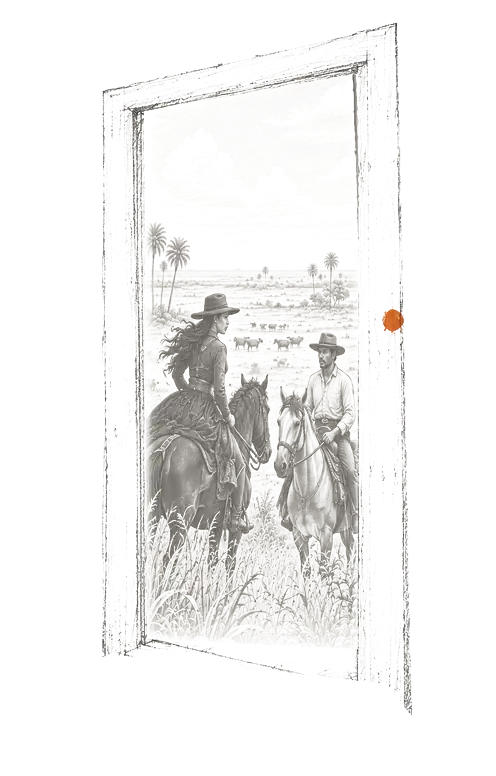
Santos Luzardo, a lawyer trained in Caracas, returns to the plains of the Apure to sell the family estate. He finds the region under the sway of Doña Bárbara, beautiful and unscrupulous, the devourer of men, who covets his land; giving up the sale, he sets out to restore Altamira, and finds Marisela, daughter of Doña Bárbara and of his cousin Lorenzo, living in neglect.
Timeline
- 1800–1922FoundationAndrés Bello, then Teresa de la Parra opens modern prose.
- 1931–1946Novel of the landUslar Pietri, Gallegos, Otero Silva. The land, oil, dictatorship.
- 1947–1965PoetryGerbasi, Cadenas, Sánchez Peláez, Palomares. A generation with no school.
- 1968–1974RuptureAdriano González León's Portable Country: the guerrilla enters the novel.
- 1973–1995Venezuelan cinemaChalbaud, de la Cerda, Fina Torres. The poor neighbourhoods on screen.
Reading keys
- The Spanish usage of two surnames applies, and one classifies by the father's name.
- The Wayúu names of the north-west and the Warao names of the Orinoco delta signal indigenous peoples with their own languages and institutions.
- The Wayúu are matrilineal: belonging and inheritance pass through the mother, and the maternal uncle arbitrates conflicts.
- Recent emigration, which concerns several million people, has brought about a literature of the diaspora.
- The oil rent and its management have been the central political subject for a century, and every narrative takes a position on it.
- The events of February 1989, riots suppressed in blood in Caracas, are a turning point that literature has not finished treating.
- The crisis and the exodus since 2015 are a contemporary subject treated mostly from abroad.
- The cult of Bolívar is a use made by the state, and discussing it is delicate.
- Catholicism is in the majority, with an evangelical advance and a very active popular cult.
- The cult of María Lionza, queen of the waters depicted naked on a tapir, gathers tens of thousands of people on the mountain of Sorte, with trances and healings. It is not a marginal sect.
- The cult of José Gregorio Hernández, a doctor who died in 1919 and was beatified in 2021, is practised throughout the country for healing.
- The Warao of the delta have a tiered cosmology with the wisiratu, a shaman, and the Wayúu a system of dreams that commands decisions.
- The wake and the nine days of prayers organise the mourning, with a commemoration at the end of a year.
- Among the Wayúu, the second burial, several years after the death, gathers the maternal family who exhume and clean the bones.
- The dancing devils of Yare, at Corpus Christi, dance masked in front of the church before submitting, a rite listed as intangible heritage.
- Black is worn in mourning, and red is the colour of the devils and of María Lionza.
- Amalivaca, the transformer hero of the Tamanaco, recorded in 1741 by a Jesuit who wanted to refute him, is the best documented mythological figure in the country.
- The Warao and Wayúu cosmologies, collected at the beginning of the twentieth century, form the indigenous corpus of reference.
- María Lionza and her cult are a common knowledge that the texts do not translate.
- The historical legends of Arístides Rojas, published in 1890, fixed the country's colonial anecdotal stock.
- Venezuela is not a Caribbean country in the island sense: it has a Caribbean coast, an immense plain, Andes and a part of the Amazon.
- María Lionza is not a residual superstition but a mass cult, with its places, its specialists and its pilgrimages.
- Oil did not enrich the country's literature: it almost always speaks of it as of a curse.
- The Wayúu are matrilineal and have their own customary law, recognised and practised on both sides of the Colombian border.
Tales and mythologies 1
- ChronicleSaggio di storia americanaFilippo Salvatore Gilii · 1780not translated into EnglishThe Tamanaco account of the flood and of Amalivaca, collected by a missionary on the Orinoco.Literature
Available in English 9
The books from this country that can be read in English, in the original or in translation.
- PoetryThe Agriculture of the Torrid ZoneSilva a la agricultura de la zona tórridaAndrés Bello · 1826A poem written in London, which sings of the crops of the tropics and sends the new nations of America back to their fields.LiteraturePublic domain
- NovelIphigeniaIfigenia. Diario de una señorita que escribió porque se fastidiabaTeresa de la Parra · 1924A young woman back from Paris writes, in the Caracas of the twenties, what her family does not want to hear.Literature
- NovelDoña BarbaraDoña BárbaraRómulo Gallegos · 1929The Venezuelan plain disputed between a lawyer who has come from the city and the estate owner who holds it by force.Literature
- NovelThe Red LancesLas lanzas coloradasArturo Uslar Pietri · 1931Independence seen from a hacienda, through a foreman who bides his time and the servile troop he leads to war.Literature
- NovelCubaguaEnrique Bernardo Núñez · 1931A journey backwards, from the oil era to the time of the conquistadors: Enrique Bernardo Núñez's groundbreaking novel.Literature
- NovelAna Isabel, a Respectable GirlAna Isabel, una niña decenteAntonia Palacios · 1949A little girl in Caracas, under Juan Vicente Gómez, learns what it means to be a respectable child.Literature
- PoetryDefeatDerrotaRafael Cadenas · 1963A poem from 1963 that makes the admission of failure a voice for part of Venezuelan youth.Literature
- PoetrySpaces to Say the Same [Thing]Espacios para decir lo mismoHanni Ossott · 1974A collection from 1974, in which the prose poem serves to think the self rather than to narrate it.Literature
- NovelDoña Inés vs. OblivionDoña Inés contra el olvidoAna Teresa Torres · 1992The voice of a dead aristocrat pleading for her lands from beyond the grave: a fresco of Venezuelan history by Ana Teresa Torres.Literature
A selection to begin with 10 / 38
- NovelIphigeniaIfigenia. Diario de una señorita que escribió porque se fastidiabaTeresa de la Parra · 1924A young woman back from Paris writes, in the Caracas of the twenties, what her family does not want to hear.Literature
- NovelThe Red LancesLas lanzas coloradasArturo Uslar Pietri · 1931Independence seen from a hacienda, through a foreman who bides his time and the servile troop he leads to war.Literature
- NovelAna Isabel, a Respectable GirlAna Isabel, una niña decenteAntonia Palacios · 1949A little girl in Caracas, under Juan Vicente Gómez, learns what it means to be a respectable child.Literature
- PoetryDefeatDerrotaRafael Cadenas · 1963A poem from 1963 that makes the admission of failure a voice for part of Venezuelan youth.Literature
- NovelPaís portátilAdriano González León · 1969not translated into EnglishA guerrilla fighter crosses Caracas on a mission, burdened with his whole Andean lineage.Literature
- CinemaCuando quiero llorar, no lloroMauricio Walerstein · 1973Three boys born on the same day in 1948, and three worlds that never meet.Cinema
- CinemaI Am a CriminalSoy un delincuenteClemente de la Cerda · 1976Caracas in 1976, seen from its poor neighbourhoods and those who grow up there.Cinema
- CinemaThe Smoking FishEl pez que fumaRomán Chalbaud · 1977A brothel run like a kingdom, where power passes from one lover to another.Cinema
- CinemaOrianaFina Torres · 1985A family house on the coast, and an heiress who already lives elsewhere.Cinema
- CinemaMacu, The Policeman's WomanMacu, la mujer del policíaSolveig Hoogesteijn · 1987A poor neighbourhood, a child married to a policeman, and a criminal case seen from inside the house.Cinema