Poetry
Baba Tomorri
Not translated into English
Andon Zako Çajupi · 1902
Opening lines
Baba-Tomorr, Kish’e Shqipërisë
mal i lartë, fron’i Perëndisë!
Tek Ti vinin njerëzit qëmoti
për të msuar se ç’urdhëron Zoti.
Baba-Tomorr, Church of Albania,
high mountain, throne of God!
In olden days people came to You
to learn what the Lord commands.
Translation by Erostrate
Text quoted from archive.org
Synopsis
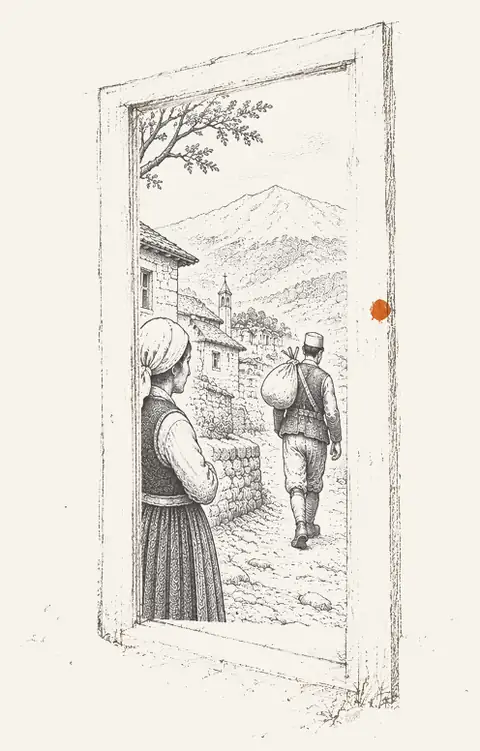
The collection takes its name from Father Tomor, a figure of Albanian mythology linked to Mount Tomorr, and opens with a poem bearing that name. The pieces are divided into three sections: the homeland, love, then narratives in verse, true and false. Patriotic verses stand alongside social ones: the satire of the beys, servants of the Empire, the misery of the poor and emigration, which the author regards as a scourge of the country.
Context
The collection appeared in Cairo in 1902. In a 1973 study, Floresha Haxhiaj notes that a patriot poet was long read in it, and points out what its verses carry that is social: irony against the big landowners, criticism of inequality, emigration seen as a wound of the nation, condemnation of patriarchal customs and marriages of money. The comedy of the boy married at fourteen is given sometimes as a piece in the collection, sometimes as a posthumous publication. Kolë Luka gave a French translation of it in Tirana in 1962.
Who it is for
A collection of short poems in southern Albanian, to be read piece by piece; a French translation has existed since 1962.
Prizes and reception
Regarded as one of the first Albanian books to paint social life realistically, after long being read as a merely patriotic work.
Sources for this page 4
The pages consulted to check this page.