Tale
The Fair-Haired Eckbert
Der blonde Eckbert
Ludwig Tieck · 1797
Opening lines
In einer Gegend des Harzes wohnte ein Ritter, den man gewöhnlich nur den blonden Eckbert nannte. Er war ohngefähr vierzig Jahr alt, kaum von mittler Größe, und kurze hellblonde Haare lagen schlicht und dicht an seinem blassen eingefallenen Gesichte.
In a region of the Harz there lived a knight whom people usually called simply Fair Eckbert. He was about forty years old, scarcely of middle height, and short, light-blond hair lay flat and close about his pale, hollow face.
Translation by Erostrate
Text quoted from zeno.org
Synopsis
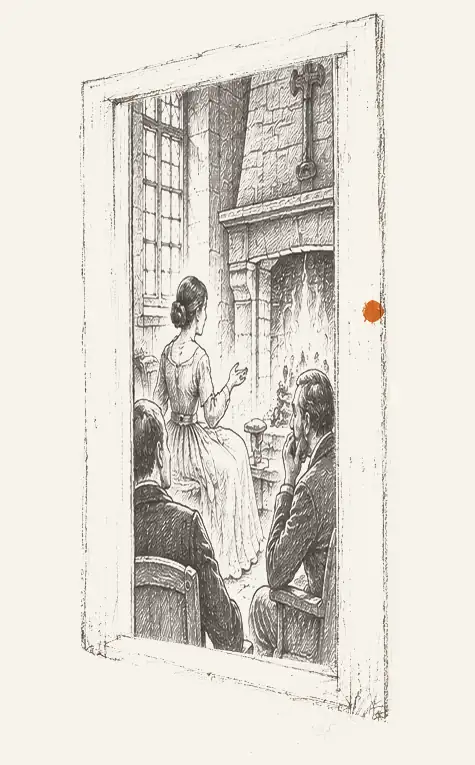
Eckbert lives in seclusion with his wife Bertha in a castle isolated in the woods; they have no children, and their only friend is Walther. One evening, in front of him, Bertha tells the story of her childhood: her flight, at the age of eight, from a brutal father, the old woman who took her in at her cabin, the dog, and the bird that sings of the forest's solitude while laying every day a pearl or a precious stone. She also tells how she left.
Context
The tale appeared in 1797, in Berlin, in the Volksmärchen that Tieck published under the name of Peter Lebrecht, from the bookseller Nicolai, alongside Puss in Boots and Bluebeard. The bird's song keeps returning to a single word, Waldeinsamkeit. Bertha's account, told in the first person, forms a tale within the tale, and the reader is invited not to take it for a mere fable. In France, its author has been seen as the forerunner of Hoffmann.
Who it is for
A tale of a few dozen pages, read in one sitting; it is best to know nothing about it before reading.
Prizes and reception
Regarded as one of the founding texts of German Romanticism; some date the movement's beginning from it.