South Africa
- works
- 50
- 41 books · 9 films
- period covered
- 1883–1999
- language of writing
- English
The motto of South Africa is written in a language that nobody speaks any more. Adopted in 2000, the formula that appears on the country's coat of arms is in ǀxam, the language of a people of the Cape whose last speakers died at the beginning of the twentieth century. It is known because two linguists, between 1870 and 1884, brought ǀxam prisoners into their home and wrote down from their dictation eighty-seven narratives, indicating each time the name of the narrator. A state gave itself as a motto a sentence borrowed from those it had allowed to disappear.
Read moreShow less
That gesture sums up a country that has always written against itself. Eleven official languages, a literature in English, another in Afrikaans, another in Zulu, in Xhosa and in Sotho, and almost no reader who covers all four. Sol Plaatje, founder of the first great black political movement, wrote in 1930 a historical novel in English while translating Shakespeare into Setswana. The Afrikaner authors of Brink and Breytenbach's generation wrote against their own community, and one of them spent seven years in prison.
The dominant form was imposed by circumstances: testimony, the short story, reportage. Under apartheid, Drum magazine published in the nineteen fifties a generation of journalist-writers from Sophiatown, several of whom died young, in exile or of drink. Alex La Guma wrote the slums of the Cape from prison and then from exile, Nadine Gordimer and Coetzee received the Nobel. The price was prohibition: dozens of authors banned, books seized, and a cinema that could not show the townships until 1988, filming half clandestinely.
What awaits the reader is a literature of moral urgency, in which the question is never what to recount but whether one has the right to do so. The novel that opens this page follows a Zulu pastor searching for his son in Johannesburg, and it appeared a few months before apartheid became law.
A way to begin
Cry, the Beloved Country
Zoltan Korda · 1952
The great South African novel of 1948, which sold more than fifteen million copies in its author's lifetime.
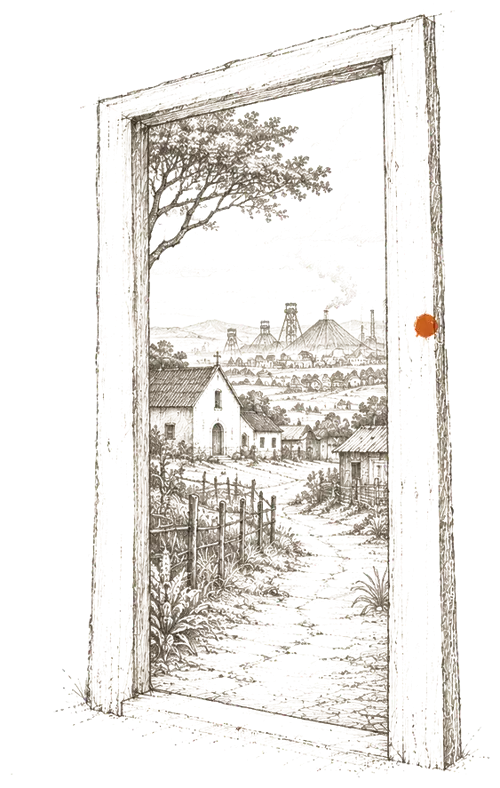
The Zulu pastor Stephen Kumalo leaves his village in Natal for Johannesburg, where he finds his sister reduced to prostitution and searches for his son Absalom. The young man is arrested for the murder of Arthur Jarvis, a white engineer who fought for racial equality and the son of a farmer who is Kumalo's neighbour.
Timeline
- 1880–1930First voicesOlive Schreiner, Thomas Mofolo. Two worlds that do not read each other.
- 1948–1990ApartheidCensorship, exile, clandestinity. Writing becomes an act.
- 1950–1970The Drum generationThe Black magazine of Sophiatown gives rise to a feverish urban prose.
- 1974–1991International recognitionGordimer and Coetzee carry the South African question everywhere.
Reading keys
- Eleven official languages produce very different names: Mphahlele and Sepamla are Sotho, Ndebele and Mtshali Zulu, Brink and Breytenbach Afrikaner, La Guma and Rive Coloured from the Cape.
- The Bantu prefixes indicate the person and the people: a muZulu belongs to the amaZulu, the language is isiZulu, the country kwaZulu.
- Among the Nguni, the isibongo, the clan name, serves as a respectful greeting and one thanks somebody by pronouncing it.
- Lobola, the payment made by the groom to the bride's family, is negotiated in cattle or in money and structures many narratives.
- Apartheid, from 1948 to 1991, its laws of racial classification and its forced removals, including the destruction of Sophiatown, are the frame of almost all the production of the century.
- Censorship banned hundreds of books and outlawed authors, so that part of South African literature first appeared in London.
- The word "Coloured" designates at the Cape a precise community with its language and its history, and not an indeterminate mixing.
- Post-apartheid violence and the question of land are the sensitive subjects of the recent period.
- Christianity dominates, with very powerful African independent churches, including the Zionist Church, which mix healing and the cult of the ancestors.
- The amadlozi, ancestors, are consulted and fed, and the sangoma, diviner-healer, is an ordinary character distinct from the sorcerer.
- Muti, a remedy prepared by a healer, may be beneficial or criminal according to its use, and killings for muti are a judicial fact.
- The ǀxam stock, with ǀKaggen the demiurge mantis and the young girl who created the Milky Way, is the oldest documented corpus in the country.
- Mourning imposes on the widow black clothes and a seclusion that may last a year, with precise public prohibitions.
- Sunday funerals, with choirs and speeches, are the social event of the week in the townships.
- Ukuthwasa, the initiation of the sangoma, involves an initiatory illness and a retreat, and a character who "is called" cannot refuse.
- The ritual slaughter of an animal seals family events, and its absence signals poverty or a rupture.
- The eighty-seven ǀxam narratives collected between 1870 and 1884, with the names of their narrators, form the founding corpus and are the source of the national motto.
- The Zulu religious system described from 1870 in Zulu and in English, with Unkulunkulu the first being and the amatongo, is the Bantu corpus of reference.
- Shaka, founder of the Zulu kingdom, is an omnipresent figure, celebrated and disputed throughout Southern Africa.
- Sophiatown, a district destroyed in 1955, has become a place of literary and musical memory.
- Afrikaans is not only the language of white Afrikaners: it is also the first language of the majority of the Coloured people of the Cape, and a militant literature is written in it.
- The national motto in ǀxam is not an innocuous homage: it borrows from a people whose extermination has never been repaired.
- The sangoma is not a sorcerer: the language carefully distinguishes the healer from the malefactor.
- The end of apartheid did not close the literature of violence, which has shifted towards the city, the land and the family.
Tales and mythologies 1
- TaleSpecimens of Bushman FolkloreWilhelm Bleek and Lucy Lloyd · 1911A San language, ǀxam, recorded in the 1870s from prisoners entrusted to two scholars in Cape Town; it is now extinct.LiteraturePublic domain
A selection to begin with 10 / 50
- NovelMhudiSol Plaatje · 1930The 1830s see the Matabele kingdom, the Barolong chiefdoms and the Boer wagon trains contend for the same high plateau.Literature
- NovelCry, the Beloved CountryAlan Paton · 1948Rural Natal and Johannesburg on the eve of apartheid, seen through a Zulu pastor who sets out to look for his son.Literature
- NovelA Walk in the NightAlex La Guma · 1962A night of anger and violence among the poor Coloured people of Cape Town, under the eye of a brutal police force, in the early 1960s.Literature
- PoetryCry Rage!James Matthews and Gladys Thomas · 1972In the early 1970s, Black poetry in South Africa takes on the tone of anger, in the face of a censorship that bans whatever disturbs.Literature
- CinemauDeliweSimon Sabela · 1975Johannesburg and the Zulu countryside in the 1970s, in a Zulu-language film intended only for the cinemas reserved for the Black public.Cinema
- CinemaHow Long?Gibson Kente · 1976Life in a township under apartheid, brought to the screen in 1976 by a Black man of the theatre, from one of his banned plays.Cinema
- CinemaThe Gods Must Be CrazyJamie Uys · 1980A comedy shot under apartheid, which sets the clash between a San community and the modern world in an imaginary Botswana.Cinema
- CinemaPlace of WeepingDarrell Roodt · 1986The South African countryside under apartheid, around the murder of a black farm worker whom almost everyone would like to keep quiet about.Cinema
- CinemaMapantsulaOliver Schmitz · 1988Soweto in the 1980s, in the time of demonstrations and police raids, seen through a thug who has no interest in politics.Cinema
- NovelDisgraceJ. M. Coetzee · 1999South Africa in the years following the end of apartheid, between the city and an isolated farm in the east of the country.Literature