Namibia
- works
- 8
- 6 books · 2 films
- period covered
- 1864–2000
- language of writing
- English
In 1904, a German general signed an order prescribing the expulsion from the territory of all the Herero, women and children included, and the shooting of those who remained. There followed four years of camps, forced labour and poisoned wells, at the end of which the majority of the Herero and a large part of the Nama had disappeared. Historians see in it the first genocide of the twentieth century. Germany recognised it as such only in 2021, a hundred and thirteen years later, at the end of negotiations that the descendants judge insufficient.
Read moreShow less
That fact weighs on all the cultural production of the country. Namibia was a German colony, then administered by South Africa which applied apartheid there, then independent only in 1990 after twenty-four years of war. It has some thirty languages, English as the official language chosen precisely because it was that of no local coloniser, and an Afrikaans still widely spoken. The Herero have worn for a century Victorian dresses and headdresses in the shape of horns, a garment taken from those who massacred them and turned into a sign of mourning and then of identity.
Written literature is therefore very recent. Joseph Diescho published in 1988, two years before independence, the first Namibian novel by a black author, about a man who leaves his village for the mines. Dorian Haarhoff, who came from South Africa, published in 1991 a history in verse of his adopted country. Cinema begins at the end of the nineteen nineties, with films that take as their subject the return and the name one bears. The price is double: a slender corpus, and a memory of the genocide carried above all by orality, by songs and by ceremonies rather than by books.
What awaits the reader is a literature of the mine, the desert and the return, still in the course of constituting itself. The novel that opens this page follows a villager to the gold mines of South Africa, and it appeared in New York two years before Namibia's independence.
A way to begin
Born of the Sun
Joseph Diescho · 1988
Regarded as the first novel published by a Namibian-born author: the political awakening of a villager gone to the mines.
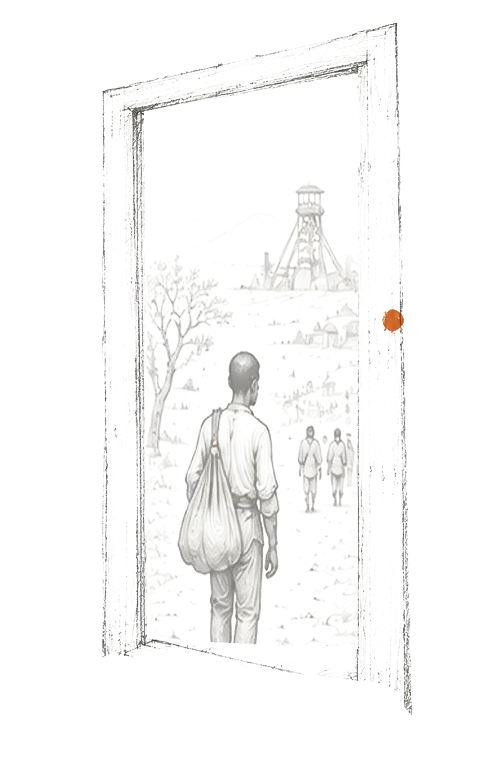
Muronga, a young man from a remote village in northern Namibia, sees missionaries upend his people's way of life; he and his wife take catechism to marry in church, and he becomes a father. When colonial taxes become unbearable, he goes to work in the gold mines of South Africa, where exploitation and racial discrimination gradually open his eyes.
Timeline
- 1978–1988Writing under apartheidDorian Haarhoff, then Joseph Diescho's Born of the Sun, published in exile.
- 1999First filmsHangula and Moller shoot, nine years after independence.
Reading keys
- Names indicate the group: Herero, Ovambo, Nama, Damara, Kavango, San, each with its own language and its own history.
- Herero societies are of double descent, belonging passing at once through the mother for goods and through the father for status, which has no simple equivalent.
- The Nama and San languages use clicks, noted by bars and exclamation marks, and a badly transcribed name becomes illegible.
- German and Afrikaner names survive, borne by descendants of settlers and by black families who received them.
- The genocide of 1904 to 1908, its reparations and the restitution of the skulls taken to Germany are an active dispute.
- Relations between the majority Ovambo group, from which power has come since 1990, and the other groups are a subject little approached head-on.
- The condition of the San, marginalised and deprived of land, is a difficult subject.
- The apartheid applied by South Africa until 1990 left a social geography that the narratives describe without naming it.
- Lutheran Christianity is very much in the majority, implanted by the German and Finnish missions.
- The Herero cult of the ancestors is practised around the sacred fire, the okuruwo, maintained by the head of the lineage, and its extinction means the end of a house.
- Among the Nama and the San, the religious stock documented since the nineteenth century includes Tsui-ǁGoab and his adversary, as well as the jackal narratives.
- The spirits of the dead intervene in family affairs and certain names are not pronounced.
- The Herero dress, long and with petticoats, with the two-pointed headdress evoking the horns of an ox, is a garment of memory worn daily by the women.
- Mourning includes a wake, a burial and ceremonies at the lineage's sacred fire.
- Cattle are the measure of wealth and of kinship, and their loss is a narrative catastrophe as much as an economic one.
- 26 August, the day of remembrance of the genocide, and 21 March, independence in 1990, are the two civil landmarks.
- The Khoikhoi fables published in 1864, in which the jackal and the hyena play the part that Reynard holds in Europe, form the oldest documented corpus.
- Tsui-ǁGoab, the Khoikhoi god studied as early as 1881 by an author born in the country, is the best documented religious reference.
- The memory of the genocide, transmitted by songs, place names and ceremonies, is the central narrative stock of the Herero.
- The San narratives of the Kalahari are shared with Botswana and South Africa.
- The Victorian dress of Herero women is not a passive colonial survival: it is a garment turned into a mark of identity and of mourning.
- Namibia was not colonised only by Germany: South African apartheid lasted longer there.
- Click languages are not rudimentary languages: they have some of the most complex phonological systems in the world.
- The thinness of the written corpus is explained by an independence dating from 1990, not by an absence of narrative tradition.
Tales and mythologies 1
- TaleReynard the Fox in South AfricaWilhelm Bleek · 1864The preface raises the question of the originality of these fables: are they indigenous, or borrowed from Europeans?Literature
A selection to begin with 6 / 8
- PoetryBorderingDorian Haarhoff · 1991The author, who came from the Northern Cape and became a Namibian, was later a university professor in Windhoek.Literature
- PoetryThoughts from ExileMvula ya Nangolo · 1991The exile poems of Namibia's national poet, published in Windhoek in the early 1990s.Literature
- NarrativeThe Price of FreedomEllen Ndeshi Namhila · 1997A Namibian childhood thrown into war and exile, told by the woman who became a librarian.Literature
- Feature filmThe NamingCecil Moller · 1997A sixty-four-minute feature film, co-produced by Namibian public television.Cinema
- CinemaKauna's WayVickson Hangula · 1999A forty-five-minute medium-length fiction film, co-produced by Namibian public television.Cinema
- TheatreNew Namibian PlaysAnonymous · 2000A first volume of Namibian plays, bringing together eleven playwrights and a Windhoek company.Literature