Zambia
- works
- 8
- 8 books
- period covered
- 1920–1996
- language of writing
- English
In 1964, the year of independence, a Zambian schoolteacher announced that his country would send a woman and two cats to Mars. Edward Nkoloso had founded a national academy of science, space research and philosophy, trained his recruits by rolling them down a hill in oil drums, and requested funding from the United Nations. It was much laughed at. Something else is seen in it today: at the moment when a country was gaining sovereignty, somebody publicly asked why the future should belong to others.
Read moreShow less
That question is Zambia's. The country was born of copper: the Copperbelt mines have attracted since the nineteen twenties a working population come from everywhere, created mining towns with their unions, their orchestras and their newspapers, and made Zambia one of the most urbanised countries in Africa while making it dependent on a single metal. Seventy-two languages are spoken, none is in the majority, and seven have a regional official status, which made English a practical choice more than an inheritance.
Written literature came from the school and from the mine. Stephen Mpashi published as early as 1950 narratives in Bemba, including the story of a man who enlists in the colonial army, and he is the country's first popular author. Fwanyanga Mulikita, a future minister, published short stories in English in 1968. Dominic Mulaisho wrote in 1971 a novel about a village where a healer contests the chief's place, under the eyes of the mission. The price is a production that is not abundant and badly distributed, in a country where school publishing absorbed most of the means and where literary print runs remain tiny.
What awaits the reader is a literature of social ascent and of the village that resists, written without bitterness. The novel that opens this page pits a chief, a healer who covets his place and a Christian mission against one another, and the whites stay in the background of a conflict that sets the villagers first against each other.
A way to begin
The Tongue of the Dumb
Dominic Mulaisho · 1971
A chief, a healer who covets his place and a Christian mission compete for a village in colonial times.
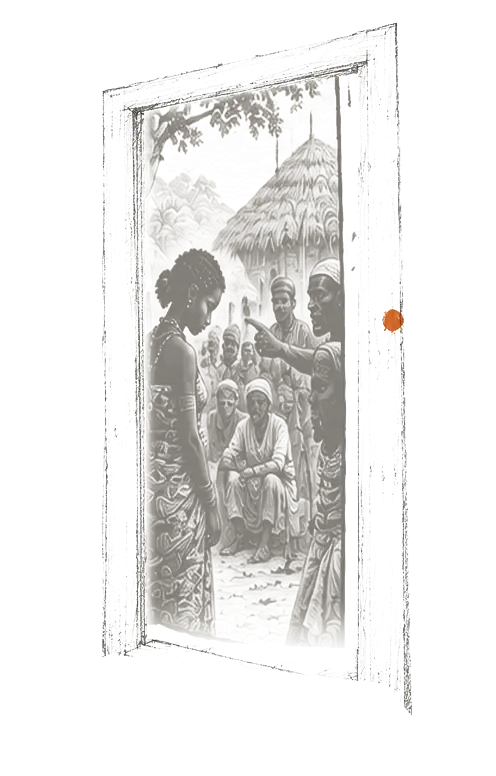
In a village in colonial times, Chief Mpona returns after five years away. Lubinda, a healer and councillor who covets his place, accuses him of being too close to the whites and spreads rumours. He has Natombi accused of witchcraft, blamed for her son Mwape's muteness and for a death in a flash flood, and turns on the schoolteacher. At the nearby mission two priests are at odds, one compassionate, the other rigid.
Timeline
- 1950–1964First narrativesMpashi writes in Bemba; Wilbur Smith publishes his first novel.
- 1968–1971After independenceMulikita and Mulaisho, senior officials turned novelists.
Reading keys
- Names indicate the group: Bemba in the north, Tonga in the south, Lozi in the west, Nyanja in the east, with the Bantu class prefixes.
- Bemba societies and some of the others are matrilineal: inheritance and authority pass through the maternal uncle, which changes the reading of family relations.
- Matrilocal marriage, in which the husband settles with his wife's family for several years, is common.
- Lobola exists but counts for less than in the neighbouring patrilineal societies.
- Dependence on copper and the effects of the collapse of prices in the nineteen seventies and eighties are a permanent social fact.
- The single party from 1972 to 1991 framed publishing and the university, which limited criticism.
- Sorcery is an accusation with real consequences, and the courts have dealt with it.
- Restraint and respect for elders organise public speech, and one does not interrupt an elder.
- Christianity is very much in the majority, with revival churches very present in the mining towns.
- Lesa or Leza is the supreme god, and the mizhimo the ancestral spirits to whom requests are addressed.
- The nganga, healer and diviner, is an ordinary character, distinct from the sorcerer.
- The Bantu narrative of the origin of death, in which a badly transmitted message deprives men of immortality, is the central aetiological myth of the region.
- Mourning includes a wake, a burial and a ceremony of purification for the widow or the widower.
- The initiation of girls, chisungu among the Bemba, involves a retreat, songs and clay figures, and has been the object of a famous ethnographic study.
- The Kuomboka, the annual ceremony in which the Lozi king moves house by barge as the waters rise, is the country's great ritual gathering.
- 24 October, the day of independence in 1964, is the civil landmark.
- The Ila tales and proverbs published in 1920, in the original language with a translation, form the country's most extensive documented corpus.
- The Lamba narratives, collected by a linguist in the nineteen thirties, complete that stock.
- Chisungu and its vocabulary are a common knowledge, notably a female one, that the texts assume is known.
- The Kuomboka and the Lozi royalty are a strong identity reference for the west of the country.
- The matrilineality of several Zambian societies reverses what a reader expects of a family: the maternal uncle decides, not the father.
- Zambia is not a rural country: the Copperbelt made it one of the most urbanised on the continent as early as the nineteen fifties.
- The space project of 1964 was not an isolated joke but a political gesture whose significance is today seriously discussed.
- The absence of a majority language explains the place of English, which is not here a simple colonial inheritance but a practical choice.
Tales and mythologies 1
- TaleThe Ila-Speaking Peoples of Northern RhodesiaEdwin Smith and Andrew Dale · 1920A missionary linguist and a colonial magistrate recorded the culture of a people of present-day Zambia.Literature
A selection to begin with 6 / 8
- NovelCekesoni aingila ubusojaStephen Andrea Mpashi · 1950not translated into EnglishThe author, a former soldier, was one of the first to write novels in Bemba, the most widely spoken language of the north of the country.Literature
- NarrativeZambia Shall Be FreeKenneth Kaunda · 1962The leader of the Zambian struggle for independence tells of his life and his fight against colonial rule.Literature
- NovelWhen the Lion FeedsWilbur Smith · 1964The first novel by its author, it opens a family saga that will follow several generations of the same line.Literature
- Short storiesA Point of No ReturnFwanyanga Mulikita · 1968The author wrote on the margins of a career as a diplomat and minister of independent Zambia.Literature
- NovelBefore DawnAndreya Masiye · 1971The life of a Chewa village, its rites and its elders, facing the novelties brought by colonial rule.Literature
- NovelQuills of DesireBinwell Sinyangwe · 1996A brilliant and proud pupil sees his dreams of study abroad falter, between a Zambian boarding school and village.Literature