England
- works
- 139
- 87 books · 52 films
- period covered
- 1390–1985
- language of writing
- English
In October 1960, the publisher Penguin was prosecuted for having published in paperback, at three shillings and sixpence, D. H. Lawrence's last novel. Counsel for the Crown asked the jurors whether it was a book they would be willing to let their wives or their servants read. The jury, which included three women and several workers, acquitted on 2 November, and three million copies went out within a few months. The prosecutor's question had said the essential: what was on trial was who has the right to read.
Read moreShow less
That literature does indeed have class for its permanent subject and for its material condition. The English novel was manufactured in a market: circulating libraries that imposed the three-volume format, publication in monthly instalments, one-shilling editions. Jane Austen measures incomes to the pound, Dickens makes people weep over orphans while keeping an eye on his print runs, and the post-war years had to come before the voice of the workers of the North entered the novel, and then the cinema with Karel Reisz in 1960.
The English form is free indirect style, which lets a consciousness speak through the narrative without commenting on it, and the social comedy that cuts more than it amuses. The price is judicial and imperial. Oscar Wilde was sentenced in 1895 to two years' hard labour and came out destroyed. Wilfred Owen was killed a week before the armistice of 1918, at twenty-five, and his poems appeared after his death. Joseph Conrad, a Pole who wrote in English, his third language, published in 1899 in a magazine, then in book form in 1902, a narrative about the Congo that puts the colonial enterprise at the centre, and Virginia Woolf asked in 1925 who organises whose days.
What awaits the reader is a held irony, an attention to incomes and accents, and a constant formal invention beneath an appearance of good manners. The novel that opens this page, written in 1796 and 1797 and turned down unread by a bookseller, waited more than ten years before appearing in 1813, without the author's name, and it has never been out of print since.
A way to begin
Pride and Prejudice
Jane Austen · 1813
A lively and witty comedy of manners, perfect for entering the English novel without apprehension.
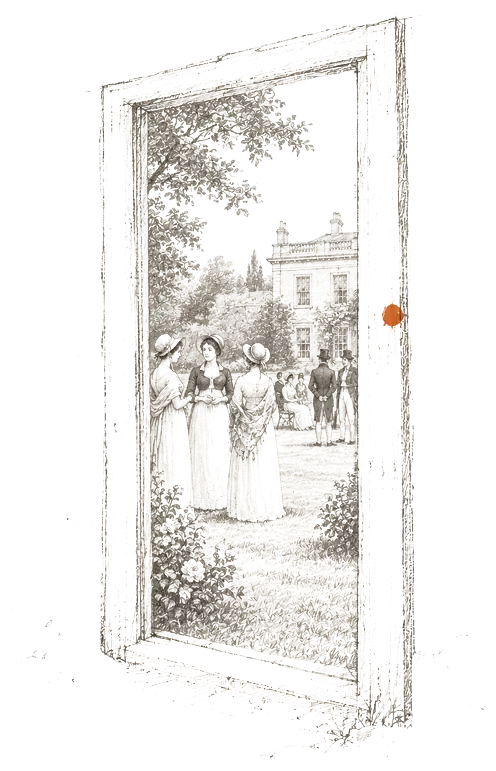
Five daughters to be married in a country house that will pass to a cousin for want of a male heir. At the village ball, the friend of a rich neighbour, richer still, refuses to dance with anyone but his host's sisters; the second of the daughters hears him say that she is not handsome enough to tempt him. She laughs at it, but does not forgive him.
Timeline
- 1000Old EnglishBeowulf. An epic from before English became English.
- 1380–1400Middle AgesChaucer and his Canterbury Tales found English literature.
- 1580–1640Elizabethan RenaissanceShakespeare, Marlowe, Donne. The theatre invents a language.
- 1660–1780Restoration and EnlightenmentDefoe, Swift, Fielding. The English novel is born here.
- 1790–1830RomanticismBlake, Wordsworth, Keats, Byron, Shelley.
- 1837–1901Victorian eraDickens, the Brontës, Eliot, Hardy. The novel becomes an institution.
- 1900–1940ModernismWoolf, Joyce, Conrad, Lawrence. Consciousness takes over from plot.
- 1930–1960Documentary and EalingBritish cinema finds its voice, between reportage and comedy.
Reading keys
- The accent, more than the name, places a character socially: so-called received pronunciation, learnt in the private schools, against regional accents, and an English dialogue is first of all a social map.
- Noble titles have precise rules, Lord, Sir, Lady, honourable, and a novelist handles them to indicate an exact position that French translation flattens.
- Double family names with a hyphen signal an alliance or a pretension, and the name of the school attended functions as an additional family name.
- The first name alone is reserved for intimacy in nineteenth-century novels, and the move from the name to the first name marks an event.
- Class remains the subject that can be named directly, unlike French usage, and a text that ignores it is read as a taking of position.
- The empire, slavery and the fortunes that come from them have been the object of public re-examination for twenty years, including in the institutions and the museums.
- Ireland, the partition and the decades of conflict in Northern Ireland are stated with a cautious vocabulary, and the choice of words situates the author.
- Understatement is the rule, direct complaint is frowned upon, and excessive compliment passes for a disguised insult.
- The Church of England is established, the sovereign heads it, and that situation explains the place of parsons, parsonages and sinecures in the nineteenth-century novel.
- Protestant dissent, Methodists, Quakers, Baptists, produced a culture of self-education and temperance that working-class narratives assume is known.
- Catholicism was a minority and suspect identity for three centuries, which gives twentieth-century literary conversions their charge.
- The ghosts of English literature are not folklore but a codified genre, with its season, Christmas, and its rules of narration.
- Tea is a social moment regulated according to class and hour, and the contents of a tray place a character.
- On 5 November an effigy of Guy Fawkes is burnt, and on 11 November a poppy is worn, two civic rites that the texts use as landmarks.
- Funerals are sober and the expression of grief restrained, demonstration passing for indecency.
- School rites, uniforms, houses, team captain, structure a whole literary genre and provide political metaphors.
- Shakespeare is a common stock of quotations, often used without quotation marks, and knowledge of a few lines is assumed.
- The Arthurian matter, invented by Geoffrey of Monmouth around 1136 and fixed by Malory in 1485, provides a repertoire with which English literature has never finished.
- The King James Bible gives the rhythm and the formulas, including in authors without faith.
- Joseph Jacobs's collections, published from 1890, gathered the English tales, and Alice, Robinson and Sherlock Holmes have become references usable without explanation.
- England is not the United Kingdom: Scotland, Wales and Northern Ireland have their literatures, their languages and their institutions, and the catalogue places them here for convenience.
- A major part of this literature is written by authors come from elsewhere, Conrad, Kipling, Jhabvala, then the writers from the Caribbean and South Asia from the nineteen fifties.
- The detective novel and science fiction are here major genres, held by criticism on the same footing as the rest.
- Politeness and understatement are not lukewarmness: social violence is stated there by indirect means that translation erases.
- The catalogue stops in the mid nineteen eighties and mixes literature and British cinema, which reflects the state of rights more than production.
Tales and mythologies 1
- TaleEnglish Fairy TalesJoseph Jacobs · 1890Forty-three tales gathered in a country said to have none.Literature
A selection to begin with 10 / 139
- NovelOliver TwistCharles Dickens · 1838London, its workhouses and its gangs of child thieves, through the fate of an orphan.LiteraturePublic domain
- NovelHeart of DarknessJoseph Conrad · 1902One evening on the Thames, four men listen to what one of their number went to look for at the far end of a river.LiteraturePublic domain
- PoetryPoemsWilfred Owen · 1920Twenty-three poems gathered by a friend, two years after the death of the man who had written them.LiteraturePublic domain
- NovelMrs DallowayVirginia Woolf · 1925A single summer day, and two lives that never cross.LiteraturePublic domain
- NovelLady Chatterley's LoverD. H. Lawrence · 1928A crippled husband allows his wife to seek elsewhere the heir he cannot give her.LiteraturePublic domain
- CinemaSaturday Night and Sunday MorningKarel Reisz · 1960A lathe operator works all week and spends everything on Saturday night.Cinema
- CinemaLawrence of ArabiaDavid Lean · 1962An English officer crosses a desert that no one crosses, and the country he rouses is not his own.Cinema
- CinemaThe ServantJoseph Losey · 1963A servant turns up at an empty house, at the home of a master who expects everything of him.Cinema
- CinemaTom JonesTony Richardson · 1963A man returns from a journey and discovers that a child has been left at his home.Cinema
- CinemaZuluCy Endfield · 1964In the aftermath of an English disaster, a missionary and his daughter understand that they must flee.Cinema