India
- works
- 92
- 52 books · 40 films
- period covered
- 300–1997
- language of writing
- Hindi and English
There is no such thing as Indian literature. The country's academy of letters awards its prizes in twenty-four languages, and a novel in Malayalam, a poem in Assamese and a play in Marathi have neither the same history, nor the same forms, nor the same audience. A reader in Chennai does not read what an author in Calcutta writes without going through a translation, often through English, which makes the colonial language the bridge between two Indian literatures. What the word "India" designates, in matters of books, is a federation of literatures that politely ignore one another.
Read moreShow less
That plurality rests on a shared stock, and that is what makes it legible. The Mahabharata and the Ramayana, known to all through theatre, television and recitation, provide a stock of characters and situations that each language reworks in its own way. The Ramayana exists in dozens of versions, some of which find Rama in the wrong. The Panchatantra, a collection of fables of the third century, passed into Pahlavi, into Arabic under the name of Kalila wa Dimna, into Hebrew, into Latin, and fed La Fontaine: it is probably the most travelled book in history.
Hence an industry of narrative without equivalent. Indian cinema has produced since 1913 films in some fifteen languages, with its obligatory songs, its avowed changes of tone and its three-hour length, and it invented a grammar that the West long took for bad taste. Alongside it, a Bengali auteur cinema filmed village poverty in 1955 with a sobriety that astounded Cannes. Both come from the same country and sometimes from the same studio, and the Indian audience sees no contradiction in loving both.
What awaits the reader is an avowed excess, an abundance of characters and a calm indifference to psychological plausibility. The collection that opens this page earned its author the first non-European Nobel prize, and he wrote the national anthems of two countries.
A way to begin
Gitanjali
Rabindranath Tagore · 1910
The collection whose English version won Tagore the 1913 Nobel Prize, the first awarded to a non-European writer. Free of rights.
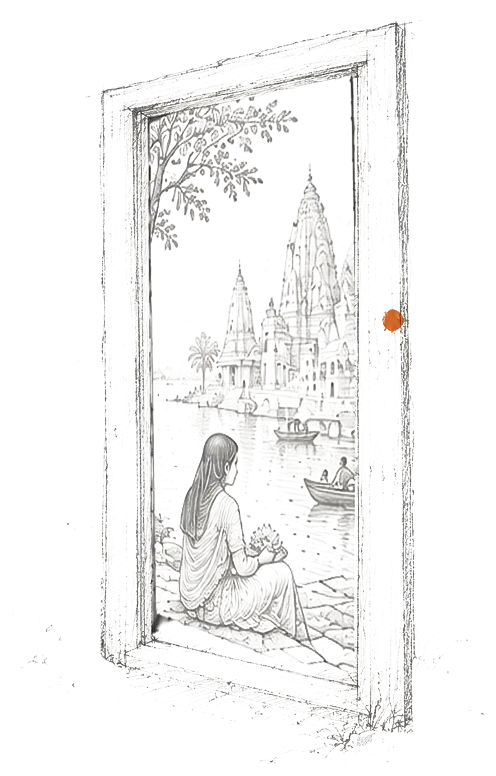
A hundred and fifty-seven lyric poems, many of them songs, written in the tradition of medieval Indian devotion. The poet addresses God, awaits his coming and offers him his songs; love runs through most of them, and a few poems speak of the conflict between desire for worldly goods and spiritual thirst.
Timeline
- -1500–500Sanskrit textsVedas, Mahabharata, Ramayana, the theatre of Kalidasa.
- 1170–1700Devotional poetryKabir, Mirabai, Tulsidas. Faith passes into the languages of the people.
- 1860–1930Bengal RenaissanceCalcutta invents Indian modernity. Tagore, first non-European Nobel.
- 1930–1947Literature of independencePremchand, Anand. The social novel in Hindi and in English.
- 1955–1990Auteur cinema and BollywoodSatyajit Ray on one side, the world's most prolific industry on the other.
Reading keys
- The name indicates the language, the region, the religion and often the caste: a Chattopadhyay is a Bengali Brahmin, a Patel a Gujarati, a Reddy from Telangana, a Khan a Muslim.
- In the south, many names are formed from the village, the father's first name and the personal first name, in that order, and everyday usage employs only the last.
- Kinship terms distinguish the elder from the younger and the paternal from the maternal side, and one calls strangers brother, sister, uncle or aunt according to age.
- Arranged marriage remains the majority and is negotiated between families according to caste, region and horoscope, which provides the device of thousands of narratives.
- Caste organises society without being named in polite conversation, and a narrative indicates it through occupation, neighbourhood, name or what one eats.
- The Partition of 1947, with its hundreds of thousands of dead and its millions displaced, is a wound that literature never stops reopening.
- Tensions between Hindus and Muslims are a dangerous subject, and several authors have been prosecuted or threatened.
- The kiss and physical contact were long forbidden on screen, which produced an erotics of the detour, of the rain and of the song.
- Hinduism is in the majority, with an immense pantheon in which each region privileges its own divinities, and there is neither creed nor central authority.
- Islam concerns more than two hundred million people, and the country also has Sikhs, Christians, Jains, Buddhists and Parsis, each with their own literature.
- Reincarnation and karma are not exotic beliefs but a framework for understanding events, and a misfortune may have its cause in a previous life.
- The pure and the impure organise contact, cooking and marriage, and a food transgression is a narrative event.
- White is the colour of Hindu mourning and widowhood, red that of marriage. A widow in white is not in festive dress.
- Cremation on the same day, then the rites of the thirteenth day and the annual offerings to the ancestors, organise mourning.
- Holi in spring, Diwali in autumn, Eid and Christmas are public holidays for all, which gives a very crowded calendar.
- Henna, bangles and the vermilion in the parting of the hair indicate a woman's marital status, immediate information for a local reader.
- The Mahabharata and the Ramayana are the absolute stock, known through recitation, theatre and television, and quoted as one would quote the Bible.
- The Panchatantra and the Ocean of the Rivers of Story provide a stock of fables and of embedded narratives.
- The Puranas give the cosmology, the kalpas and the yugas, and the Devi Mahatmya founds the cult of the Goddess.
- The regional epics and the narratives of saints, in Tamil, in Marathi or in Bengali, double that stock in each language.
- There is no such thing as an Indian language: Hindi is spoken by only part of the country, and English serves as the language of contact between elites.
- The white of mourning and the red of marriage reverse the European codes, and the confusion distorts the reading of many scenes.
- The songs of popular cinema are not decorative interludes but the narrative structure itself.
- Caste is not a relic: it still determines marriages, occupations and politics, and its absence from a text is in itself a piece of information.
Tales and mythologies 2
- PoetryAn Anthology of Buddhist Tantric Songsচর্যাপদAnonymous · 1000Mystical songs of a tantric Buddhist school of eastern India, written in a deliberately veiled language.Literature
- TaleThe Panchatantraपञ्चतन्त्रAnonymous · 300A collection of animal fables composed in Sanskrit to teach princes the art of governing, which travelled as far as La Fontaine.Literature
A selection to begin with 10 / 92
- NovelPather Panchali: Song of the Little Roadপথের পাঁচালীBibhutibhushan Bandyopadhyay · 1929A boy's childhood in a poor village in Bengal, at the beginning of the twentieth century, seen at the level of the seasons and of play.Literature
- NovelUntouchableMulk Raj Anand · 1935A whole day in the life of an untouchable sweeper, from dawn to evening, in the colonial India of the thirties.Literature
- NovelThe Gift of a CowगोदानMunshi Premchand · 1936Peasant debt and the dream of owning a cow, in the colonial countryside under the rule of the great landowners.Literature
- NovelPadma River Boatmanপদ্মা নদীর মাঝিManik Bandyopadhyay · 1936Poor fishermen of a river in eastern Bengal, caught between hunger, desire and the dream of a promised island.Literature
- CinemaShahjehanशाहजहाँA. R. Kardar · 1946A poet, a young girl and the emperor who will build the Taj Mahal, in a sung Mughal fresco.Cinema
- CinemaRanakdeviરાણકદેવીV. M. Vyas · 1946A legend of Saurashtra, half historical and half popular, about a queen contested by two kings.Cinema
- CinemaDharti Ke Lalधरती के लालKhwaja Ahmad Abbas · 1946The Bengal famine of 1943, seen through a family of sharecroppers driven from their land towards Calcutta.Cinema
- CinemaPather Panchaliপথের পাঁচালীSatyajit Ray · 1955A boy's childhood in a poor village in Bengal, among his mother, his sister and an old aunt.Cinema
- CinemaMughal-e-Azamमुग़ल-ए-आज़मK. Asif · 1960The love of a Mughal prince for a young woman of low condition, and the quarrel that sets him against his father, the emperor.Cinema
- NovelMidnight's ChildrenSalman Rushdie · 1981A child is born at the very instant a country becomes independent, and the book holds that his life and that of the state govern each other. Thirty years of history pass through a single family.Literature