Canada
- works
- 138
- 93 books · 45 films
- period covered
- 1832–1999
- language of writing
- French and English
The poet who fixed the image of Canadian nature in the anthologies also ran the Department of Indian Affairs. Duncan Campbell Scott was its deputy superintendent from 1913 to 1932 and made residential school compulsory for indigenous children in 1920. At the same time he was writing sonnets about a race he called doomed. Before members of parliament, he had stated his objective: to continue until there was no more Indian question.
Read moreShow less
The country is organised around literatures that do not read one another. Hugh MacLennan gave in 1945 the title that has served since to name the thing, Two Solitudes, borrowed from a sentence of Rilke's on love. Anglophones and francophones each have their prizes and their textbooks, while the indigenous nations were set apart by the Indian Act, whose school regime removed a hundred and fifty thousand children from their families. The scarcity of translation between those ensembles is a structural fact, not an accident.
The form invented here is documentary. The National Film Board, created in 1939, produced a whole school, from the drawing on film of Norman McLaren, whose Neighbours shows in 1952 two men killing each other over a flower, to the direct cinema of Mon oncle Antoine, shot by Claude Jutra in 1971. The price is paid. In October 1970, the War Measures Act had nearly five hundred people arrested without charge, including the poet Gérald Godin, and a 1974 film re-enacts those arrests with those who underwent them. Michel Tremblay caused a scandal in 1968 with Les Belles-sœurs, written in joual, the spoken language of Montreal, held to be a fault.
What awaits the reader is a literature of winter, of the village and of the gap, in which the landscape is never decorative and the language remains in question, as in Gabrielle Roy in 1945, in the working-class Montreal of The Tin Flute. The novel that opens this page is by a Frenchman who spent six months of 1912 in Péribonka with a farmer, and it appeared as a serial in Paris when its author was already dead.
A way to begin
Maria Chapdelaine
Louis Hémon · 1914
A girl from Lac Saint-Jean between three suitors, free of rights: a novel that has sold more than ten million copies.
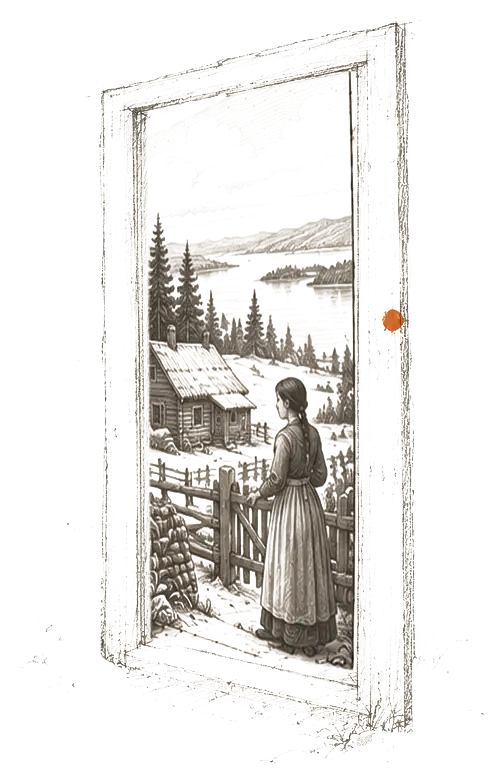
In the Quebec of the land-clearers, a young girl must choose between three men: the one who leaves for the woods, the one who leaves for the United States, and the one who stays on the land.
Timeline
- 1900–1945The land novelThe land, the parish, survival. Maria Chapdelaine is its emblem.
- 1960–1970Quiet RevolutionQuebec secularises overnight. Literature bursts out.
- 1939–1980National Film BoardCanadian documentary and animation become a world reference.
Reading keys
- French Canadian families often bear a double name with the particle dit, Lévesque dit Lafrenière, and the same stock is found under two surnames according to the branch.
- Sibling groups of ten to fifteen children are ordinary before 1960, the result of a settlement policy encouraged by the clergy, so that the size of a family in a novel is documentary.
- A Scottish or Irish surname in Quebec, Johnson, Ryan, O'Neil, most often designates a francophone family for several generations.
- The residential schools replaced Cree, Innu or Anishinaabe names with Christian first names, and the Inuit were identified by a numbered disc until surnames were assigned around 1970.
- The indigenous residential schools, the truth and reconciliation commission of 2015 and the burial sites found since are the country's heaviest subject, and it involves the literary institutions themselves.
- The question of Quebec's status runs through everything: Bill 101 on language in 1977, the referendums of 1980 and 1995, and a text situates itself by its choice of words alone.
- The October crisis of 1970 and the arrests that accompanied it remain a point of disagreement between the two memories.
- The word Indian is administrative and dated, Indigenous and First Nations are in use, and the appropriation of an indigenous voice by a non-indigenous author has been a public debate since the nineteen eighties.
- The Catholic Church held schools, hospitals and the civil registry in Quebec until the nineteen sixties, and the anticlericalism of the novels of that period targeted an institution that governed ordinary life.
- French Canadian legend puts the devil in the position of a contracting party: in the chasse-galerie, lumberjacks borrow a flying canoe from him against conditions they try to circumvent.
- The potlatch of the Pacific coast and the sun dance of the Prairies were forbidden by law from 1884 to 1951, and their resumption is recent.
- Indigenous spiritualities are alive and distinct from one nation to another, with ceremonial dress, elders and precise rules of transmission.
- Saint-Jean-Baptiste, on 24 June, is the national holiday of Quebec, distinct from the federal 1 July, a day that also serves as the common moving date in Montreal.
- The réveillon follows midnight mass, with tourtière and pigs' trotter stew, and the festivity extends to Epiphany.
- Hockey structures the year and provides a repertoire of images that literature uses without having to explain them, down to the team jersey as a sign of belonging.
- The body is displayed at the funeral home for one or several days, and the obligatory visit there replaces the procession.
- The summer powwow, with its drums and its dance categories, is an intertribal gathering and not a spectacle for visitors.
- The chasse-galerie, put into form by Honoré Beaugrand in 1900, and the werewolf form the legendary stock that every Quebec text assumes is known.
- Marius Barbeau collected between 1916 and 1920 hundreds of tales while noting the name and the parish of each storyteller, which makes it a dated and located source.
- Louis Riel, hanged in 1885, is a traitor or a founder according to the province, and naming him is enough to situate a text.
- The narratives of the Pacific coast were written in Tsimshian by Henry Tate before being translated by Franz Boas, a collaboration long erased behind the ethnologist's name.
- The coureurs des bois and the voyageurs of the fur trade provide the repertoire of the far north and the river.
- The French of Quebec is not a patois: joual is a Montreal register, and its use in a book is a political gesture dated to the end of the nineteen sixties.
- Quebec literature has its institutions, its prizes and its chronology, and is not read as a regional French literature.
- Acadians are not Quebecers: Antonine Maillet's Sagouine speaks a French of another territory, with its own history of deportation.
- The country is not a temperate United States, and its recent literature is written in large part by authors come from elsewhere, from Sri Lanka, Tanzania or Haiti.
- An important part of so-called Canadian cinema was financed by public institutions, which explains the place of the documentary and the rarity of large studios.
Tales and mythologies 1
- TaleTsimshian MythologyHenry Wellington Tate and Franz Boas · 1916Among the Tsimshians, a story is family property, passed down with a name and rights, and told at feasts that Canadian law forbade from 1884 to 1951.LiteraturePublic domain
A selection to begin with 10 / 138
- PoetryLabor and the AngelDuncan Campbell Scott · 1898Second verse collection by a poet from Ottawa, in which his first sonnets on Iroquois subjects appear.LiteraturePublic domain
- NovelTwo SolitudesHugh MacLennan · 1945A father pushed aside by his parish, a son torn between two worlds, and a country that does not speak to itself.Literature
- NovelThe Tin FluteBonheur d'occasionGabrielle Roy · 1945Beneath the viaduct of a working-class district of Montreal, a family driven in different directions by winter and war.Literature
- PoetryOvertureF. R. Scott · 1945First collection by a Montreal lawyer, between satire of literary circles and political poems.Literature
- CinemaNeighboursNorman McLaren · 1952Two peaceful neighbours quarrel over a flower that has grown between their plots, and the quarrel turns bitter.Cinema
- TheatreLes Belles-SoeursLes Belles-sœursMichel Tremblay · 1968Fifteen women paste bonus stamps in a Montreal kitchen, and speak the language that was not brought on stage.Literature
- CinemaMy Uncle AntoineMon oncle AntoineClaude Jutra · 1971A teenager from a mining village spends a Christmas Eve with his uncle that initiates him into the adult world.Cinema
- CinemaMelanieRex Bromfield · 1982An illiterate young woman goes to Los Angeles to get her son back, and must first learn to read.Cinema
- CinemaVideodromeDavid Cronenberg · 1983In Toronto, the head of a local channel picks up images of torture, and his own flesh begins to betray him.Cinema
- CinemaWhere the Spirit LivesBruce Pittman · 1989Two Kainai children, Blackfoot, are torn from their family and placed in a boarding school where their language and their name are erased.Cinema