Chile
- works
- 56
- 40 books · 16 films
- period covered
- 1837–2000
- language of writing
- Spanish
On 25 September 1973, two weeks after the coup, a funeral procession crossed Santiago under military surveillance. Pablo Neruda, who had died two days earlier, was being buried, and the people following the hearse began to sing and to shout slogans in front of armed soldiers. It was the first public demonstration against the junta, and it took place at a funeral. The poet had just finished his memoirs, published the following year, and his house in Santiago had been ransacked a few days earlier, the books thrown into the water.
Read moreShow less
A narrow and distant country produced two Nobel prizes for poetry. The first, in 1945, went to a village schoolmistress from the north, Gabriela Mistral, the first Latin American woman to be honoured, who wrote about dead children and barrenness. The second to Neruda in 1971. Beside them, Vicente Huidobro invented in 1931 a poem that disintegrates into pure syllables, and Nicanor Parra proposed in 1954 antipoetry, in which one speaks as at a bar counter. For a country of that size and that distance, the density is abnormal.
The dominant form after 1973 is that of memory and of the document. Patricio Guzmán filmed during the coup images that he had smuggled out and edited in exile into a film in three parts that remains the reference on that period. Isabel Allende published in 1982 from Venezuela a family saga that crosses the Chilean century and became one of the most widely read books in the world. Raúl Ruiz, who left for France, shot more than a hundred films without ever ceasing to be Chilean. The price was the exile of almost a whole generation of writers and film-makers, and a literature written for twenty years outside the country.
What awaits the reader is a poetry that occupies the place of the novel, and a literature that has made testimony a form. The novel that opens this page follows four generations of a family, from the woman who sees spirits to her granddaughter, in a country that is never named.
A way to begin
The House of the Spirits
Isabel Allende · 1982
Four generations of a Chilean family, from the woman who sees spirits to her granddaughter: the novel that launched Isabel Allende.
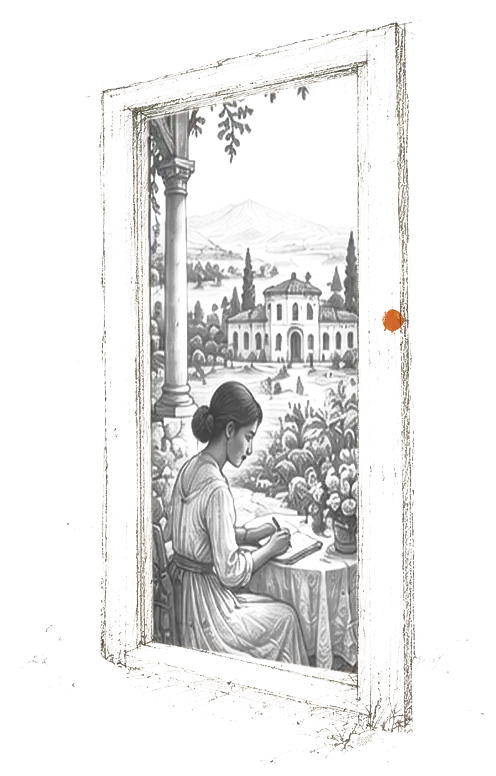
Four generations of the Trueba family, from the early twentieth century to the seventies. Clara del Valle, a child gifted with supernatural powers, keeps a record of everything that happens. Esteban Trueba restores the Tres Marías hacienda, then marries Clara; their daughter Blanca loves Pedro Tercero García, the foreman's son, and from this love Alba is born, while the country goes through its upheavals.
Timeline
- 1920–1945Two NobelsGabriela Mistral in 1945, Pablo Neruda in 1971. A very small country, crowned twice.
- 1970–1973Popular UnityAllende in power. A brief effervescence.
- 1973–1990PinochetThe coup. Neruda dies twelve days later. Literature goes into exile.
Reading keys
- The Spanish usage of two surnames applies, and the second name, the mother's, is commonly used.
- Gabriela Mistral and Pablo Neruda are pseudonyms: their civil names were Lucila Godoy and Ricardo Neftalí Reyes.
- Mapuche names, in Huenchu, Lemun, Catrileo, signal a claimed belonging in a country that long denied it.
- The German names of the south, and the Palestinian and Croatian ones, bear witness to migrations organised in the nineteenth and twentieth centuries.
- The dictatorship from 1973 to 1990, its disappeared and its civilian complicities are the central subject, and its memory is still politically disputed.
- The Mapuche conflict in Araucanía, with its trials and its dead, is a raw subject that the state describes as terrorism.
- The social question and inequality, reactivated by the uprising of 2019, run through recent production.
- Restraint is valued in social relations, and irony serves as an indirect expression of disagreement.
- Catholicism is in the majority, with an important evangelical Protestantism in working-class circles, and the Church played a decisive role of protection under the dictatorship.
- Mapuche religion is alive, with the ngillatun, a collective ceremony of several days, and the machi, a shaman most often a woman, who heals and dreams.
- The ngen, masters of places, inhabit the rivers and the forests, and the narrative of the flood of Trentren Vilu and Caicai Vilu explains the geography of the south.
- The folklore of Chiloé, with the Trauco, the ghost ship Caleuche and the Pincoya, forms a distinct island ensemble.
- The wake is held at home or in a hall, and the ninth day as well as the first anniversary are marked.
- Black is worn in mourning.
- The fiesta of La Tirana, in the northern desert, mixes devil dances and Marian devotion over several days.
- 18 September, the national holiday, imposes the asado, the cueca and the fondas, and often serves as a narrative hinge.
- The Mapuche texts collected between 1895 and 1897 in Mapudungun with a translation are the documented indigenous corpus, with the flood and the ngen.
- The tales of Pedro Urdemales, a trickster who cheats everybody, published in 1925, are the Hispanic stock common with the whole of Latin America.
- The narratives of Chiloé, with the Caleuche and the Trauco, are known to all and abundantly taken up.
- The Rapanui traditions of Easter Island, collected in 1919 from the last witnesses of the old order, form a Polynesian corpus apart.
- Chile is not a country without an indigenous population: the Mapuche number several hundred thousand and were never conquered by the Spaniards.
- Easter Island has been Chilean since 1888 and its culture is Polynesian, which attaches the country to two distinct areas.
- The poetic density of the country is not a tourist cliché: two Nobels and two inventors of forms in fifty years.
- Testimony is not a minor genre here: it was the only way of writing history for seventeen years.
Tales and mythologies 1
- TaleEstudios araucanosRodolfo Lenz · 1897not translated into EnglishMapuche stories, songs and dialogues dictated to a linguist and published with their translation.Literature
A selection to begin with 10 / 56
- PoetryDesolaciónGabriela Mistral · 1922Poems of mourning and school pieces, written by a provincial schoolteacher.Literature
- NovelThe Final MistLa última nieblaMaría Luisa Bombal · 1934An unhappily married woman, a night with a stranger and the mist that blurs every memory.Literature
- Short storiesCape Horn and Other Stories from the End of the WorldCabo de HornosFrancisco Coloane · 1941Shepherds, seal hunters and lighthouse keepers facing the wind and cold at the end of the continent.Literature
- PoetryPoems and AntipoemsPoemas y antipoemasNicanor Parra · 1954Irony, sarcasm and ordinary speech set against the solemn tone of the Chilean poetry of his time.Literature
- CinemaValparaíso, My LoveValparaíso, mi amorAldo Francia · 1969Four children from the hills of Valparaíso, left without protection after their father's arrest.Cinema
- NarrativeMemoirsConfieso que he vividoPablo Neruda · 1974The life of a poet and diplomat told through anecdotes, from childhood in the south to the consulates of Asia.Literature
- CinemaThe Battle of ChileLa batalla de ChilePatricio Guzmán · 1979The last months of the Allende government, filmed day by day by a team of five people.Cinema
- CinemaA Man, When He Is a ManEl hombre cuando es hombreValeria Sarmiento · 1982Men of Costa Rica talk about love, between boleros and cinema melodramas.Cinema
- Cinema100 Children Waiting for a TrainCien niños esperando un trenIgnacio Agüero · 1988Children from a poor community learn, one Saturday after another, how images are born.Cinema
- CinemaCandy or MintCaluga o mentaGonzalo Justiniano · 1990Unemployed young people from a Santiago suburb, drugs, and the love of a girl who is said to be mad.Cinema