Argentina
- works
- 98
- 54 books · 44 films
- period covered
- 1816–2000
- language of writing
- Spanish
In 1955, a man was appointed director of the National Library at the moment when he was going blind. Jorge Luis Borges would direct for eighteen years nine hundred thousand volumes that he could no longer read, and he wrote on the subject four lines in which he refuses to see an injustice in it: he salutes the magnificent irony of the God who gave him at one stroke the books and the night. He has to be read aloud to, he composes from memory, he dictates. His most famous texts describe infinite libraries, maps on the scale of the territory and men who cannot forget.
Read moreShow less
That figure suits a country built on books come from elsewhere. Buenos Aires received between 1880 and 1930 a massive immigration, Italian above all, and part of its population had been born abroad: a city of readers with no common memory, which invented the tango, the lunfardo slang and a literature of the library. Reviews were founded there, everything that appeared in Europe was translated, and Argentine authors wrote as though the whole world belonged to them, with no complex of the periphery.
What precedes is nevertheless the opposite: the national literature had been founded in 1872 on a long poem written in the speech of a gaucho by a journalist from the city, the story of a man who is forcibly enlisted and deserts. That founding text therefore imitates a voice its readers did not have, and it has become the obligatory reference of the whole country. Between the two traditions, Roberto Arlt wrote in 1929 the rage of the outskirts in an ill-bred language, Cortázar shifted the fantastic into apartments, and the cinema of the nineteen eighties confronted the dictatorship as soon as it fell.
What awaits the reader is a literature of the library and of the street, with a taste for the device and a constant irony. The collection that opens this page gathers short stories in which a library, an encyclopedia or a memory become vertigo, and Le Monde placed it among the hundred books of the century.
A way to begin
Fictions
Jorge Luis Borges · 1944
The collection Le Monde placed among the hundred books of the century: short stories in which a library, an encyclopedia or a memory become vertigo.
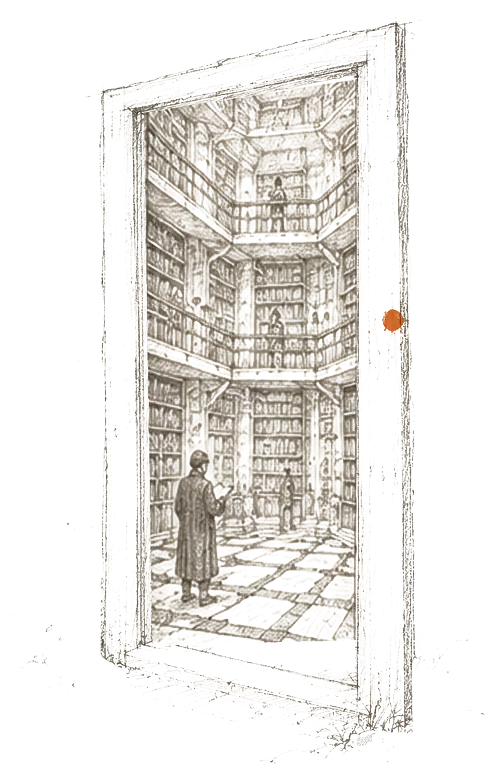
A library of hexagonal galleries holds books drawn from an alphabet of twenty-five signs; the mention of a country missing from an encyclopedia opens an inquiry; Pierre Menard sets out to reproduce the Quixote; Ireneo Funes, after an accident, can no longer forget anything; a man condemned to death awaits his execution.
Timeline
- 1872–1879The gauchoMartín Fierro builds a national mythology on a deserter.
- 1900–1930Cosmopolitan Buenos AiresImmigration, tango, a capital that believes itself European.
- 1940–1970Borges, Cortázar, BioyArgentine fiction becomes a laboratory of thought.
- 1976–1983DictatorshipThirty thousand disappeared. Literature writes with that hole in it.
Reading keys
- The Spanish usage of two surnames applies, but Argentine practice often reduces it to the father's name.
- Italian, Spanish, German, Central European Jewish, Arab and Welsh names bear witness to the waves of migration, and a surname places a generation of arrival.
- Classical formal address has disappeared in favour of vos, a form proper to the Río de la Plata, and its use in a dialogue signals the origin.
- The word che, an interjection of address, and lunfardo, a slang mixed with Italian, are social and regional markers.
- The dictatorship from 1976 to 1983, its thirty thousand disappeared and the stolen children are the central subject of production since 1983.
- Peronism has divided the country since 1945 and every narrative takes a position on it, including by not speaking of it.
- The military campaigns against the indigenous peoples at the end of the nineteenth century are a subject long absent from the textbooks.
- Psychoanalysis is a very widespread practice, and a character in analysis is not a sick character.
- Catholicism is in the majority, with a moderate practice and one of the largest Jewish communities on the continent.
- The cult of the civil dead is intense: Gardel, Evita and Maradona have shrines, and one speaks to the deceased.
- La Difunta Correa, a woman who died of thirst and whose child survived at her breast, receives offerings along the roads.
- The cult of the Gauchito Gil, an executed bandit venerated by drivers, is signalled by red rags at the roadside.
- The wake is held in a hired room, and the burial follows within twenty-four hours.
- Mate, an infusion shared from the same gourd with a common straw, is passed in a precise order: refusing one's place is an offence.
- The asado, meat grilled on Sunday, is a social rite whose organisation states the family hierarchy.
- 24 March, the day of memory of the 1976 coup, has been a public holiday since 2006.
- Martín Fierro, a gaucho forcibly enlisted and become a deserter, is the national poem that every Argentine has read at school.
- The gaucho, his solitude and his guitar, form a stock of images that urban literature summons while deconstructing it.
- La Difunta Correa, the Gauchito Gil and the Pombero of the north-east are the figures of the popular stock.
- The Mapuche and Tehuelche narratives, collected at the beginning of the twentieth century with the names of stars and the myths of the Southern Cone, form the documented indigenous corpus.
- Argentina is not a country without an indigenous population: Mapuche, Qom and Wichí live there, and their invisibility is the product of a policy.
- The tango was not originally an elegant ballroom dance: it was born in the outskirts and the brothels, and was ennobled in Paris before being ennobled in Buenos Aires.
- Mate is not a drink but a rite of sharing, and refusing it is legible.
- Borges is not an author detached from politics: his positions were debated all his life and still are.
Tales and mythologies 1
- TaleMapuche and Tehuelche Narratives of PatagoniaRelatos mapuche y tehuelcheAnonymous · 1998Tehuelche creation narratives and a Mapuche myth of the flood, from one end of Patagonia to the other.Literature
A selection to begin with 10 / 98
- PoetryThe Gaucho Martín FierroEl gaucho Martín FierroJosé Hernández · 1872Forcibly conscripted to guard the frontier, a gaucho deserts and finds only an empty house.LiteraturePublic domain
- NovelThe Seven MadmenLos siete locosRoberto Arlt · 1929A clerk accused of embezzlement joins a secret society that is to be financed by brothels.LiteraturePublic domain
- NovelRosa at Ten O'ClockRosaura a las diezMarco Denevi · 1955A boarding house in Buenos Aires, a shy painter, love letters, and five witnesses who each tell their own version.Literature
- NovelZamaAntonio Di Benedetto · 1956A Crown official waits in Paraguay, for years on end, for the post that would bring him closer to the capital.Literature
- Short storiesLas armas secretasJulio Cortázar · 1959not translated into EnglishFive stories, most of them in Paris, in which a letter, a photograph or an appointment opens onto something else.Literature
- CinemaDar la caraJosé A. Martínez Suárez · 1962Three young men just out of the barracks, and the paths they take.Cinema
- CinemaMan on Pink CornerHombre de la esquina rosadaRené Mugica · 1962On the night of the centenary, in a suburb celebrating, a man who has been pardoned comes to challenge the most feared knife in the neighbourhood.Cinema
- CinemaOdd NumberLa cifra imparManuel Antín · 1962A couple who have taken refuge in Paris receive letters that speak in the present tense of a dead brother.Cinema
- CinemaChronicle of a Boy AloneCrónica de un niño soloLeonardo Favio · 1965An eleven-year-old boy moves between the reformatory and the shantytown where his mother lives.Cinema
- CinemaThe Official StoryLa historia oficialLuis Puenzo · 1985A history teacher, at the end of the dictatorship, begins to doubt the origin of her adopted daughter.Cinema