Denmark
- works
- 70
- 33 books · 37 films
- period covered
- 1208–1998
- language of writing
- Danish
In 1981, an employee emptying a cupboard at the Dikemark psychiatric hospital, near Oslo, found boxes of film there. They contained the version Carl Th. Dreyer had wanted of his 1928 film about Joan of Arc, whose negative had burnt the same year in Berlin. The reels had been sent from Copenhagen to the establishment's chief physician and nobody had opened them. Dreyer had died thirteen years earlier believing his edit lost.
Read moreShow less
This country is used to losing pieces. Norway escapes it in 1814, Schleswig in 1864, the Danish West Indies are sold to the United States in 1917, Iceland detaches itself in 1944, and Greenland remains. At each amputation the response was the same, to cultivate the interior: folk high schools, collective singing, language held to be the bond of the nation, a programme of which Grundtvig is the name. A language read by six million people compels reliance on translation, and explains why a set of tales and a film-maker carried the country further than its novelists.
The Danish form lies in the face and in the exact word. Dreyer filmed his trial in close-ups, on sets one hardly sees, and he took up again in 1955 Ordet, a play first staged in 1932 by Kaj Munk, pastor and dramatist, whom a German commando abducted and shot in January 1944. The price is paid in departures. Herman Bang, pursued by press campaigns about his homosexuality, died in 1912 during a lecture tour in the United States, and Karen Blixen first published in English under a man's first name. Lars von Trier, whose Breaking the Waves came out in 1996, had co-signed the previous year a manifesto forbidding sets, added music and the director's name in the credits.
What awaits the reader is an irony that gives no warning, short books and a cruelty held at a distance by the politeness of the sentence. The tale that opens this page appeared in 1837, alongside The Emperor's New Clothes, and a statue in Copenhagen harbour has made its heroine the emblem of the city.
A way to begin
The Little Mermaid
Hans Christian Andersen · 1837
A daughter of the sea king pays with her voice for the wish to join humankind: one of Andersen's most famous tales, free of rights.
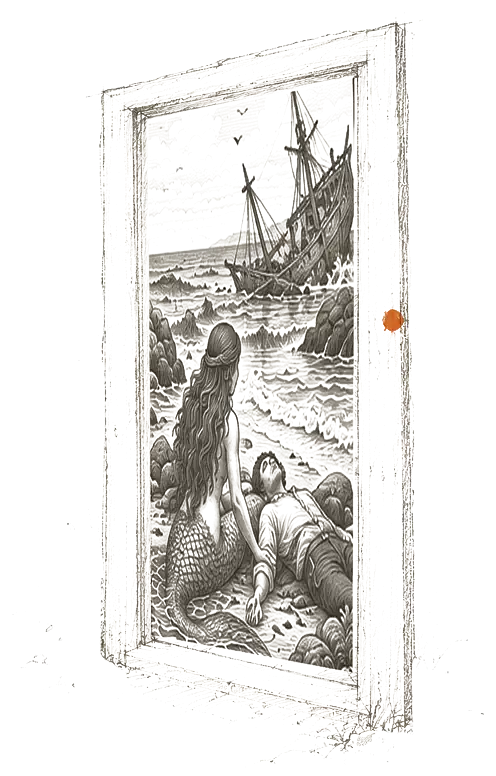
The youngest of the sea king's daughters waits for her fifteenth birthday to rise to the surface. She sees a festive ship, a prince, then the storm: she pulls him from the water and lays him on a beach without his knowing who saved him. To live among humans and win an undying soul, she sells her voice to the sea witch; every step will be like walking on blades.
Timeline
- 1835–1875AndersenThe tales travel the world and change the idea of childhood.
- 1843KierkegaardExistential philosophy is born in Copenhagen, under pseudonyms.
- 1920–1955DreyerAn austere and towering filmmaker, from Joan of Arc to Ordet.
- 1995–2005Dogme 95Von Trier and Vinterberg impose rules in order to recover truth.
Reading keys
- Surnames in -sen, Andersen, Jensen, Nielsen, are filiation names frozen in 1828 and then made hereditary, so that they say nothing more about the father and a few dozen names cover a large part of the population.
- The first name is the ordinary unit of designation, including towards a superior, and formal address has practically disappeared from use.
- Reconstituted families and children born outside marriage have been ordinary since the nineteen seventies, and a novel does not make a subject of them.
- The wife's name may be combined with the husband's by a hyphen, a bourgeois usage that places a character socially.
- The German occupation from 1940 to 1945, the government's cooperation and the rescue of the Danish Jews in 1943 form an ensemble in which every text takes a position through its omissions.
- Greenland is an open and painful subject: colonial status until 1953, displacements of population, children sent to Denmark, imposed sterilisations.
- Immigration and the laws on foreigners have occupied public debate for twenty-five years, and a position on that point classifies an author.
- The dominant tone is irony and understatement; enthusiasm and self-assertion pass for vulgarity, which the law of Jante names without indulgence.
- The Lutheran Church is a state Church, financed by a tax, with weak practice and high membership: one goes there for baptisms, confirmation and funerals.
- Grundtvig's movement made language, singing and the folk high school into a national Christianity, which explains the weight of the hymn book in common culture.
- Popular narratives are peopled with trolls, elves and dead who come back, and Saxo Grammaticus preserved around 1200 a Danish version of Odin very different from that of the Icelanders.
- Confirmation, at about fourteen, remains a social rite of passage, including in families without faith.
- The flag serves as a table decoration for birthdays and departures, with no political charge, which surprises a French reader.
- Hygge designates a codified way of keeping the light low, the candles lit and the conversation even, and a novel uses it to state the social milieu.
- The Christmas eve of 24 December includes goose or duck, rice pudding with a hidden almond, and a round dance about the tree.
- Funerals are brief and sober, often followed by coffee in the parish hall, and the expression of grief remains contained there.
- Andersen's tales are the densest common reference, with their unhappy endings that the versions for children erase.
- Svend Grundtvig established between 1853 and 1976 the edition of the Scandinavian ballads, the base of the songs that texts quote with a single line.
- Saxo's Deeds of the Danes, around 1200, provides the story of Amleth that Shakespeare took up, which makes Hamlet a Danish character before being an English one.
- Nexø's novel about a young worker come from Sweden, published from 1906, is the reference of the social narrative, brought to the screen in 1987.
- Denmark is not the whole of Scandinavia: it was the colonial power over Norway, Iceland and Greenland, and that position is legible in the texts of the other three.
- Andersen does not write for children: his tales have a spoken language, a social irony and cruel endings.
- Politeness and evenness of tone do not mean the absence of hierarchy, but its maintenance by other means.
- The word social democracy designates here a historical compromise between employers and unions, not a simple party label.
- A national cinema with such a place in the festivals rests on public financing and a country of fewer than six million inhabitants, which explains the circulation of the same actors from one film to another.
Tales and mythologies 1
- ChronicleGesta Danorum: The History of the DanesGesta DanorumSaxo Grammaticus · 1208A Latin chronicle in sixteen books, half pagan legends and half Christian history, written to give the kingdom a past as ancient as that of Rome.Literature
A selection to begin with 10 / 70
- PoetrySang-Værk til den Danske KirkeNikolai Grundtvig · 1837A pastor wants to give the Danish Church a living song again, by letting all the voices of Christendom be heard in its own language.Literature
- NovelKatinkaVed VejenHerman Bang · 1886A small provincial railway station, a woman with nothing to do all day, and a narrative that shows instead of explaining.LiteraturePublic domain
- NovelThe Pilgrim KamanitaDer Pilger KamanitaKarl Adolph Gjellerup · 1906A Buddhist legend written in German by a Dane, sixteen years before Hermann Hesse's Siddhartha.LiteraturePublic domain
- Short storiesBabette's FeastKaren Blixen · 1950A parable about what a gift costs, in a community that has promised itself in advance to take no pleasure in it.Literature
- CinemaThe WordOrdetCarl Th. Dreyer · 1955Two ways of believing clash between two farming households, filmed in shots so long that there is time to enter into them.Cinema
- CinemaHungerSultHenning Carlsen · 1966A northern city at the end of the century, a man who does not eat and who will ask for nothing, and a camera that stays with him from beginning to end.Cinema
- CinemaThe Perfect HumanDet perfekte menneskeJørgen Leth · 1968A white room, two bodies observed as in a laboratory: Denmark of the late sixties put on display.Cinema
- CinemaBallad of Carl-HenningBalladen om Carl-HenningSven and Lene Grønlykke · 1969A village in the marshes of Sønderjylland, and a boy too naive for what life has in store for him.Cinema
- CinemaBreaking the WavesLars von Trier · 1996A rigorist community on the Scottish coast, closing itself off from the world, and a woman who mistakes her desire for a duty.Cinema