Gambia
- works
- 9
- 9 books
- period covered
- 1965–1988
- language of writing
- English
In 1977, a Gambian village became a place of American pilgrimage. An African American writer had traced his genealogy back to an ancestor abducted on this bank of the river in the eighteenth century, and his narrative, adapted for television, was followed by tens of millions of people. Since then, visitors have come to Juffureh looking for the trace of a family whose name, Kinteh, is also that of a line of griots. Historians have contested the soundness of that genealogy. The village, for its part, still receives them.
Read moreShow less
The episode says something about a particular position. The Gambia is a country that follows a river inside another country, cut out by an absurd colonial border between a British colony and the French empire, so that the same population, Mandinka, Wolof, Fulani, finds itself on both sides with two different official languages. The country writes in English and thinks in Mandinka, and it shares the whole of its cultural stock with its neighbour without sharing its administration. One and the same family may have a cousin who writes in English and another in French.
The dominant form is brief, and often the work of people who practised another profession. Lenrie Peters was a surgeon and published in 1965 his only novel, about a young doctor who returns to Freetown after studies in England. Ramatoulie Kinteh published in 1968 a play about a chief's daughter who refuses the husband her parents have chosen. Ebou Dibba recounted in 1986 the colonial Gambia of the nineteen thirties from London. The price is invisibility: these books appear in London, are little read, and a country with no publishing house and no review has no literary life of its own, only scattered authors.
What awaits the reader is a sober prose and a constant theme, that of return and of the place one does not find again. The novel that opens this page follows the return to Freetown of a young doctor trained in England, and its author, a surgeon, wrote no other.
A way to begin
The Second Round
Lenrie Peters · 1965
The only novel by a Gambian surgeon: a young doctor trained in England returns to Freetown.
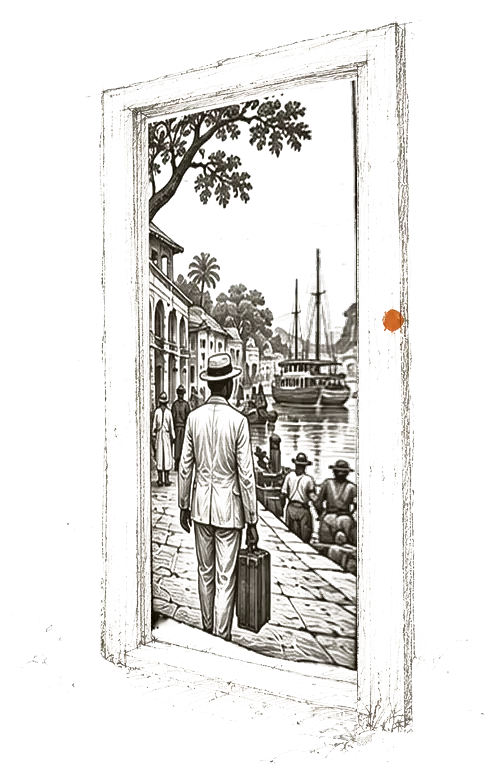
In the aftermath of Sierra Leone's independence, young Dr Kawa, who studied in England, comes back to settle in Freetown, the town of his childhood, confident in his future and the country's. He falls for a girl whose infidelity he discovers, then lets himself be seduced by his neighbour's wife, and finds himself drawn into other people's troubles.
Timeline
- 1966Two beginningsLenrie Peters publishes the first Gambian novel; Ramatoulie Kinteh writes for the stage.
- 1981–1986The next generationSwaebou Conateh, Ebou Dibba. The Gambia is also written from London.
- 1987–1988Poetry and chronicleNana Grey-Johnson, Tijan Sallah. The literature of a small country.
Reading keys
- Names are the same as in Senegal: Kinteh, Jobarteh, Diallo, Sanneh, with English transcriptions instead of French ones. Kinteh and Kanté are the same name.
- The griots, called jali, form a hereditary caste of speech, and the Jobarteh, Kouyaté and Sissoho belong to it.
- Joking kinship between lineages authorises ritual insult and forbids conflict.
- Polygamy is frequent and relations between co-wives are a narrative device.
- The regime of Yahya Jammeh, from 1994 to 2017, with its disappearances and its witch hunts, is a recent and heavy subject.
- The question of the authenticity of the genealogy that made Juffureh famous is delicate locally, where it is a source of income.
- Slavery and the role of local societies in the trade are approached with caution.
- Respect for the elders and the delegation of speech to the jali organise public exchanges.
- Islam is very much in the majority, with the Sufi brotherhoods and a small Christian minority.
- The marabout is a healer, a protector and sometimes a political actor, and jujuu designates objects and practices of protection.
- The kankurang, the protective mask of Mandinka boys undergoing circumcision, listed as intangible heritage, comes out during initiations and disperses onlookers.
- The spirits of the river and of the sacred woods have their prohibitions, and one does not enter there.
- Muslim mourning is brief, with burial on the same day and three days of condolences.
- The kankurang, covered with leaves or red bark, appears at initiation periods and its passage requires people to withdraw.
- The kora, a twenty-one-stringed harp-lute played by the jali, accompanies epic narratives and is passed down within the family.
- Ramadan and the Eids order the year.
- The epic of Sunjata and the repertoire of the jali are shared with Mali, Guinea and Senegal, and the kora is its instrument.
- The kingdom of Kaabu, a Mandinka state of the south bank, provides the local narratives of foundation.
- The kankurang and its protocol are a common knowledge that the texts assume is known.
- The memory of the slave trade and of the trading posts of the river, including James Island, is a shared reference.
- The Gambia is not a Senegalese enclave but a distinct state, with a different official language and a different legal system.
- The American narrative that made Juffureh famous is a literary work whose genealogical accuracy is contested by historians.
- The jali is not an entertainment musician but a hereditary professional of memory and mediation.
- The small size of the written corpus is explained by the absence of local publishing, not by the absence of a narrative tradition.
Tales and mythologies 1
- EpicKaabu and Fuladu: Historical Narratives of the Gambian MandinkaAnonymous · 1976Griot epics on the end of the Mandinka domination born of the Mali empire, on the Atlantic coast of Africa.Literature
A selection to begin with 7 / 9
- TheatreRebellionAugusta Jawara · 1968A play published under a pen name, in a Gambia where few women had yet published a book.Literature
- TheatreThe Trial of BusumbalaGabriel J. Roberts · 1970The trial over the theft of an overloud radio set, at the heart of a Gambian school, in a play written for radio.Literature
- EpicKelefa Saane: His Career Recounted by Two Mandinka BardsAnonymous · 1978The epic of a hero of Kaabu who came to the aid of the king of Niumi, sung by two Mandinka griots.Literature
- PoetryGreat Wrinkles Up the Sky's SleeveSwaebou Conateh · 1981First collection by a pioneer of Gambian journalism, who also edited the country's first literary magazine.Literature
- NovelChaff on the WindEbou Dibba · 1986The first novel of a Gambian settled in England, which brings back to life the colonial town as it was before his birth.Literature
- Short storiesA Krio Engagement and Other StoriesNana Grey-Johnson · 1987The first book by a Gambian journalist, published under a pseudonym and regarded as the first short story collection to appear in Gambia.Literature
- Short storiesBefore the New EarthTijan Sallah · 1988First volume of stories by a Gambian poet turned economist, published in Calcutta.Literature