Guinea (Conakry)
- works
- 17
- 14 books · 3 films
- period covered
- 1825–1997
- language of writing
- French
On 28 September 1958, a single African territory voted no. Guinea refused to enter the French Community and became independent within days. France withdrew taking what it could, and the country began its existence in immediate isolation. Five years earlier, a young man from Conakry had published in Paris the narrative of his Malinke childhood, a limpid book without anger that was to become the most widely read in all francophone Africa.
Read moreShow less
Those two dates frame the literary history of the country. The refusal of 1958 produced a regime that made culture a matter of state, with national ballets, regional orchestras and a policy of promoting the national languages, and that simultaneously set about eliminating those who thought. Fodéba Keïta, author of the first Guinean collection of poems, founder of the Ballets africains and minister of the interior, died in 1969 in camp Boiro, the prison of his own government. Camara Laye went into exile and never returned, and his last book appeared in the year of his death in Dakar.
The dominant form is therefore the novel of oppression written from outside. Alioum Fantouré published in 1972 an allegory of a country governed by a tyrant who is not named, Tierno Monénembo in 1979 a narrative of the dictatorship from exile, William Sassine bitter novels about lost illusions, written by a man who had given up teaching in order to survive. Djibril Tamsir Niane did something else: he collected from a griot of Kela the epic of Sunjata and published it in 1960, offering the whole of West Africa a founding text in French, with the name of the reciter on the first page.
What awaits the reader is a literature of lucid bitterness, in which the hope of independence is examined like a piece of evidence. The narrative that opens this page follows a Malinké childhood in Kouroussa, beside a blacksmith father, and its author, who came into conflict with the regime, ended his life in Senegal.
A way to begin
The Dark Child
Camara Laye · 1953
The childhood narrative that Alain Mabanckou counts among the founding texts of contemporary African literature.
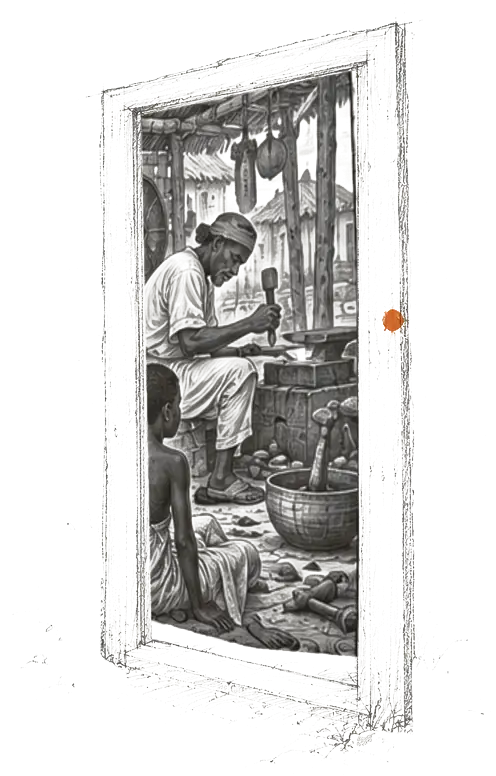
Laye grows up in Kouroussa, in Upper Guinea, beside a father who is a blacksmith and goldsmith, whose work with gold he watches, and a mother to whom the book is dedicated. He discovers the fields at his grandmother's, attends the French school, goes through the rites that make him a man, then leaves to study in Conakry, until the possibility of France opens up.
Timeline
- 1950–1953First voicesFodéba Keïta, Camara Laye's The African Child, and Mouramani in cinema.
- 1960SundiataDjibril Tamsir Niane writes down the Mandinka epic.
- 1973–1979A generation in exileSassine, Alioum Fantouré, Monénembo. Writing against Sékou Touré.
- 1980–1990Cinema and returnBarry Sékou Oumar, Moussa Kémoko Diakité, Boubacar Diallo.
Reading keys
- Names indicate the group and often the caste: Camara, Keïta, Kouyaté, Condé for the Malinke area, Diallo, Bah, Barry, Sow for the Fulani area of the Fouta Djallon.
- The griots bear names proper to their hereditary function, distinct from those of the nobles.
- The Fulani Fouta Djallon produced a lettered elite writing Pular in Arabic characters, which distinguishes the north from the rest of the country.
- Joking kinship between lineages authorises ritual insult and forbids conflict.
- Camp Boiro and the disappearances under the regime from 1958 to 1984 are the central and long forbidden subject of this literature.
- The permanent plot, invoked by the authorities to justify arrests, produced a mistrust that the novels stage.
- Rivalries between groups, Malinke, Fulani and Susu, are a politically sensitive subject.
- The respect due to the elders and the delegation of speech to the griot organise dialogues.
- Islam is very much in the majority, with the Sufi brotherhoods and, in the Fouta Djallon, a tradition of scholars and old Quranic schools.
- The old cults survive in the forest, with the initiatory societies and the masks of the Kissi, Toma and Guerze country.
- The nimba masks and the Baga initiation figures of the coast are religious objects that have become museum pieces.
- The nyama, forces released by death or transgression, are dangerous, and the blacksmith-diviner knows how to handle them.
- Muslim mourning is brief, with burial on the same day, condolences for three days and a prayer on the fortieth.
- The masks of the forest come out during initiations, on dates that are not public.
- The balafon, a xylophone whose Mandinka tradition goes back to the empire of Mali, accompanies epic narratives.
- 2 October, the day of independence in 1958, is the civil landmark.
- The epic of Sunjata, collected from the griot Mamadou Kouyaté and published in 1960, is the founding Mandinka text shared with Mali.
- The sacred balafon of Sosso, kept at Niagassola, is an object of memory listed as intangible heritage.
- The narratives of the Fouta Djallon, written in Pular ajami, form a distinct lettered corpus.
- The Malinke tales with the hare and the hyena constitute the domestic stock.
- Guinea-Conakry is not to be confused with Guinea-Bissau or with Equatorial Guinea.
- Camara Laye's narrative of childhood was reproached to its author as too peaceful, in a context where a book of denunciation was expected. That reproach is part of its history.
- The regime of 1958 pursued a real and ambitious cultural policy at the same time as a massive repression. Both are true.
- Pular has been written in Arabic characters since the eighteenth century, which contradicts the idea of an area without writing.
Tales and mythologies 2
- EpicSundiata: An Epic of Old MaliSoundjata ou l'Épopée mandingueDjibril Tamsir Niane · 1960At the time of the independences, a young historian sets down in writing the great epic that the griots of Manding passed on by word of mouth.Literature
- ChronicleChroniques et récits du Foûta DjalonAnonymous · 1968not translated into EnglishA century and a half before the French conquest of 1896, Fula scholars found a Muslim state and keep its annals in their own language.Literature
Available in English 2
The books from this country that can be read in English, in the original or in translation.
- NovelThe Dark ChildL'Enfant noirCamara Laye · 1953A young Guinean, a worker by day and a student in the evening in Paris, writes the story of his childhood.Literature
- NovelTropical CircleLe Cercle des tropiquesAlioum Fantouré · 1972Twelve years after independence, an exiled Guinean economist draws the portrait of an African dictatorship.Literature
A selection to begin with 10 / 17
- PoetryAube africaineFodéba Keïta · 1965not translated into EnglishA Guinean poet, founder of a dance troupe that became the national company, tells in verse the story of Africa under colonisation.Literature
- TheatreAmazoulouCondetto Nénékhaly-Camara · 1967not translated into EnglishA Guinean historical drama on the great Zulu sovereign, written in the years of independence.Literature
- DocumentaryAnd Then Came FreedomEt vint la libertéSékoumar Barry · 1969Ten years after the no of 1958, Sékou Touré's regime entrusts a young filmmaker of the state service with the film marking the independence jubilee.Cinema
- NovelTropical CircleLe Cercle des tropiquesAlioum Fantouré · 1972Twelve years after independence, an exiled Guinean economist draws the portrait of an African dictatorship.Literature
- NovelChaîneSaïdou Bokoum · 1974not translated into EnglishAn African student adrift in the French capital, in the early seventies.Literature
- NovelLe Jeune Homme de sableWilliams Sassine · 1979not translated into EnglishGuinea has lived under the dictatorship of Sékou Touré for more than twenty years, and its writers publish from exile.Literature
- CinemaNaitou (l'orpheline)NaïtouMoussa Kémoko Diakité · 1982Guinea's state studio entrusts a folk tale to the dancers of the national company.Cinema
- NovelD'un Fouta-Djalloo à l'autreSirah Baldé de Labé · 1985not translated into EnglishA year after the end of Sékou Touré's regime, a schoolteacher from the Fouta publishes in Paris the first novel signed by a Guinean woman.Literature
- NovelLes Écailles du cielTierno Monénembo · 1986not translated into EnglishIn exile since 1969, a Guinean novelist tells of the hope of the independence years and of what became of it.Literature
- Feature filmDakanMohamed Camara · 1997In a West Africa where homosexuality remains taboo, a Guinean filmmaker makes it the subject of a feature film.Cinema