Senegal
- works
- 41
- 22 books · 19 films
- period covered
- 1886–1999
- language of writing
- French and Wolof
Ousmane Sembène stopped writing novels because those he was speaking about could not read them. A docker in Marseille and self-taught, he published in 1960 a great book about the strike of the Dakar-Niger railwaymen, then noted that his real audience was in Europe. He went off to learn cinema in Moscow and directed in 1963 a short film about a Dakar cart driver who loses his cart. The reasoning was simple: in a country where the majority do not read French, the image speaks and the book excludes.
Read moreShow less
That calculation explains Senegal's singular position. The country produced both a poet who became president and a member of the Académie française, and the founding film-maker of the whole of sub-Saharan Africa, and the two embodied two opposite answers to the same question: what to do with the coloniser's language. Senghor chose to inhabit it to the end, Sembène to go around it, and the country produced enough schools and reviews for the two paths to coexist. Between them settled Cheikh Hamidou Kane, who wrote the tearing apart of the Quranic school pupil sent to the French school, and Birago Diop, who set down in writing the tales of a griot.
The dominant form is therefore double, and cinema there is an art of speech as much as of the image. Djibril Diop Mambéty filmed in 1973 two young people who dream of Paris on a motorbike with zebu horns, with an editing that obeys no rule. Safi Faye, the first woman director of sub-Saharan Africa, filmed her own village in 1975. Mariama Bâ published in 1979 the letter of a widow to her friend, which is also a trial of polygamy. The price: Sembène was censored, and his film about the massacre of riflemen by the French army in 1944 remained invisible in France for a long time.
What awaits the reader is a literature of addressed speech, made of letters, reported narratives and pleadings. The novel that opens this page is a widow's letter to her childhood friend, written during the seclusion of mourning, and it won the first Noma Prize.
A way to begin
So Long a Letter
Mariama Bâ · 1979
A Dakar widow's letter to her childhood friend: a short novel, winner of the first Noma Prize, on Senegal's school syllabus.
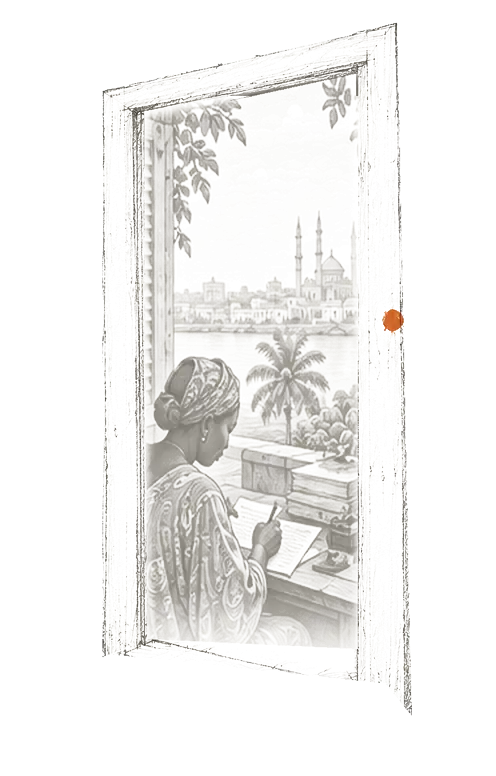
Ramatoulaye, a schoolteacher in Dakar, has just lost her husband, who had abandoned her to marry in secret a classmate of their daughter. During the seclusion of mourning she writes to her childhood friend Aïssatou, who left for the United States after divorcing rather than remain in a household turned polygamous. She tells of their youth and their marriages, then of the suitors who appear as soon as mourning ends.
Timeline
- 1930–1960NegritudeSenghor, with Césaire and Damas, invents in Paris a movement that changes Africa.
- 1956–1970Novel of decolonisationOusmane Sembène, Cheikh Hamidou Kane. Writing the in-between.
- 1963–1980Birth of African cinemaSembène turns to the camera to reach those who do not read.
- 1979–1990Women's voicesMariama Bâ, Aminata Sow Fall. Speech changes sides.
Reading keys
- Names, Diop, Ndiaye, Fall, Sow, Bâ, refer to lineages and sometimes to a caste. Fulani and Wolof names are not to be confused.
- The sinankunya, joking kinship between lineages, authorises ritual insult and forbids real conflict.
- The castes of griots, blacksmiths and cobblers survive and weigh on marriages.
- Polygamy is legal and frequent, and relations between co-wives are a major narrative device, with a precise vocabulary for each position.
- The massacre of Senegalese riflemen by the French army at Thiaroye in 1944 is a subject long censored and now central.
- Polygamy and the condition of wives have been stated head-on by women writers since 1980, which was a rupture.
- The beggar, the talibé entrusted to a Quranic master, and obligatory almsgiving are realities that the novels examine.
- Restraint is valued: kersa, modesty, forbids exposing one's feelings, and a character who complains loses face.
- Sufi Islam dominates, structured by powerful brotherhoods, Mouride and Tijani, whose founders are the object of devotion and whose holy cities organise the calendar.
- The marabout is at once a spiritual guide, a healer and an economic and political actor. He is not a folkloric character.
- The rab, ancestral spirits of the Lebou and Serer stock, are treated by rituals of possession, the ndëpp, which coexist with Islam.
- A Christian minority, including Senghor, occupies a disproportionate place among the intellectual elites.
- Muslim mourning is brief, with burial on the same day, condolences for three days and prayers on the fortieth.
- Widowhood imposes on the woman a seclusion, the ërr, of four months and ten days, which several novels describe.
- The boubou and the quality of its cloth indicate rank and occasion, and the sabar, festival drum, marks ceremonies.
- The Magal of Touba and the Gamou of Tivaouane gather millions of people and set the whole country in motion.
- The tales of Amadou Koumba, set down in writing by Birago Diop in 1947 after a griot, are the narrative stock that every Senegalese has read at school.
- Leuk the hare and Bouki the hyena form the pair of Wolof tricksters, one cunning and the other greedy.
- Kocc Barma, a Wolof sage of the seventeenth century, is quoted for his maxims as one would quote La Fontaine.
- Cheikh Amadou Bamba, founder of Mouridism, and his single photograph are an omnipresent visual reference.
- The marabout is not a charlatan: he is a religious leader whose authority is social, economic and sometimes political.
- The polygamy described in the novels is not an exoticism but a legal framework in force, with its strategies and its sufferings.
- French is the mother tongue of almost nobody: Wolof dominates daily life, and a dialogue in French in a novel is a particular situation.
- Senghor is in France a consensual figure and in Senegal a disputed one, including for his cultural policy.
Tales and mythologies 1
- TaleTales of Amadou KoumbaLes Contes d'Amadou KoumbaBirago Diop · 1947The Wolof villages and the Sahelian bush, as a veterinarian on his rounds heard them told in the evening by the griots.Literature
A selection to begin with 10 / 41
- PoetryHammer BlowsCoups de pilonDavid Diop · 1956Poems of anger and hope, struck like pestle blows: the most militant voice of Négritude.Literature
- NovelAmbiguous AdventureL'Aventure ambiguëCheikh Hamidou Kane · 1961The country of the Diallobé, on the banks of the Senegal River, at the moment when the French school wins over the children of the families who hold to the faith.Literature
- Short filmBorom SarretOusmane Sembène · 1963Dakar in the aftermath of independence, where the colonial city has kept its boundaries and where the small trade no longer feeds the man who plies it.Cinema
- NovelThe WoundLa PlaieMalick Fall · 1967A vagrant and his wound in the streets of Saint-Louis: a novel of marginality, between cruelty and comedy.Literature
- Feature filmTouki BoukiDjibril Diop Mambéty · 1973The Dakar of 1973, where leaving for France is at once an everyday dream and an undertaking that has to be financed.Cinema
- NarrativeA Dakar ChildhoodDe Tilène au Plateau, une enfance dakaroiseNafissatou Niang Diallo · 1975A Dakar childhood of the forties and fifties, told by the woman who lived it, between the working-class district where she was born and the streets of the colonial centre.Literature
- NovelThe Beggars' StrikeLa Grève des bàttuAminata Sow Fall · 1979Driven out of an African capital that the authorities want to make presentable to travellers, the beggars stop begging, in a country where almsgiving is a religious obligation.Literature
- Short filmLe Certificat d'indigenceMoussa Yoro Bathily · 1981A destitute mother looks for the paper that would allow her to have her child treated, and discovers what the administration demands of those who own nothing.Cinema
- Feature filmJomAbabacar Samb-Makharam · 1981A griot links the strike at a Dakar factory to older acts of resistance, around a Wolof word that expresses dignity held and the refusal to sell oneself.Cinema
- Feature filmCamp de ThiaroyeThierno Faty Sow and Ousmane Sembène · 1988December 1944, in a transit camp near Dakar: riflemen back from Europe await their pay and their demobilisation, and the army they served meets them with different accounts.Cinema