Ghana
- works
- 14
- 11 books · 3 films
- period covered
- 1911–1988
- language of writing
- English
On 27 August 1963, an old man died in Accra. William Du Bois, an African American sociologist, was ninety-five and had renounced his American nationality in order to come and settle in Ghana, at Nkrumah's invitation. He is buried there. Maya Angelou lived there, Malcolm X passed through, writers from the Caribbean and the United States worked there. The first independent country of sub-Saharan Africa, in 1957, Ghana wanted to be the capital of a black world in the process of reconstituting itself, and it financed congresses, reviews and scholarships to that end.
Read moreShow less
That position has an ancient depth. The Ashanti kingdom stood up to the British until 1901 with a political organisation elaborated around the golden stool, and it had developed the adinkra symbols, the gold weights and a repertoire of proverbs serving as a code. The country is also the one from which the ships left: the forts of the coast, Elmina, Cape Coast, are the places from which millions of people were embarked, and they today receive the descendants of those who left them, come to look for a door that is called the door of no return.
The dominant form is lucid disenchantment. Ayi Kwei Armah published in 1968 a novel in which an honest employee is crushed by ordinary corruption, ten years after independence, and the book shocked by its darkness. Ama Ata Aidoo wrote in 1970 a play in which a woman refuses an arranged marriage and finds herself mixed up in the slave trade. Efua Sutherland had founded a national theatre conceived to be performed outdoors, in a device borrowed from the tale. The price was an avowed disillusion: those authors wrote against the regime that had welcomed Du Bois.
What awaits the reader is a demanding prose, often bitter, that refuses to celebrate the independence it comes from. The novel that opens this page takes as its title, spelling mistake included, an inscription painted on a bus: the beautyful ones are not yet born.
A way to begin
The Beautyful Ones Are Not Yet Born
Ayi Kwei Armah · 1968
A railway clerk refuses the corruption that has spread through the whole country, in the last months of Nkrumah's regime.
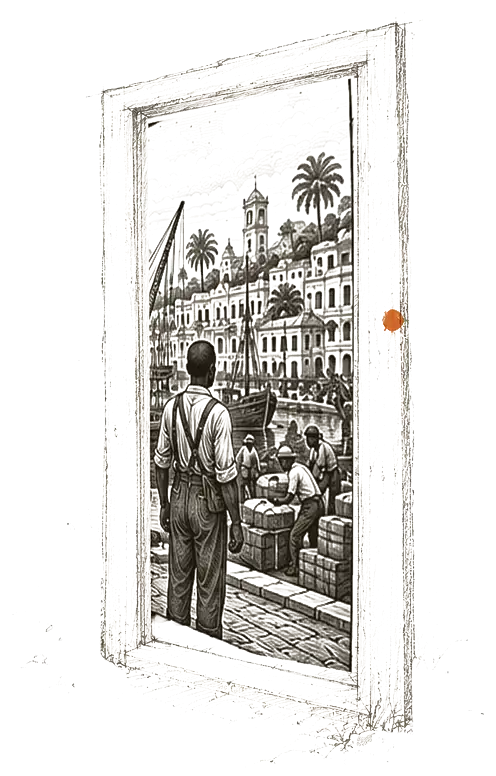
Ghana, 1965. A railway clerk, whom the novel does not name, refuses a bribe from a timber merchant, while everyone around him lets himself be bought. His wife, Oyo, reproaches him for an honesty that deprives their children of comfort. A former schoolmate, Koomson, now a minister, comes back into their lives with a fishing-boat deal.
Timeline
- 1952–1966IndependenceThe first Ghanaian film; Sutherland, Awoonor, Selormey.
- 1968–1970DisillusionArmah and Ama Ata Aidoo write the aftermath of Nkrumah without mercy.
- 1981–1988Ghanaian cinemaKwaw Ansah films in Accra; Akomfrah films the diaspora in London.
Reading keys
- Among the Akan, the first name indicates the day of birth: Kwame was born on a Saturday, Kofi on a Friday, Ama on a Saturday. Nkrumah was called Kwame, so born on a Saturday.
- Akan societies are matrilineal: inheritance and the lineage name pass through the mother, and the maternal uncle has authority over his sister's children.
- The stool is the seat of power and of the soul of a lineage. To hold a chieftaincy is said to be "occupying the stool".
- Krobo, Ewe and Dagomba names differ from Akan names and immediately place a character.
- Post-independence corruption is the great subject, treated head-on since 1968, which earned Armah a reputation for bitterness.
- The participation of local societies in the Atlantic slave trade is addressed by Aidoo and remains uncomfortable.
- The successive coups from 1966 to 1981 form a background that the narratives assume is known.
- The palabre and mediation by a spokesman, the chief's okyeame, organise public speech: one does not address a chief directly.
- Christianity is in the majority in the south, Islam in the north, and the Akan and Ewe cults are practised beneath both.
- Nyame is the sky god, the abosom divinities attached to places and rivers, the nsamanfo the ancestors. A libation is poured to them before any important meeting.
- The mmoatia, little people of the forest, and Sasabonsam, monster of the trees, belong to the Ashanti stock.
- The adinkra symbols, printed on mourning cloths, each carry a proverb and are read.
- Red and black are the colours of mourning, worn at funerals, while white marks the victory over death and the anniversary of an old death.
- Funerals are the major social event, announced by posters, with gifts publicly counted, and may bring together thousands of people.
- Kente, a woven cloth with named patterns, indicates rank and occasion, and each pattern has a name and a meaning.
- The yam festivals and the Ashanti Odwira mark the ritual calendar.
- Ananse the cunning spider is the central trickster, and the seventy-five Akan tales collected in 1930 in Twi and in English form the documented corpus. It is from there that the Jamaican Anansi and the Surinamese Anansi-tori come.
- The Akan proverbs, more than eight hundred published as early as 1916, are used as arguments in a conversation.
- The golden stool, come down from the sky according to tradition and never placed on the ground, is the central political object of the Ashanti.
- The adinkra symbols and their proverbs are a common knowledge that the texts assume is legible.
- Akan societies are matrilineal, which entirely changes the reading of family relations: the father does not have the rights a French reader assumes for him.
- Sumptuous funerals are not a contradiction of mourning: they are its form, and their cost is a frequent narrative stake.
- The name of the country comes from a medieval empire situated further north, with no territorial continuity with the present state.
- Ananse is a morally ambiguous character, neither hero nor villain, and reading him as an edifying fable misses him.
Tales and mythologies 1
- TaleAkan-Ashanti Folk-TalesRobert Sutherland Rattray · 1930A colonial administrator who speaks Twi transcribes, over the course of evening gatherings, the tales the Ashanti villagers tell one another.LiteraturePublic domain
A selection to begin with 10 / 14
- TheatreThe BlinkardsKobina Sekyi · 1915A Cape Coast comedy that mocks Africans aping English manners, under colonial rule.Literature
- CinemaThe Boy KumasenuSean Graham · 1952Five years before independence, the cinema of the British colony tells of a village boy's arrival in the big city.Cinema
- PoetryRediscovery and Other PoemsKofi Awoonor · 1964In the early sixties, a young Ghanaian poet renders into English the funeral dirge of his Ewe people.Literature
- PoetrySongs from the WildernessFrank Kobina Parkes · 1965In Nkrumah's Ghana, a poet at the national radio sings the pride of being Black.Literature
- NovelThe Narrow PathFrancis Selormey · 1966Near Keta, a child grows up under the rod of a father who runs the mission schools.Literature
- TheatreForiwaEfua Sutherland · 1967Five years after independence, Ghanaian theatre shows a small town that must reconcile its old customs with new ways.Literature
- NovelThe Strange ManAmu Djoleto · 1967A defiant old man relives a harsh childhood, between Ghana before and after independence.Literature
- TheatreAnowaAma Ata Aidoo · 1970From a Ghanaian legend, a woman playwright draws a play about wealth and the slave trade.Literature
- CinemaLove Brewed in the African PotKwaw Ansah · 1980In Ghana in the eighties, a filmmaker single-handedly finances a feature film about love, class and the colonial legacy.Cinema
- CinemaTestamentJohn Akomfrah · 1988Twenty years after the fall of Nkrumah, an exile returns to Ghana and no longer finds a home there.Cinema