Ivory Coast
- works
- 25
- 16 books · 9 films
- period covered
- 1960–1998
- language of writing
- French
In March 1948, an employee of the colonial administration saw the sky covered with signs. Frédéric Bruly Bouabré drew a mission from it: to give a writing to his language, Bété, which has none. He devised a few hundred pictograms, then spent the rest of his life drawing on small cards the size of a postcard, in coloured pencil, captioning each one with a sentence. He produced thousands of them, today in museums all over the world, and he presented himself not as an artist but as the scribe of a knowledge received.
Read moreShow less
That invention says something about the country. Côte d'Ivoire is a crossroads of peoples and migrations, with some sixty languages, forest in the south and savanna in the north, and a plantation economy that has attracted workers from all the neighbouring countries for a century. Abidjan has become a regional cultural capital, with its publishing houses, its studios and its slang, Nouchi, made by the young people of the neighbourhoods and become a literary language. A third of the country's population was born elsewhere.
The major form is a French reworked from within. Ahmadou Kourouma published in 1968 a novel written in a French thought in Malinke, with its turns of phrase, its proverbs and its rhythm, because he refused to write in a language that was not that of his characters. Bernard Dadié had opened the way by publishing the legends of his country as early as 1954. Cinema followed with the popular comedy of Henri Duparc. The price was paid after 1999: the crisis and the civil war scattered a generation, closed institutions and emptied the cinemas.
What awaits the reader is a French language inhabited by another, with proverbs that interrupt the narrative and an avowed orality. The novel that opens this page follows a Malinké prince ruined by independence, and its title plays on a Malinké word meaning at once sun, day and era.
A way to begin
The Suns of Independence
Ahmadou Kourouma · 1968
A Malinké prince ruined by independence, in a French bent to the syntax of Malinké: Ahmadou Kourouma's first novel.
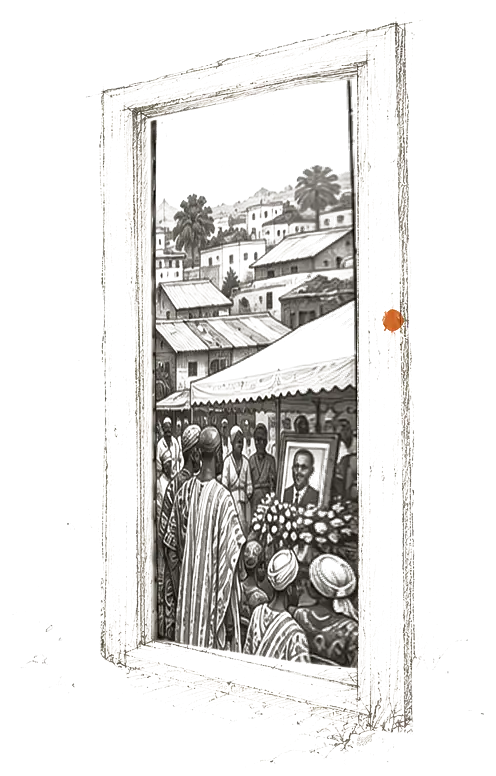
In the aftermath of independence, in the capital of a West African country, Fama Doumbouya, last descendant of a line of Malinké princes, has nothing left of his rank. He goes round the funerals of the big city offering his services and collecting a few alms. Salimata, his wife, bears the wound of a violated youth and the sorrow of having been unable to give him a child.
Timeline
- 1954–1960First authorsBernard Dadié, Aké Loba. Tales, the novel, and colonial prison.
- 1968KouroumaThe Suns of Independence twists French to let Malinke in.
- 1961–1981Birth of cinemaJean Rouch films in Abidjan; Kramo-Lanciné Fadika takes over.
- 1976–1986The Abidjan generationAdiaffi, Véronique Tadjo, Tanella Boni, Zadi Zaourou.
- 1985–1988Ivorian cinemaDésiré Écaré, Sidiki Bakaba, Duparc, Gnoan M'Bala. Four very dense years.
Reading keys
- The name indicates the group: Kourouma and Coulibaly for the Mandinka area of the north, Adiaffi and Aké for the Akan area of the east, Zadi and Bouabré for the Kru area of the west.
- The Akan societies of the east are matrilineal, those of the north and the west mostly patrilineal. The system determines who inherits.
- Joking kinship between groups authorises ritual insult and prevents conflict.
- The name may also indicate an old foreign origin, Burkinabe, Malian or Guinean, which has been a major political stake.
- The question of ivoirité, a criterion of national belonging used from the nineteen nineties, and the civil war that followed are the most sensitive subjects.
- Relations between indigenous populations and migrants in the plantation zones are an old and raw subject.
- The regime of Houphouët-Boigny, from 1960 to 1993, was hardly open to public criticism, which pushed towards allegory.
- Nouchi, the slang of the neighbourhoods, is a strong social marker and its use in a text is a position taken.
- Islam in the north, Christianity in the south, ancestral cults everywhere beneath them.
- The masks of the Dan, We and Senufo country are beings and not objects: they dance, speak and judge, and their coming out suspends the ordinary order.
- The Senufo poro and the initiatory societies of the north form political as much as religious institutions.
- The komian, an Akan diviner-healer, and the fetish priests are ordinary characters in the narratives.
- Funerals take place in two stages and the second ceremony commits the extended family to several years of savings.
- The Dan and We masks, carved and costumed, appear at funerals and at judgements.
- The Baoulé loincloth and woven cloth indicate rank and occasion, and the loincloth given as a gift seals alliances.
- The yam festivals of the east and the Baoulé Paquinou, the return to the village at Easter, structure the year.
- The legends collected and rewritten by Bernard Dadié from 1954, including Spider the ingenious, are the stock that every Ivorian schoolchild knows.
- Kacou Ananzè, the cunning spider, is the trickster of the Akan area, the same figure as in Ghana.
- The Dan and Senufo masks and their names are a common knowledge that the texts assume is known.
- Djéliya, the art of the Mandinka griots of the north, is shared with Mali and Guinea.
- Kourouma's French is not approximate: it is a French built on Malinke syntax, and translations into English break their teeth on it.
- The masks are not decorative objects but ritual persons, and seeing them in a display case is already a misreading.
- Ivoirité is not a neutral cultural concept but a political device of exclusion.
- Akan matrilineality changes the reading of family relations in the narratives of the east of the country.
Available in English 3
The books from this country that can be read in English, in the original or in translation.
- NovelThe Suns of IndependenceLes Soleils des indépendancesAhmadou Kourouma · 1968A Malinke prince ruined by independence, in a French bent to the syntax of his own language.Literature
- NovelMasseniTidiane Dem · 1977A child born of a granted wish, in a village of the Ivorian savannah before the war, amid rites and beliefs.Literature
- PoetryRed EarthLatériteVéronique Tadjo · 1984The first collection of an Ivorian poet, written on the desert roads and turned toward Senufo country.Literature
A selection to begin with 10 / 25
- TheatreMonsieur Thôgô-gniniBernard Dadié · 1970not translated into EnglishA servant of the king becomes the go-between for the European traders who have come to open up commerce, and grows rich at the expense of his own people.Literature
- NovelMasseniTidiane Dem · 1977A child born of a granted wish, in a village of the Ivorian savannah before the war, amid rites and beliefs.Literature
- NovelLa Carte d'identitéJean-Marie Adiaffi · 1980not translated into EnglishAn Agni prince summoned to prove his identity with a piece of paper, in a novel that takes the form of an initiation.Literature
- CinemaDjeli, a Modern TaleDjéli, conte d'aujourd'huiFadika Kramo-Lanciné · 1981Two students whom custom keeps apart, he the son of a griot, she of noble blood, in present-day Ivory Coast.Cinema
- CinemaPetanquiKozoloa Yéo · 1983A notable from the time of the famine is brought to trial, and the child who has become a lawyer pleads for him.Cinema
- CinemaAn Exotic ComedyComédie exotiqueKitia Touré · 1984A French specialist in sacred art, masks and a prohibition: Kitia Touré's first feature film.Cinema
- PoetryRed EarthLatériteVéronique Tadjo · 1984The first collection of an Ivorian poet, written on the desert roads and turned toward Senufo country.Literature
- CinemaFaces of WomenVisages de femmesDésiré Écaré · 1985Women's desire and money, filmed in fragments over twelve years, in a village and in Abidjan.Cinema
- CinemaDancing in the DustBal poussièreHenri Duparc · 1988A village notable, already provided with five wives, insists on taking a sixth.Cinema
- CinemaAduefue, the Lords of the StreetLes GuérisseursSidiki Bakaba · 1988A young man returned from France, whom the street and the nights of the capital draw away from any plan.Cinema