Guadeloupe (France)
- works
- 7
- 6 books · 1 film
- period covered
- 1911–1998
- language of writing
- French
On 10 May 1802, an army sent by Bonaparte to restore slavery had just landed, and the officer Louis Delgrès made known a proclamation, “To the whole universe, the last cry of innocence and despair”. On 28 May, surrounded on the Danglemont estate, at Matouba, he blew up the powder stores with some three hundred men rather than surrender. Slavery was restored that year, and it was not abolished until 1848.
Read moreShow less
Guadeloupe is an archipelago: two large islands, Basse-Terre and Grande-Terre, and dependencies, Marie-Galante, Les Saintes, La Désirade. After 1848 the registry office forged tens of thousands of names there for the freed people, and from 1854 to 1889 some forty-three thousand indentured labourers arrived from India. A French département since 1946, the island experienced in May 1967, in Pointe-à-Pitre, a repression whose toll, acknowledged in 1985, is at least eighty-seven dead, and in 2009 a general strike of forty-four days against the high cost of living.
Saint-John Perse, born in Pointe-à-Pitre, published in 1911 Eloges and Other Poems, a memory of a plantation childhood, before making his life in France and in the United States. Guy Tirolien gathered his poems of négritude in 1961 in Balles d'or. Simone Schwarz-Bart in 1972, Daniel Maximin in 1981, Maryse Condé in 1989 and Gisèle Pineau in 1993 told of lineages, villages and wakes, from slavery to the Guadeloupe of today, and Christian Lara brought to the screen in 1998 the imaginary trial of Ignace, Delgrès's companion. The price, here, is remoteness: the island's most famous poet left it as a child, and Condé long wrote far from it, in Africa and in the United States.
What awaits the reader is a prose in which Creole surfaces beneath French, with its proverbs and its wake tales, and a memory of slavery passed on by grandmothers. The novel that opens this page appeared from Seuil in 1972; the following year it received the Grand prix des lectrices de Elle, and Patrick Chamoiseau has called it “never out of print and inexhaustible”.
A way to begin
The Bridge of Beyond
Simone Schwarz-Bart · 1972
The life of a peasant woman of Guadeloupe and of four generations of women: a classic, never out of print since 1972.
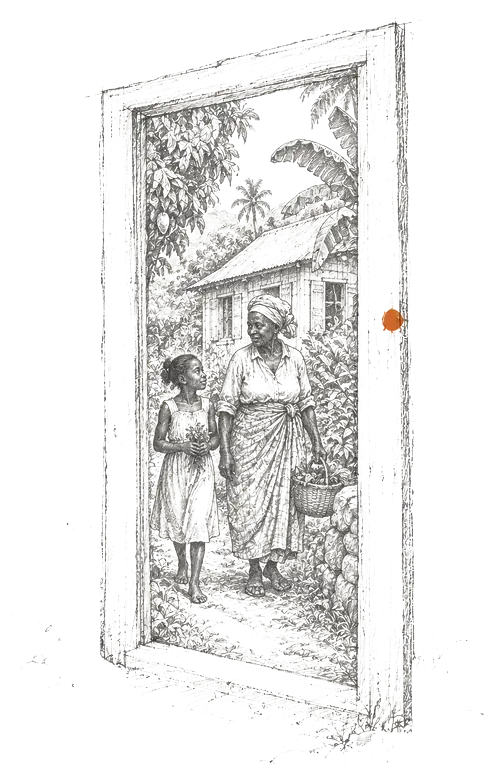
Télumée, a peasant woman of Guadeloupe, tells her life and that of the Lougandor women from whom she descends, from her great-grandmother Minerve, freed by abolition. Entrusted as a child to her grandmother, Queen Without a Name, at Fond-Zombi, she learns from her and from Man Cia, a sorceress, the memory of slavery, and grows up alongside Élie, her childhood friend, who becomes her first love.
Timeline
- 1802DelgrèsThe proclamation of 10 May and Delgrès's death at Matouba, against the restoration of slavery.
- 1911–1961The poetsSaint-John Perse publishes Eloges and Other Poems, Guy Tirolien Balles d'or.
- 1972–1998The novel and the filmSchwarz-Bart, Maximin, Condé and Pineau, then Lara's film about Ignace.
Reading keys
- The surnames given to freed people after 1848 are often anagrams of the first name or names drawn from Antiquity, geography and nature.
- The same first name could produce two surnames depending on the commune where the registrar forged them, such as Oragif at Anse-Bertrand and Garofil at Saint-Claude, both drawn from Figaro.
- The descendants of the Indian indentured labourers bear names of Tamil origin fixed late.
- The mother or the grandmother is often the “poto mitan”, the pillar of the family: single-parent families made up 42% of families in 2020, against 24% in mainland France.
- May 1967 remains a wound: the official toll at the time spoke of seven or eight dead, and the archives opened only late.
- The restoration of slavery in 1802 and the death of Delgrès lie at the heart of collective memory, and the way one tells them commits one to a position.
- Chlordecone, a banana-plantation pesticide used until 1993, contaminated almost the entire population, and the dismissal of the case in 2023 is experienced as a denial.
- The high cost of living provoked the great strike of 2009, led by the LKP collective, and it remains a burning subject.
- Many Indo-Guadeloupeans are Catholics while honouring the Hindu gods.
- The Tamil goddess Mariamman is prayed to there under the name of Maliémin, and Maldévilin protects her temple; the oldest temple, at Changy, on Basse-Terre, is in the Dravidian style.
- Kali is associated with healing and the protection of children.
- On All Saints' Day families light candles on the graves, and after nightfall the cemeteries take on a festive air.
- Carnival begins on the first Sunday of January, peaks on Shrove Tuesday and ends on Ash Wednesday, when she-devils dressed in black and white burn King Vaval.
- On the evening of a death, the wake gathers neighbours and friends around the deceased, with songs, riddles in Creole and games, to distract the family from its grief.
- Gwoka, music, song and dance to the ka drum, once made from salvaged barrels, was long despised and banned before being inscribed in 2014 on UNESCO's intangible heritage list.
- Gwoka drums accompany demonstrations, as during the 2009 strike.
- Delgrès and his proclamation of 1802 are the foremost reference in the Guadeloupean history of freedom.
- Saint-John Perse, Nobel Prize winner in 1960, was born in Pointe-à-Pitre and left the island as a child, when his family settled in Pau.
- Maryse Condé, crowned in 2018 by the New Academy Prize, and Simone Schwarz-Bart are read as the two great voices of the Guadeloupean novel.
- Négritude, coming from Martinique and Paris, found in Guadeloupe an early companion in Tirolien.
- Guadeloupe is not one island but an archipelago, and Marie-Galante or Les Saintes have their own history.
- It is a département and a region of France, with the euro and national elections, and not an independent country.
- Lara's film does not tell the story of Delgrès himself but of an imaginary trial of his companion Ignace.
- Indo-Guadeloupeans make up about 14% of the population: the island is not only Afro-Caribbean.
Available in English 5
The books from this country that can be read in English, in the original or in translation.
- PoetryEloges and Other PoemsÉlogesSaint-John Perse · 1911The first book of a Guadeloupean poet, drawn from his childhood on the island.Literature
- NovelThe Bridge of BeyondPluie et vent sur Télumée MiracleSimone Schwarz-Bart · 1972A line of Guadeloupean peasant women, from the aftermath of slavery to the twentieth century, in the voice of the last of them.Literature
- NovelLone SunL'Isolé soleilDaniel Maximin · 1981Three centuries of Guadeloupean history taken up by a young woman who writes, in the author's first novel.Literature
- NovelCrossing the MangroveTraversée de la mangroveMaryse Condé · 1989A Guadeloupean village tells its own story around a dead man from elsewhere, over the space of a single night.Literature
- NovelThe Drifting of SpiritsLa Grande Drive des espritsGisèle Pineau · 1993A Guadeloupean family from the 1930s to the 1970s, among beliefs, spells and spirits of the dead.Literature
A selection to begin with 6 / 7
- PoetryEloges and Other PoemsÉlogesSaint-John Perse · 1911The first book of a Guadeloupean poet, drawn from his childhood on the island.Literature
- PoetryBalles d'orGuy Tirolien · 1961not translated into EnglishThe only poetry collection of a companion of Senghor and Césaire, between Marie-Galante and Africa.Literature
- NovelLone SunL'Isolé soleilDaniel Maximin · 1981Three centuries of Guadeloupean history taken up by a young woman who writes, in the author's first novel.Literature
- NovelCrossing the MangroveTraversée de la mangroveMaryse Condé · 1989A Guadeloupean village tells its own story around a dead man from elsewhere, over the space of a single night.Literature
- NovelThe Drifting of SpiritsLa Grande Drive des espritsGisèle Pineau · 1993A Guadeloupean family from the 1930s to the 1970s, among beliefs, spells and spirits of the dead.Literature
- CinemaBitter SugarSucre amerChristian Lara · 1998The Guadeloupean revolt against the restoration of slavery, retried by an imaginary tribunal.Cinema