Indonesia
- works
- 34
- 26 books · 8 films
- period covered
- 1390–1999
- language of writing
- Indonesian
Pramoedya Ananta Toer first told his novel aloud. Deported without trial in 1969 to the island of Buru, in a labour camp where the jungle was being cleared, he had neither paper nor pencil, and he spent years narrating the story every evening to his fellow prisoners, so as not to forget it and so that they would carry it if he disappeared. Later authorised to write, he set it down on paper in four volumes. He had already lost a manuscript once during an earlier arrest, in 1965, when his house and his library were ransacked.
Read moreShow less
That story tells of a country that has erased a great deal. Indonesia has more than seven hundred languages on seventeen thousand islands, a Javanese stock with its court chronicles, its shadow theatres and its poems in Old Javanese, a Malay stock, Balinese, Batak and Minangkabau traditions, and a Hindu-Buddhist history of a thousand years before Islam. On all of that, two successive regimes imposed a single national language, Indonesian, forged from trade Malay, and an official reading of history.
The dominant form is the novel of social constraint, and it appears early. Kartini, a Javanese aristocrat who died at twenty-five, wrote in the nineteen hundreds letters about the seclusion of noble girls that became a founding book. Marah Rusli published in 1920 the story of a forced marriage in Sumatra. Chairil Anwar, who died at twenty-six in 1949, broke the metre and invented modern Indonesian poetry in a few dozen poems. The price was paid in 1965 and afterwards: hundreds of thousands of dead, deported writers, books banned for thirty years.
What awaits the reader is a literature of political consciousness and of the impossible marriage, in which the social hierarchy is described with a jurist's precision. The novel that opens this page was written without paper before being written with it.
A way to begin
This Earth of Mankind
Pramoedya Ananta Toer · 1980
This Earth of Mankind, first volume of a tetralogy born in the Buru prison camp, translated into thirty-three languages before its legal reissue in Indonesia.
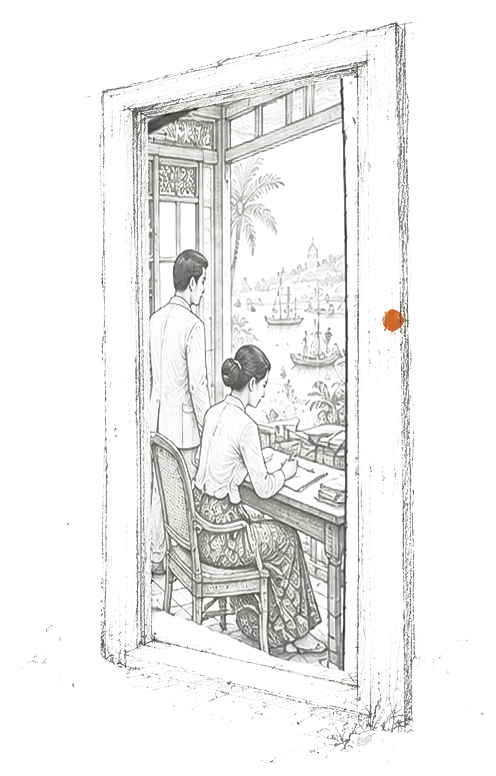
Surabaya, in the Dutch East Indies. Minke, a young Javanese of the minor nobility and a brilliant pupil at a Dutch school almost reserved for Europeans, is taken to the home of a Dutchman and his native concubine, Nyai Ontosoroh, who runs the house and the business. He falls in love with their daughter, Annelies, and learns from this unschooled woman, taught by books and by life, what colonial law does to natives.
Timeline
- 1920–1942Balai PustakaThe colonial publisher issues the first novels in Malay, under supervision.
- 1945–1949RevolutionIndependence is wrested by force of arms. The 1945 generation writes in a fever.
- 1965–1966MassacresHundreds of thousands killed. Pramoedya is deported to the island of Buru.
- 1980–1990The Buru QuartetWritten in prison, first told aloud, banned as soon as it appeared.
Reading keys
- Many Indonesians, notably in Java, bear a single name with no surname: Suharto, Sukarno, Pramoedya are complete names.
- The Javanese titles of nobility, Raden, Raden Ajeng, precede the name and indicate a real rank in colonial and postcolonial society.
- The Minangkabau of Sumatra are matrilineal, the house and the land belonging to the women, which reverses what a reader expects of a Muslim society.
- Kinship terms serve as forms of address: one calls an elder brother, an older person uncle, and the use of the first name alone is familiar.
- The massacres of 1965 and 1966, with several hundred thousand dead, were officially recounted the other way round for thirty years and remain a difficult subject.
- The question of West Papua, the occupation of Timor and the fate of the religious minorities are sensitive subjects.
- The blasphemy law and the pressure of Islamist movements bound recent production.
- Javanese refinement, alus, values self-control and allusion, and a direct character passes for coarse.
- Islam concerns nearly nine Indonesians in ten, but it arrived on a Hindu-Buddhist and animist stock that it did not erase, which explains a very syncretic Javanese Islam.
- Bali is Hindu, with a religion of its own in which the family temples and the daily offerings structure the day.
- The wayang, a shadow theatre that performs the Mahabharata and the Ramayana all night, is the dominant traditional medium, and the puppeteer is a religious figure.
- Spirits, charged places and auspicious or inauspicious days are taken seriously, and a calendar is consulted before a decision.
- Muslim mourning is brief, with burial on the same day and commemorations on the third, seventh, fortieth and hundredth days.
- In Bali, cremation is a costly collective event, sometimes deferred by several years, and a joyful one.
- Batik, whose patterns were once reserved according to rank, indicates the occasion and the status.
- Ramadan and Eid, with the massive return to the village, bring the whole country to a halt.
- The Mahabharata and the Ramayana, in their Javanese and Balinese versions, are known through the wayang more than through the book, and the characters have local names there.
- The Babad Tanah Jawi, a court chronicle, traces the kings of Java back to Adam, a borrowed genealogy comparable to those of the Malay world.
- The narratives of Roro Jonggrang and of Nyai Loro Kidul, queen of the southern seas to whom the sultans of Java say they are married, are living references.
- The kancil, a cunning mouse-deer, is the trickster of the tales, shared with Malaysia.
- Indonesia is not an Arab country and its Islam arrived late through trade, on a Hindu-Buddhist stock that it absorbed.
- Indonesian is a standard of Malay, and not a language unrelated to that of Malaysia.
- Bali is not representative of the country: it is a Hindu exception in a Muslim archipelago.
- The Minangkabau are matrilineal and Muslim, a combination believed impossible that concerns millions of people.
Tales and mythologies 2
- ChronicleThe Pasai ChronicleHikayat Raja-Raja PasaiAnonymous · 1390The oldest surviving Malay chronicle, written in Sumatra about the first Islamised kingdom of the archipelago.Literature
- ChronicleThe Chronicle of JavaBabad Tanah JawiAnonymous · 1700The great genealogical narrative of Java, which traces the sultans of Mataram back to Adam and the Hindu gods.Literature
Available in English 12
The books from this country that can be read in English, in the original or in translation.
- ChronicleThe Precious GiftTuhfat al-NafisRaja Ali Haji · 1865A dynastic chronicle written at Penyengat in the nineteenth century, in which a scholar of the ruling house describes his own world.Literature
- NarrativeLetters of a Javanese PrincessDoor duisternis tot lichtRaden Ajeng Kartini · 1911The letters of a secluded young Javanese woman who wanted girls to go to school, at the turn of the century.Literature
- NovelSitti Nurbaya: A Love UnrealizedSitti NurbayaMarah Rusli · 1922A forced marriage in the Minangkabau high society of Padang, at the beginning of the twentieth century.Literature
- NovelNever the TwainSalah AsuhanAbdoel Moeis · 1928A young man from Sumatra who disowns his own people for Europe and for a Eurasian woman: a classic of the young Indonesian literature.Literature
- NovelThe Rape of SukreniSukreni Gadis BaliAnak Agung Pandji Tisna · 1936A village stall, a girl who is too beautiful and a police chief, under the colonial administration.Literature
- NovelShacklesBelengguArmijn Pane · 1940A doctor, his overly modern wife and a kroncong singer: the first psychological novel in Indonesian literature.Literature
- PoetryThe Voice of the NightDeru Campur DebuChairil Anwar · 1949The poems of revolt and death of a young bohemian from Jakarta, during the occupation and the revolution.Literature
- NovelTiger!Harimau! Harimau!Mochtar Lubis · 1975Seven resin gatherers hunted by a tiger in the Sumatran jungle, a fable about the power of a charismatic leader.Literature
- NovelThis Earth of MankindBumi manusiaPramoedya Ananta Toer · 1980The youth of a Javanese educated at a colonial school, first volume of a tetralogy born in a prison camp.Literature
- NovelThe WeaverbirdsBurung-Burung ManyarY. B. Mangunwijaya · 1981An officer serving the Dutch and a republican woman who love each other on opposite sides of the revolution: Romo Mangun's great novel.Literature
- NovelThe DancerRonggeng Dukuh ParukAhmad Tohari · 1982A child consecrated as the ritual dancer of a Javanese hamlet: the first part of Ahmad Tohari's trilogy.Literature
- NovelThreads of DignityMerajut HarkatPutu Oka Sukanta · 1999The survival of a political prisoner in Suharto's jails, written by a former detainee.Literature
A selection to begin with 10 / 34
- NarrativeLetters of a Javanese PrincessDoor duisternis tot lichtRaden Ajeng Kartini · 1911The letters of a secluded young Javanese woman who wanted girls to go to school, at the turn of the century.Literature
- NovelThe Rape of SukreniSukreni Gadis BaliAnak Agung Pandji Tisna · 1936A village stall, a girl who is too beautiful and a police chief, under the colonial administration.Literature
- NovelShacklesBelengguArmijn Pane · 1940A doctor, his overly modern wife and a kroncong singer: the first psychological novel in Indonesian literature.Literature
- PoetryThe Voice of the NightDeru Campur DebuChairil Anwar · 1949The poems of revolt and death of a young bohemian from Jakarta, during the occupation and the revolution.Literature
- CinemaThe Long MarchDarah dan DoaUsmar Ismail · 1950The long march of a division of the Republic across Java, seen by an officer who doubts.Cinema
- NovelTiger!Harimau! Harimau!Mochtar Lubis · 1975Seven resin gatherers hunted by a tiger in the Sumatran jungle, a fable about the power of a charismatic leader.Literature
- CinemaThe Moon and the SunRembulan dan MatahariSlamet Rahardjo · 1979The return to the village of a repentant exile, in the first film of a great actor turned director.Cinema
- CinemaNovember 1828Teguh Karya · 1979A Javanese village occupied by the colonial army in the time of Diponegoro, between loyalty and betrayal.Cinema
- CinemaNagabonarNaga BonarM. T. Risyaf · 1987A Medan pickpocket promoted to general during the revolution, in a comedy written by a poet of the 1945 Generation.Cinema
- CinemaTjoet Nja' DhienEros Djarot · 1988The last resistance fighter of Aceh, aged and with failing eyesight in the jungle, facing the Dutch colonial war.Cinema