Bangladesh
- works
- 59
- 40 books · 19 films
- period covered
- 1400–1999
- language of writing
- Bengali
On 21 February 1952, the police fired on students demonstrating in Dhaka. They were demanding that Bengali be recognised as an official language of Pakistan, of which they then formed the eastern province, alongside Urdu decreed the sole state language. Several died. A monument was raised on the site of the shooting, destroyed by the army, then rebuilt. Twenty years later, the country became independent under the name of free Bengal, and UNESCO made that date the international day of the mother tongue. Few nations can say that they were born of a question of official language.
Read moreShow less
The language in question is worth a riot. Bengali carries a continuous literature since the tenth century, with its Buddhist songs, its poems of devotion to Krishna, its nineteenth-century novels and a Nobel prize in 1913. It is spoken by more than two hundred million people, on either side of a border traced in 1947 and then in 1971, and the Bengalis of Dhaka and of Calcutta share all their classical stock while having two distinct political histories.
The dominant form is the village narrative and the war testimony. Syed Waliullah published in 1948 the story of a man who invents a saint's tomb in order to live off the piety of the peasants, a novel of glacial irony about utilitarian religion. Jasimuddin had written in 1928 a long narrative poem about rural life that the country knows by heart. The price was paid in 1971: during the war of liberation, the Pakistani army deliberately executed professors and writers, including the author of a play written in prison about the martyrs of 1952.
What awaits the reader is a literature of the river and of the monsoon, in which nature is not a setting but an actor that moves villages and redraws the land from one season to the next. The novel that opens this page tells of a man who covers a forgotten grave with a red cloth and makes it a saint's shrine, and it appeared the year after partition.
A way to begin
Tree Without Roots
Syed Waliullah · 1948
Tree Without Roots: a forgotten grave, a red cloth and a credulous village, in a Bengali classic translated into French and English.
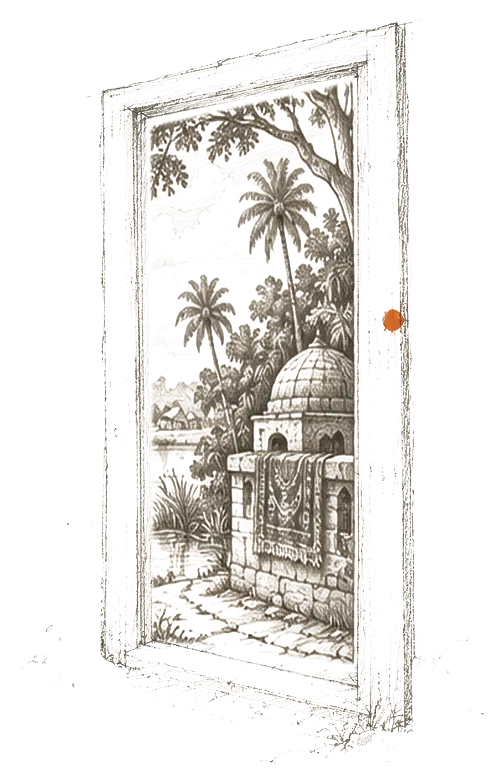
In the Bengali village of Mahabbatnagar, where life is hard, a shrewd man named Majid arrives. He finds an old forgotten grave, covers it with a red cloth and proclaims that it belongs to a saint whose shrine he has come to keep. The villagers bring their offerings, and Majid gradually extends his authority over the village.
Timeline
- 1400–1650Early Bengali poetryChandidas, Alaol. The Arakan court has works written in Bengali.
- 1861–1930Bengal RenaissanceMadhusudan Dutt, Mir Mosharraf Hossain. Bengali becomes a language of the novel.
- 1947–1955Partition and languageWaliullah, Munier Chowdhury. The language movement forges a consciousness.
- 1956–1971First cinemaMukh O Mukhosh, then Zahir Raihan, who disappeared during the liberation war.
- 1971–1999After independenceSelina Hossain, Taslima Nasrin, and a cinema that returns to 1971.
Reading keys
- Muslim names, Rahman, Chowdhury, Hossain, and Hindu ones, Das, Chattopadhyay, Ghosh, coexist and immediately signal the community.
- The title of Chowdhury or of Khan indicates a landowning family, social information that the narratives exploit.
- Kinship terms are highly differentiated and one calls strangers by a kinship term according to age, which makes dialogues disconcerting in translation.
- The dowry, illegal but practised, is a frequent narrative device and a cause of conjugal violence that literature addresses.
- The war of 1971, its massacres and the number of its victims are a permanent political stake, and the question of the collaborators still divides the country.
- The mass sexual violence of 1971 and the status of the women who suffered it are a subject that was made official and then stifled.
- Criticism of religion is dangerous, and several authors and bloggers have been killed or forced into exile since the nineteen nineties.
- The relation with India, at once the ally of 1971 and a cumbersome neighbour, is a sensitive subject.
- Sunni Islam is very much in the majority, with a strong Sufi tradition and shrines of saints, the mazar, visited by Muslims as by Hindus.
- An important Hindu minority survives, with its temples and its festivals, notably Durga Puja which is a public moment.
- The bauls, itinerant mystical singers who refuse religious categories, are listed as intangible heritage and constitute a major poetic reference.
- The specifically Bengali divinities, including Manasa the serpent goddess and Chandi, have their own corpus of poems, distinct from the pan-Indian pantheon.
- Muslim mourning is brief, with burial on the same day and a reading on the fortieth day; Hindu mourning goes through cremation and white.
- The white of the Hindu widow's sari and the red of the bride are immediate markers.
- Pohela Boishakh, the Bengali new year in April, is a secular and national festival in which all communities take part.
- 21 February, the day of the language martyrs, is the major civil landmark, with the laying of flowers at the monument.
- The poems of devotion to Krishna and the mangalkavya devoted to the Bengali divinities form the classical stock common with West Bengal.
- The tales collected in 1883 and above all the 1907 collection prefaced by Tagore, grandmother's bag, are what every Bengali child knows.
- The songs of the bauls and those of Tagore and of Nazrul Islam are sung and quoted by everyone.
- The river, the monsoon and the villages carried away by the water constitute a shared stock of images.
- Bangladesh is not a region of Pakistan or of India: it is a country born of a linguistic conflict and then of a war.
- Bengali is written in an alphabet of its own and is neither Hindi nor Urdu.
- Tagore belongs to both Bengals and wrote the national anthems of India and of Bangladesh, which makes his classification by country debatable.
- Bengali Islam is old, largely Sufi, and reducing it to contemporary rigorism distorts the reading of the literature.
Tales and mythologies 1
- TaleTales from Thakurmar Jhuliঠাকুরমার ঝুলিDakshinaranjan Mitra Majumdar · 1907Tales collected in the villages of eastern Bengal at the beginning of the twentieth century, and given back to children in their own language.Literature
A selection to begin with 10 / 59
- NovelAbdullahআবদুল্লাহKazi Imdadul Huq · 1920A novel against the customs of the author's own community, given to a journal in his lifetime and completed by another hand.Literature
- PoetryThe Field of the Embroidered Quiltনকশী কাঁথার মাঠJasimuddin · 1929A love between young peasants from two villages of eastern Bengal, separated by a great field.Literature
- PoetryBanalata Senবনলতা সেনJibanananda Das · 1942A slim collection published in the middle of the world war, in which the nature of Bengal and the passing of time take the place of a story.Literature
- PoetryThe Sailor of the Seven Seasসাত সাগরের মাঝিFarrukh Ahmad · 1944In the forties, Muslim poets of Bengal seek a poetry of their own, apart from the Calcutta current, in the past of Islam.Literature
- TheatreকবরMunier Chowdhury · 1953not translated into EnglishA play born of the February 1952 shooting of students who were demanding their language, written in the place where the authorities had imprisoned its author.Literature
- Cinemaওরা ১১ জনChashi Nazrul Islam · 1972Shot in the months following the victory, with former fighters and their own weapons.Cinema
- CinemaA River Called TitasTitash Ekti Nadir NaamRitwik Ghatak · 1973A community of fishermen and their river, filmed in East Bengal in the aftermath of independence.Cinema
- CinemaThe Endless Trailগোলাপী এখন ট্রেনেAmjad Hossain · 1978A village film about the rural poor and the fate dealt to women, adapted from a novel by its own author.Cinema
- CinemaThe Ominous Houseসূর্য দীঘল বাড়ীSheikh Niamat Ali · 1979A film based on a novel about a woman alone in the Bengali countryside, the first made with state funding.Cinema
- CinemaShongkhonil KaragarMustafizur Rahman · 1992A family drama based on a widely read youth novel, about the expectations placed on an eldest daughter.Cinema