Israel
- works
- 92
- 59 books · 33 films
- period covered
- 600–1999
- language of writing
- Hebrew
In 1882, a man decided to speak to his son only in Hebrew. Eliezer Ben-Yehuda had just settled in Jerusalem with the idea that a language reserved for seventeen centuries to prayer and study could become again a language of the kitchen, of quarrels and of insults. Thousands of words had to be invented, including those for tomato, newspaper and bicycle, and for a few years his son was the only child in the world whose mother tongue was Hebrew. Today several million people speak it, and no other liturgical language has managed that.
Read moreShow less
That resurrection is the central fact of Israeli literature, and it produces a particular effect: every sentence written in modern Hebrew resonates with involuntary biblical quotations, since the vocabulary comes from there. Authors play on that echo or defend themselves against it. Shmuel Yosef Agnon, Nobel prize in 1966, wrote in a deliberately archaising language, while the following generation looked for an everyday Hebrew.
The dominant form is the family novel as a political form. Amos Oz, whose pen name means strength, published in 1968 the story of a woman who is bored in the Jerusalem of the nineteen fifties and dreams of two Arab twins, and that is enough to make a book about the country. Aharon Appelfeld wrote the Shoah through what precedes it, without ever naming it. David Grossman constructed in 1986 a novel in four parts, one of which is a dictionary. Cinema followed the same path, with films about prisons, the army and the internal fractures, one of which takes place entirely in a cell shared by Jewish and Palestinian detainees.
What awaits the reader is a very written literature, often ironic, that quarrels with its own country. The novel that opens this page takes place inside the head of a young Jerusalem woman whose daydreams draw her away from her husband, and it was the best-selling Israeli novel of 1968 and 1969.
A way to begin
My Michael
Amos Oz · 1968
A young woman in Jerusalem whose daydreams draw her away from an overly sensible husband: the best-selling Israeli novel of 1968 and 1969.
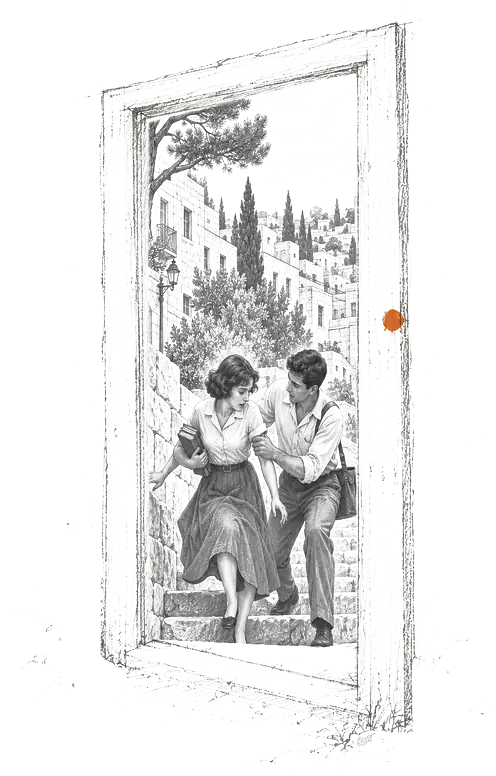
In 1950s Jerusalem, Hannah, a literature student, stumbles on some steps, and Michael, a geology student, catches her. They marry; she gives up her studies and settles with him in a dark old flat. Michael is steady, practical, unimaginative; Hannah meets again in dreams the Arab twins of her childhood, Captain Nemo and Michael Strogoff, and drifts away from a husband who does not understand her.
Timeline
- 600–1200Medieval Hebrew poetryKalir, Yehuda Halevi. Hebrew is first written in prayer and poem.
- 1853–1910HaskalahMapu, Smolenskin, Bialik. Writing novels in Hebrew is learned again.
- 1920–1948The Yishuv generationShlonsky, Alterman, Rachel. Poetry accompanies the settlement.
- 1947–1965The 1948 generationYizhar, Shamir, Gouri. Writing the war from within the ranks.
- 1966–1990DoubtOz, Yehoshua, Grossman. The Israeli novel wins the world as it loses its certainties.
- 1964–1993CinemaFrom popular comedy to the films of Bukai and Riklis, the country looks at itself.
Reading keys
- Many authors Hebraised their names on arriving: Amos Oz was called Klausner, Ben-Yehuda was called Perlman. That change is an ideological act and not a whim.
- The name often indicates the origin: Ashkenazi from Central and Eastern Europe, Sephardi from the Mediterranean world, Mizrahi from the Arab countries and Iran, Ethiopian, Russian. That geography is a social hierarchy that literature speaks of a great deal.
- Biblical first names are in current use and signal no particular religiosity.
- Palestinians who are citizens of Israel bear Arabic names and sometimes write in Hebrew, which the catalogue signals badly.
- The vocabulary is disputed: the events of 1948 are called War of Independence by Israelis and Nakba by Palestinians, and the choice of words situates a text.
- The Shoah is omnipresent and was long unsayable directly: the literature of the nineteen fifties and sixties speaks of it through silence, ellipsis or fable.
- Relations between Ashkenazi and Mizrahi Jews, and the treatment of immigrants from the Arab countries in the nineteen fifties, are a major subject of internal dispute.
- Military service, compulsory and long, is a passage that almost every narrative crosses, and refusals are the object of a literature of their own.
- Society is run through by a line between the religious and the secular that structures daily life, marriage, transport and the calendar.
- There is no civil marriage, which obliges some couples to marry abroad, a frequent narrative motif.
- The Sabbath, from Friday evening to Saturday evening, brings part of the country to a halt, and a scene set on a Saturday does not have the same meaning as on another day.
- The Jewish legendary stock, rabbinic aggadah and Hasidic narratives, is a reserve of allusions that authors mobilise, including the most secular ones.
- Mourning follows codified stages: swift burial, seven days of shiva during which one receives seated low, thirty days, then a year. A shiva scene is a complete social scene.
- The Hebrew calendar is lunar, the year begins in autumn, and the festivals fall each year on different dates of the civil calendar.
- Yom Kippur brings the whole country to a halt, including for the non-observant, and the war of 1973, launched on that day, left a lasting mark.
- Holocaust Remembrance Day and the day for fallen soldiers immediately precede the independence festival, a very particular emotional sequence.
- The Book of Legends, an anthology of the aggadah published in Odessa between 1908 and 1911, is the collection through which several generations came to know their narrative stock.
- The Legends of the Jews, a seven-volume compendium published from 1909, are the scholarly reference in a Western language.
- The Hasidic narratives of Eastern Europe, with their masters and their parables, feed an important part of the literature.
- The Hebrew Bible functions as a lexical and allusive reserve whose echo every sentence of modern Hebrew carries.
- Modern Hebrew is not biblical Hebrew: it is a language reconstructed in the nineteenth century, with a partly invented vocabulary.
- Israeli society is not homogeneous: the fractures between Ashkenazim and Mizrahim, religious and secular, Russian speakers and native-born run through all the literature.
- Part of Israel's citizens are Palestinians and publish in Arabic and in Hebrew, which classification by country makes hard to see.
- The word used to designate 1948 varies according to the author and indicates a position: the file uses both and does not decide between them.
Tales and mythologies 1
- TaleThe Book of Legendsספר האגדהHayim Nahman Bialik and Yehoshua Hana Ravnitzky · 1908Anthology published in Odessa from 1908: the stories of the Talmud and the midrashim, drawn from the legal debates and made accessible to all.Literature
A selection to begin with 10 / 92
- NovelA Guest for the Nightאורח נטה ללוןShmuel Yosef Agnon · 1939A novel of 1939: a writer from Jerusalem returns to his native small town in Galicia, ruined by the war, and tries to bring back to life the abandoned place of study.Literature
- Poetryעכשיו ובימים האחריםYehuda Amichai · 1955not translated into EnglishFirst collection, published in 1955: a poet who says “I” when his generation said “we”, and the battles of 1948 seen by those who fought them.Literature
- NovelHimmo, King of Jerusalemחימו מלך ירושליםYoram Kaniuk · 1966A novel of 1966: in besieged Jerusalem, a nurse and a maimed soldier, and the question of what is owed to a life reduced to almost nothing.Literature
- NovelBadenheim 1939באדנהיים עיר נופשAharon Appelfeld · 1978A novel from 1978: the season begins at the spa town, the spa guests arrive, and a sanitary department starts counting the Jews.Literature
- CinemaMomentsרגעיםMichal Bat-Adam · 1979A Franco-Israeli film of 1979, written, directed and acted by the same woman: two strangers in Jerusalem, and a censorship that lasted thirty-four years.Cinema
- CinemaThe Wooden Gunרובה חוליותIlan Moshenson · 1979A film from 1979: gangs of children wage war on each other in the Tel Aviv of 1950, near a survivor whom the neighbourhood considers mad.Cinema
- CinemaTransitטרנזיטDaniel Wachsmann · 1980A 1980 film about a German Jew in Tel Aviv who has never stopped thinking of himself as passing through and dreams of returning to Berlin.Cinema
- CinemaHide and SeekמחבואיםDan Wolman · 1980A film from 1980: in the Jerusalem of 1946, a boy suspects his tutor of treason; the first Israeli film whose main character is homosexual.Cinema
- CinemaBeyond the Wallsמאחורי הסורגיםUri Barbash · 1984A 1984 film: in an Israeli prison, Jewish and Palestinian inmates, whom the management sets about pitting against each other, come to stand together.Cinema
- NovelSee Under: Loveעיין ערך: אהבהDavid Grossman · 1986A novel from 1986: a boy grows up amid things that are named in front of him without being explained to him, and will spend his life trying to say them.Literature