Jordan
- works
- 10
- 8 books · 2 films
- period covered
- 1400–1998
- language of writing
- Arabic
The alphabet in which Arabic is written descends from the Nabataean script, that is to say from Petra. The Nabataeans spoke a form of Arabic and wrote in Aramaic, and their letters, by joining to one another in inscriptions and trade documents, took on the cursive form from which Arabic derives. The script that today serves hundreds of millions of people took shape in a caravan kingdom in southern Jordan, between two languages and for the needs of commerce.
Read moreShow less
The country is made that way: very old in its soil, very recent as a state. The emirate of Transjordan was born in 1921, the kingdom in 1946, and its population was profoundly recomposed with the arrival of Palestinians in 1948 and then in 1967, so that a considerable part of Jordanian literature is written by authors whose family memory lies on the other side of the river. The question of what is Jordanian is here an open question, debated and fertile, and many authors refuse to have to choose.
One formal consequence deserves attention: Jordan built its narrative through the image before doing so through the book. As early as 1964, Abdallah Ka'ush shot "My Beloved Homeland", and in 1968 Farouk Agrama filmed a storm over Petra. The landscape becomes an actor, and the country began to host shoots from all over the world, until its deserts served as Mars and its ruins as imaginary temples. Wadi Rum has been filmed more often than most Arab capitals. The price is known: a place more famous than its authors, and a first-rate technical industry working above all for other people's stories.
What awaits the viewer is therefore a cinema constantly negotiating between the setting and the inhabitant, and films that seek to take back the word about a territory already filmed by everyone. The novel that opens this page follows an ordinary man from the war of 1948 to the defeat of 1967, and it won the an-Nahar Prize for the best Arabic novel in 1968.
A way to begin
You as of Today My Homeland
Tayseer Sboul · 1968
A short novel written in the aftermath of the Six-Day War, among the first modern Jordanian novels; an-Nahar Prize 1968.
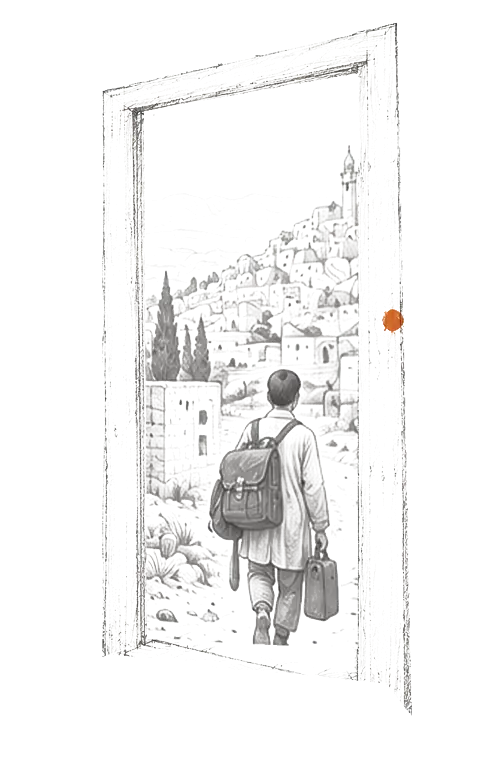
Arabi, an ordinary man with a symbolic name, leaves his village to study in town. The narrative follows his passage through Arab history, from the Palestine war of 1948 to the defeat of 1967 seen from Jordan: a tyrannical father, the hypocrisy of the parties, the disarray of the university and failed loves. An alternating narration, in the third and the first person, gradually draws the two voices together.
Timeline
- 1964–1969Birth of cinemaKaush, Agrama, al-Hindi. Three films in five years, then almost nothing.
- 1989Al-HarbaaFaisal al-Zoubi makes one of the rare Jordanian feature films.
Reading keys
- The name reads as a genealogy with ibn or bin and bint, and the last element indicates the family, the tribe or the town of origin.
- The name often makes it possible to distinguish families of Transjordanian origin from families of Palestinian origin, an important social and political distinction.
- The kunya, "father of" followed by the name of the eldest child, is the ordinary respectful form of address.
- The great tribes of the south and the east carry real institutional weight, and a tribal character is not an archaic character.
- The events of 1970 and 1971 between the Jordanian army and the Palestinian organisations remain a high-tension subject, rarely named head-on.
- The monarchy cannot be criticised publicly, and satire proceeds by displacement.
- The Palestinian or Transjordanian belonging of a character is signalled by the name, the accent, the town, never by a declaration.
- Hospitality is an absolute duty and refusing a meal offends lastingly.
- Sunni Islam is in the majority, with an old Christian minority, Orthodox and Catholic, well represented in the intellectual professions and in literature.
- Biblical and Quranic places are superimposed on the same ground: Mount Nebo, the Jordan, the caves of the seven sleepers.
- The jinn belong to Quranic cosmology, and bedouin beliefs in the spirits of places survive.
- The cult of saints and the tombs of the Prophet's companions are places of visit.
- Muslim mourning is brief, with burial on the same day and three days of condolences separated by sex. Christian mourning follows another calendar, which distinguishes the scenes.
- The red and white chequered keffiyeh is a Jordanian identity marker, the black and white one being Palestinian. The nuance is legible and meaningful.
- Ramadan and the Eids order the year, at the same time as Easter and Christmas for part of the population.
- Mansaf, a dish of lamb in fermented yoghurt served on a large shared tray, is the central rite of hospitality. Refusing to touch it is serious.
- The Nabataeans, Petra and the caravan memory serve as an identity foundation, including for authors who make no explicit reference to them.
- The bedouin cycles of northern Arabia, including the ballads of tragic love, belong to the common stock and are still sung.
- The memory of Palestine, its villages and its house keys, runs through the literature written in Jordan.
- The Mu'allaqat and the Romance of Antar serve as a learned reference shared with the peninsula.
- Petra is not a Roman ruin: it is a Nabataean capital, and the kingdom that built it spoke Arabic.
- Jordan is not a country without literature because its state is young: production there is abundant and often published in Beirut or Cairo.
- The word "bedouin" designates a living social organisation, present in the army and the administration, not a folklore.
- The keffiyeh, the tent and the desert have become tourist images, and Jordanian authors often work against those images.
Tales and mythologies 1
- EpicThe Epic of the Bani Hilalسيرة بني هلالAnonymous · 1400An oral narrative born of real migrations that took place between the tenth and the twelfth century, sung throughout the Arab world.Literature
Available in English 3
The books from this country that can be read in English, in the original or in translation.
- NovelYou as of Today My Homelandأنت منذ اليومTayseer Sboul · 1968This short novel, written in the wake of the Six-Day War, is counted among the first modern Jordanian novels.Literature
- NovelPrairies of Feverبراري الحمىIbrahim Nasrallah · 1985The novel tells of the exile of Arab teachers who went to work in the Gulf; the author had himself taught there.Literature
- NovelThe Tree StumpالقرميةSamiha Khreis · 1998The rising of the tribes against the Ottomans told from the Arab side, against the legend of Lawrence of Arabia.Literature
A selection to begin with 8 / 10
- Poetryعشيات وادي اليابسArar · 1954not translated into EnglishThe author, a magistrate and senior official of the emirate, is regarded as Jordan's greatest poet.Literature
- CinemaStruggle in Jerashصراع في جرشWasif al-Sheikh Yassin · 1957The first fictional feature film shot in Jordan, when the West Bank was attached to the kingdom, made by amateurs who built their own equipment.Cinema
- Feature filmوطني حبيبيAbdullah Kaoush · 1964It is one of the very first Jordanian fiction feature films, shot on very modest means.Cinema
- Short storiesإحدى وعشرون طلقة للنبيElias Farkouh · 1982not translated into EnglishThe margins of Amman and their forgotten inhabitants, in a collection of stories honoured by the Jordanian writers.Literature
- NovelPrairies of Feverبراري الحمىIbrahim Nasrallah · 1985The novel tells of the exile of Arab teachers who went to work in the Gulf; the author had himself taught there.Literature
- Novelاعترافات كاتم صوتMu'nis al-Razzaz · 1986not translated into EnglishA family under house arrest and the confessions of a hired killer, in a Jordanian novel of power and fear.Literature
- NovelسلطانةGhalib Halasa · 1987not translated into EnglishThe novel looks back on the early days of the kingdom, seen by a writer who lived thirty-four years in exile.Literature
- NovelThe Tree StumpالقرميةSamiha Khreis · 1998The rising of the tribes against the Ottomans told from the Arab side, against the legend of Lawrence of Arabia.Literature