Lesotho
- works
- 6
- 6 books
- period covered
- 1895–1996
- language of writing
- English
Around 1910, a printing-house proofreader handed his employers the manuscript of a novel in Sesotho. Thomas Mofolo recounts in it the rise and fall of Shaka, founder of the Zulu kingdom, making of him a man who sold his soul for power. The Protestant mission that owned the press found the book too favourable to the old beliefs and kept it in a drawer. It would appear fifteen years later, in 1925, and would be recognised as one of the first great African novels. Mofolo, in the meantime, had left the printing house and stopped writing for good.
Read moreShow less
This tiny and entirely mountainous country, enclaved within South Africa, produced a written literature before most of its neighbours for a precise reason: the Morija mission had installed a printing press there as early as 1861, and it published in Sesotho. Édouard Jacottet collected the country's tales there in Sesotho with a translation, Eugène Casalis had described the beliefs and the institutions as early as 1859. Lesotho is thus one of the places where an African language was written early, abundantly, and by its speakers. A newspaper in Sesotho was appearing before most of the newspapers of South Africa.
The form that results is the historical narrative and the testimony. Caroline Khaketla published in 1963 a collection of poems in Sesotho. Mpho Nthunya recounted her life as a domestic worker in a book published in 1996, made from the stories she told a teacher, one of the rare life narratives by a Sotho woman published in her lifetime. The price is that of enclavement: the country lives on the work of its men in the South African mines, and its literature recounts absence, letters, the money that arrives and the money that does not.
What awaits the reader is an ample prose, biblical in rhythm and pagan in substance, in which power is always paid for too dearly. The novel that opens this page waited fifteen years at the mission press, troubled that its author did not condemn the old customs.
A way to begin
Chaka
Thomas Mofolo · 1925
Chaka, in Sesotho, free of rights: chosen in 2002 among the twelve best African books of the twentieth century.
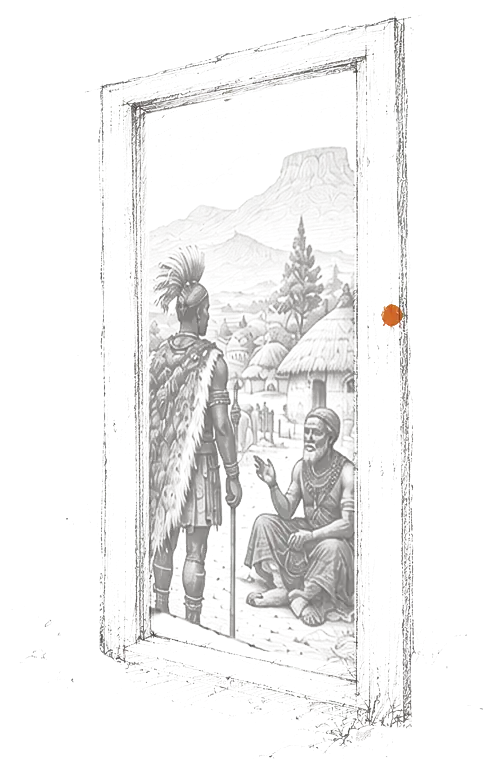
Chaka is born out of wedlock to Nandi, whom the chief Senzangakhona abandons, and the child grows up rejected and persecuted. In a vision, the king of the Deep Pool foretells his greatness. The diviner Isanusi then offers him power in exchange for absolute obedience. Chaka accepts, takes the lead of his people, reforms the army and builds a nation, at the price of what the diviner demands of him.
Timeline
Reading keys
- Sesotho names begin with prefixes that indicate the class: a Mosotho belongs to the Basotho, the language is Sesotho, the country Lesotho.
- First names are often sentences, and a child may receive a name that comments on the circumstances of his birth.
- Society is patrilineal, with hierarchical chiefs issued from the royal house of Moshoeshoe, and the pitso, a public assembly, allows speech before the chief.
- Bohali, the payment made by the groom in cattle, is negotiated at length and gives rise to disputes.
- Economic dependence on South Africa and migrant labour in the mines are the central social fact, present in almost every narrative.
- The history of the royalty and the rivalries of chieftaincy are a living political subject.
- Ritual killings, the liretlo, which gave rise to famous trials in the nineteen forties, are a heavy subject.
- The old beliefs were long judged unavowable by the missions, which explains the censorship Mofolo suffered.
- Protestant and Catholic Christianity is very much in the majority, implanted since 1833, and the Church long controlled the press and the school.
- Molimo is the supreme god and the balimo the ancestors, addressed for household affairs.
- The ngaka, healer and diviner, throws the bones, and boloi, sorcery, is a grave accusation.
- The narratives about Kholumolumo, a swallowing monster, and about Senkatana the liberating hero belong to the documented stock.
- Mourning imposes on the widow dark clothes and a seclusion of several months.
- The patterned wool blanket, worn over the shoulders, and the conical straw hat are everyday garments and marks of belonging.
- The miner's return, once or twice a year, is a recurring narrative scene and an organised social moment.
- 4 October, the day of independence in 1966, and the feast of King Moshoeshoe in March are the civil landmarks.
- Shaka, as Mofolo wrote him, has become a literary reference throughout Africa, rewritten by Senegalese and Congolese authors.
- The Sesotho tales collected by Jacottet in 1895 and 1908, in Sesotho with a translation, form the documented corpus.
- Moshoeshoe, founder of the kingdom in the nineteenth century and a skilful diplomat, is the national historical reference.
- The lithoko, praise poems recited for a chief or a warrior, are a recognised literary genre.
- Mofolo's Shaka is not a biography but a moral tragedy, and reading it as a historical document misses it.
- Lesotho is not a South African province: it is an independent enclaved kingdom, with its language and its institutions.
- Sesotho was written and printed as early as 1861, which contradicts the idea of a late entry into writing.
- The country's literature speaks above all of the absence of the men, which shifts the place of women in the narratives.
Tales and mythologies 1
- TaleContes populaires des BassoutosÉdouard Jacottet · 1895not translated into EnglishThe collector, a pastor of the Paris Protestant mission, gathered these tales in Lesotho and translated them into French.Literature
A selection to begin with 4 / 6
- NovelBlanket Boy's MoonA. S. Mopeli-Paulus and Peter Lanham · 1953The account of a Basotho chief was reworked for publication by a white writer, Peter Lanham.Literature
- Poetry'MantsopaCaroline Ntseliseng Khaketla · 1963not translated into EnglishThe author, a teacher, was the first woman in Lesotho to obtain a university degree.Literature
- Short storiesBasali! Stories by and about Women in LesothoK. Limakatso Kendall · 1995Women of Lesotho tell of their lives, between patriarchy, violence and solidarity, in a collection born at the university.Literature
- NarrativeSinging Away the HungerMpho Matsepo Nthunya · 1996The book grew out of the stories that a university cleaning woman confided to a teacher who had come from America.Literature