Lithuania
- works
- 53
- 46 books · 7 films
- period covered
- 1765–1993
- language of writing
- Lithuanian
The first novel in modern Hebrew was written in Lithuania. Abraham Mapu, a teacher of religion and German at the secondary school in Kaunas, worked on it for more than twenty years before publishing it in Vilnius in 1853. The action takes place in Jerusalem in the time of the prophet Isaiah, in a biblical language taken up to recount thwarted loves, and its author had never seen the country he described.
Read moreShow less
This country long superimposed languages without mixing them. The nobility wrote in Polish, the administration in Russian, the towns in Yiddish, the Church in Latin, and Lithuanian remained the language of the villages. Vilnius was the Jerusalem of the North, with its Talmudic schools and its institute for Yiddish research founded in 1925. Between 1941 and 1944, nearly all the Jews of Lithuania were murdered, often a few kilometres from their homes and with local auxiliaries, and that entire library disappeared from the page.
The Lithuanian form is a poem that describes work rather than a novel that recounts a life. The price is first that of print itself: from 1864 to 1904, the Russian empire banned Lithuanian in Latin characters, the books were printed in East Prussia and smuggled in by carriers, hundreds of whom were tried and deported. Then came the double occupation. Balys Sruoga wrote his Stutthof camp in a book published ten years after his death. Jonas Mekas left in 1944 and wrote the idylls of his native village in the refugee camps, before becoming a film-maker in New York. Vincas Mykolaitis-Putinas, a priest become a novelist, recounted in 1933 how one leaves the priesthood.
What awaits the reader is a literature at once peasant and learned, in which the seasons, the old gods and book smuggling hold more room than heroes. The poem that opens this page was written by the Lutheran pastor of a village in East Prussia, in nearly three thousand hexameters, and it remained in manuscript until 1818.
A way to begin
The Seasons
Kristijonas Donelaitis · 1765
Regarded as the first great poem of Lithuanian literature, free of rights: a year of serf peasants, in four seasons.
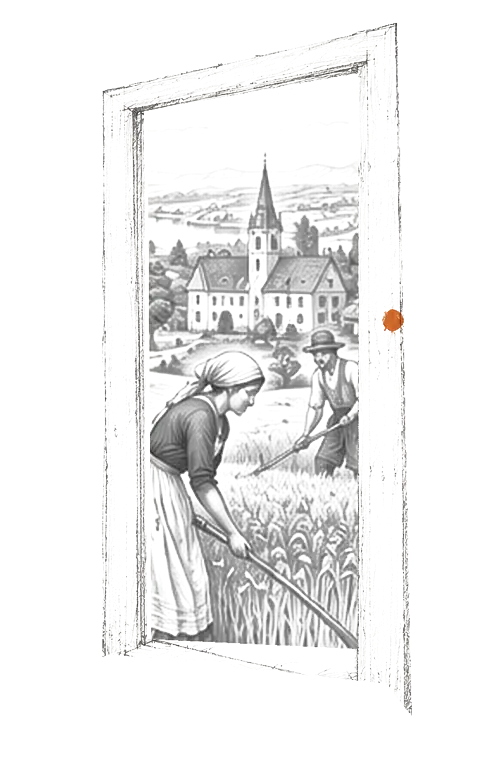
Four cantos, the joys of spring, the labours of summer, the goods of autumn and the cares of winter, follow a year in a Lithuanian village in East Prussia. The serf peasants plough, harvest, celebrate and quarrel, under masters from elsewhere whom the poem portrays satirically; the poet sets the good against the bad and describes nature in the villagers' own words.
Timeline
- 1818DonelaitisThe Seasons, the first great text in Lithuanian, written a century earlier.
- 1864–1904The alphabet banBaranauskas, Maironis, Kudirka. Books are smuggled in from Prussia.
- 1920–1940IndependenceBinkis, Putinas, Nėris. A generation builds a state literature.
- 1944–1960Exile and deportationNyka-Niliūnas and Mekas leave; Sruoga writes Forest of the Gods.
- 1957–1984Cinema and thawŽalakevičius, Vabalas, Puipa, and Mekas filming New York.
Reading keys
- Names decline and indicate the civil status of women: the ending in -aitė designates a daughter, that in -ienė a wife, and a neutral form in -ė was introduced recently.
- Surnames often have a Polonised form in the archives and a Lithuanian form in the present civil registry, so that the same author appears under two spellings according to the source.
- The Jewish names of Lithuania, the Litvaks, are found all over the world in the form taken at emigration, and their original spelling has disappeared from the local registers.
- The Catholic baptismal name and the day of the corresponding saint structure family life, more than the birthday.
- The participation of Lithuanian auxiliaries in the extermination of the Jews is the heaviest subject, and a text situates itself by the way it names or does not name the perpetrators.
- The armed resistance of the partisans, until the mid nineteen fifties, and the deportations to Siberia provide the matrix of the national narrative.
- The Polish past and the question of Vilnius, held by Poland from 1920 to 1939, remain charged, as does the status of the present Polish minority.
- The Catholic religion is associated with national resistance, and anticlericalism there takes on a colouring it does not have elsewhere.
- Catholicism is in the majority and political, the last country in Europe to be Christianised, in 1387, which explains the proximity of the old cults and of Marian devotion.
- The hill of crosses, near Šiauliai, was razed three times by the Soviet authorities and reconstituted each time: it is the most significant place of devotion in the country.
- The old Baltic pantheon, with Perkūnas the thunder, the domestic grass snakes fed with milk and the sacred groves, is known through brief sixteenth-century sources and through the songs.
- Lithuanian Judaism, a rationalist current opposed to Hasidism, formed the Talmudic schools of reference for the whole of Eastern Europe.
- Midsummer, Rasos, with wreaths, fires and the gathering of plants, and the autumn festival of the dead, with candles in every cemetery on 1 November, frame the year.
- The Kaziukas of March, the craft fair of Vilnius, with its plaited palms and its cakes, serves as a recurrent urban setting.
- The Christmas eve of 24 December includes twelve meatless dishes and a place left for the dead of the year.
- Funeral vigils last several days with songs and lamentations, a documented poetic genre distinct from prayer.
- The poem of the seasons of 1818 is the claimed founding text, and its lines on the life of the peasants are learnt at school.
- Basanavičius's collections of tales, published from 1898, are a major source for the folk tale; the tale of Eglė queen of the grass snakes, the marriage of a woman and a serpent, is material taken up by the poets.
- The book carriers of the time of the ban are a national figure, with a monument and a commemoration day.
- The medieval grand dukes, Gediminas and Vytautas, and the union with Poland are political references that literature summons without explaining them.
- Lithuanian is the most archaic living Indo-European language in its morphology, which makes it an object of national pride and an argument in the texts.
- The country was the largest state in Europe in the fifteenth century, and that imperial memory contradicts the image of a small Baltic country.
- Lithuanian and Latvian are related, but Lithuanian has nothing to do with Slavic despite centuries of Polish and Russian contact.
- The Jerusalem of the North is not a tourist metaphor: Vilnius was a major Jewish centre, and its absence in post-war texts is an effect of the extermination, not a choice.
- The catalogue mixes works written in Lithuanian, in Hebrew and in Polish: literary nationality is not confused here with language.
Tales and mythologies 1
- TaleLietuviškos pasakosJonas Basanavičius · 1898not translated into EnglishVillage tales noted down within a family and printed among the Lithuanians of America.Literature
A selection to begin with 10 / 53
- NovelAltorių šešėlyVincas Mykolaitis-Putinas · 1933not translated into EnglishThe novel of a torn priest-poet, written by a priest who was about to leave the clergy.Literature
- NarrativeForest of the GodsDievų miškasBalys Sruoga · 1945The account of a poet deported to Stutthof, who answers the horror of the camp with irony and the grotesque.Literature
- PoetryIdylls of SemeniskiaiSemeniškių idilėsJonas Mekas · 1948The native village brought back to life by a young exile, in pastoral poems written at the end of the war.Literature
- NovelStalemateLygiosios trunka akimirkąIcchokas Meras · 1963A young player facing a Nazi officer, and on the chessboard the lives of the ghetto's children.Literature
- Feature filmThe Girl and the EchoPaskutinė atostogų dienaArūnas Žebriūnas · 1964A friendship between children on a shore, over the last day of a summer.Cinema
- Feature filmNobody Wanted to DieNiekas nenorėjo mirtiVytautas Žalakevičius · 1965A Lithuanian village torn between the partisans of the forest and the new Soviet authorities.Cinema
- Feature filmFeelingsJausmaiAlgirdas Dausa and Almantas Grikevičius · 1968Two twin brothers and the women around them, on the edge of the lagoon, at the end of the war.Cinema
- Feature filmBirželis, vasaros pradžiaRaimondas Vabalas · 1970A town on the Neman frozen in waiting, just as the hopes of the thaw die out.Cinema
- PoetryThe Ballads of KukutisKukučio baladėsMarcelijus Martinaitis · 1977A village fool, Kukutis, says in ballads what Soviet censorship does not allow to be said.Literature
- Feature filmA Woman and Her Four MenMoteris ir keturi jos vyraiAlgimantas Puipa · 1983A woman among fishermen, in a world of sand and sea where life goes on in spite of everything.Cinema