Madagascar
- works
- 20
- 14 books · 6 films
- period covered
- 1830–1996
- language of writing
- Malagasy and French
The language of Madagascar is not African. Malagasy belongs to the Austronesian family, and its closest known relative is spoken in the south of Borneo, seven thousand kilometres away. Navigators therefore set out from Indonesia a little more than a thousand years ago, crossed the Indian Ocean and settled on an island four hundred kilometres from Africa, whose language they did not know. Everything else follows from that, including the way the island tells its own story: come from elsewhere and with no neighbour.
Read moreShow less
That origin explains the composition of the country: a population come from South-East Asia, from East Africa and from the Arab world, a terraced rice cultivation recalling Java, stone tombs and a cult of the ancestors belonging to none of those areas. The proverbs, the ohabolana, and the amorous poetic contests, the hainteny, form a verbal art so dense that Jean Paulhan, who lived in Tananarive before directing the Nouvelle Revue française, published in 1913 a translation of them that has remained famous.
The entry into writing was made at the cost of a sacrificed generation. Jean-Joseph Rabearivelo, expelled from school at thirteen, a badly paid proofreader in a printing house, made himself a poet by learning French on his own and working on the hainteny. He is held to be the first modern poet of Africa. In May 1937, the colonial authorities struck him off the delegation that was to represent Madagascar at the Paris Exhibition, after imprisoning him for three days over a tax. He took his own life on 22 June. Half of his work was unpublished.
What awaits the reader is a poetry of the brief image, inherited from the proverb and the contest, in which a sentence about a tree or a canoe settles a matter of life and death. The collection that opens this page is called "Translated from the Night", and its thirty poems seem to translate themselves before the reader's eyes, from one inner language to the other.
A way to begin
Translated from the Night
Jean-Joseph Rabearivelo · 1935
Thirty poems free of rights, written at once in Malagasy and in French, the summit of Rabearivelo's work.
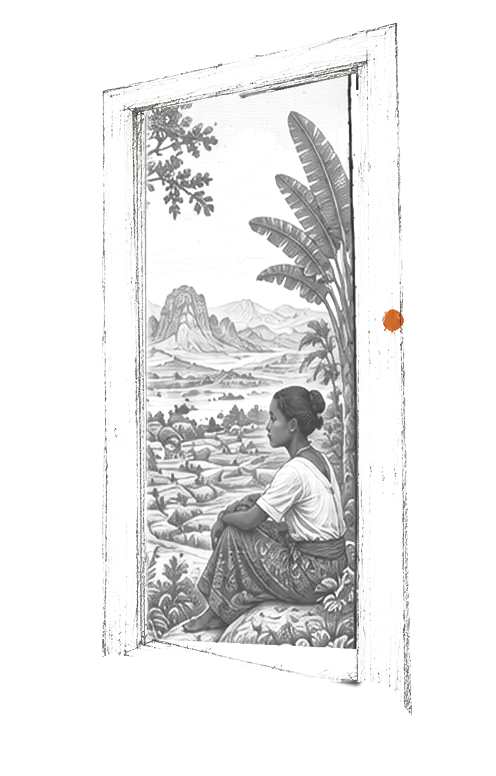
Thirty short poems, presented as “transcribed from the Hova by the author”. Images of the highlands mingle with strange dream visions, in a mode that reconnects with Malagasy oral poetry, and the poems seem to translate themselves before the reader's eyes, from one inner language to the other.
Timeline
- 1920–1936Poetry in printNy Avana, Samuel Ratany, Rodlish. The first Malagasy collections.
- 1924–1937RabeariveloThe country's greatest poet writes in French and takes his life at thirty-six.
- 1942–1958Exile and the Malagasy languageRabemananjara writes in prison; Dox sings in Malagasy.
- 1970–1975First filmsRaharimanantsoa, Ratovondrahona, Ramampy. A cinema without means.
- 1986–1988The Price of PeaceRafenomanjato's play, Rakotozanany's film, then Tabataba.
Reading keys
- Malagasy names are long and meaningful: Rabearivelo, Rabemananjara, Ratsifandrihamanana are composed of elements describing a quality or a wish. The prefix Ra marks respect.
- One does not ask for the name of a recently deceased person, and a dead person may be designated by a periphrasis.
- Kinship is thought through the family tomb: to belong to a family is to have the right to be buried in it. A character excluded from the tomb is socially dead.
- The old castes, andriana nobles, hova commoners and descendants of slaves, still structure alliances without being named.
- The insurrection of 1947 and its repression were long a forbidden subject, which the cinema of the nineteen eighties finally addresses head-on.
- The fady, the prohibition, regulates what may be said, eaten, touched or named. It varies from one region to another, and transgressing a fady has consequences in the narrative.
- Servile descent is a taboo subject, never named but present in questions of marriage.
- Indirect speech is the norm: bad news is announced by a proverb, and the kabary, ceremonial address, takes its time before reaching the subject.
- Christianity, Protestant and Catholic, took root in the nineteenth century and coexists with the cult of the ancestors without anyone seeing a contradiction in it.
- Zanahary is the creator, and the razana, the ancestors, are everyday interlocutors. One speaks to them, feeds them, consults them.
- The famadihana, the turning of the dead, consists in taking the bodies out of the tomb, wrapping them in new shrouds and dancing with them. It is a celebration, not a macabre scene.
- The vazimba, first inhabitants become spirits, haunt places of water and stones.
- The stone tomb is the investment of a lifetime and often more carefully made than the house of the living. Its description in a narrative indicates a family's rank.
- The lamba, a piece of cloth worn on the shoulder, also serves as a shroud, which charges its mention.
- The famadihana brings together the dispersed family and costs a great deal: a famadihana scene is a scene of debts and alliances as much as of piety.
- The zebu is the measure of wealth and the sacrifice that seals commitments.
- The ohabolana, proverbs, and the hainteny, amorous poetic contests, are the common stock that all authors work on.
- Ibonia, the epic of the hero of a thousand forms, is the great traditional narrative of the island.
- The vazimba, first inhabitants, and the narratives of the arrival of the ancestors by sea found the identity of the lineages.
- The royal traditions of Imerina, collected in the nineteenth century from the holders of dynastic memory, provide the founding narratives of Antananarivo.
- Madagascar is not culturally African, nor Asian, and placing it in one or the other category misses the essential.
- The famadihana is not a morbid cult: it is a reunion celebration, with music and a meal.
- The fady is not a residual superstition but a system of active prohibitions, variable according to place, which Malagasy people negotiate daily.
- The country's poverty is real but Malagasy literature is old and abundant, in Malagasy as much as in French.
Tales and mythologies 1
- EpicIboniaAnonymous · 1830The great heroic tale of the island, in which a child prodigy sets out to win back his betrothed.Literature
Available in English 1
The books from this country that can be read in English, in the original or in translation.
- PoetryTranslated from the NightTraduit de la nuitJean-Joseph Rabearivelo · 1935Thirty poems born of two languages at once, between the Malagasy highlands and the night.Literature
A selection to begin with 10 / 20
- PoetryAntsaJacques Rabemananjara · 1948not translated into EnglishA hymn to Madagascar written behind bars by a poet sentenced after the revolt of 1947.Literature
- PoetryLa Nymphe dorée ou Fleur d'AndraikibaFidelis Justin Rabetsimandranto · 1958not translated into EnglishA legend of Lake Andraikiba, put into French verse by a Malagasy poet in 1958.Literature
- CinemaSaribaoHugues Raharimanantsoa · 1970One of the first Malagasy fictions: a peasant who has come to sell his goods in town, in a few minutes.Cinema
- CinemaTranon-kalaRichard Claude Ratovonarivo · 1971One of the first Malagasy works of fiction: a man, before his execution, looks back over his life.Cinema
- CinemaL'AccidentBenoît Ramampy · 1972A twenty-nine-minute fiction film, shot with a camera lent from Paris, on the inequality between rich and poor in Madagascar.Cinema
- CinemaAsakasakaJustin Limby Maharavo · 1973A pregnancy outside marriage, the subject of one of the first fiction films shot in Madagascar, in 1973.Cinema
- PoetrySimple voyelleEsther Nirina · 1980not translated into EnglishVerses written on the banks of the Loire by a poet born in the Malagasy highlands.Literature
- CinemaIlo tsy verySolo Ignace Randrasana · 1987The Malagasy uprising of 1947 and its repression, told by a child who survived them, in a film co-produced with Algeria.Cinema
- CinemaTabatabaRaymond Rajaonarivelo · 1988The uprising of 1947 and its repression, seen through a child from the eastern coast.Cinema