Malawi
- works
- 7
- 7 books
- period covered
- 1907–1995
- language of writing
- English
On 25 September 1987, a professor of linguistics was arrested as he came out of a bar in Zomba. Jack Mapanje was taken away without a warrant, without a charge, and would spend three years, seven months and sixteen days in Mikuyu prison, without ever being tried or knowing why. His only collection of poems, published six years earlier, had been withdrawn from the bookshops and the syllabuses. The regime never explained what, in those poems about chameleons and gods, had displeased it, and the author himself still does not know.
Read moreShow less
That arrest sums up thirty years of a regime that took literature very seriously. Malawi was governed from 1964 to 1994 by a man who had banned trousers for women and long hair for men, and instituted a censorship board that examined every book entering the country. Thousands of titles were banned, including English novels of the nineteenth century. Within that framework, the university of Zomba paradoxically produced an active literary circle, where people wrote through animal metaphors and proverbs, because that was the only possible way.
The dominant form is therefore brief and allusive poetry. Mapanje works on Chichewa proverbs and turns them against the authorities, counting on the fact that a censor cannot prove that a chameleon designates a president. Legson Kayira, who walked out of Malawi as far as Uganda before reaching America, published in 1967 a novel about a divided village. Sam Mpasu published a novel that earned him, from 1975 to 1977, two years of detention without trial. The price was paid by almost all the writers of that generation: prison, exile, or silence.
What awaits the reader is a poetry that learned to speak under surveillance, and whose obliquity remains after the censorship. The collection that opens this page was withdrawn from schools in 1985, and its author was arrested two years later without any official explanation being given.
A way to begin
Of Chameleons and Gods
Jack Mapanje · 1981
Poems in a conversational tone, steeped in riddles and coded images, under Hastings Banda's one-party rule.
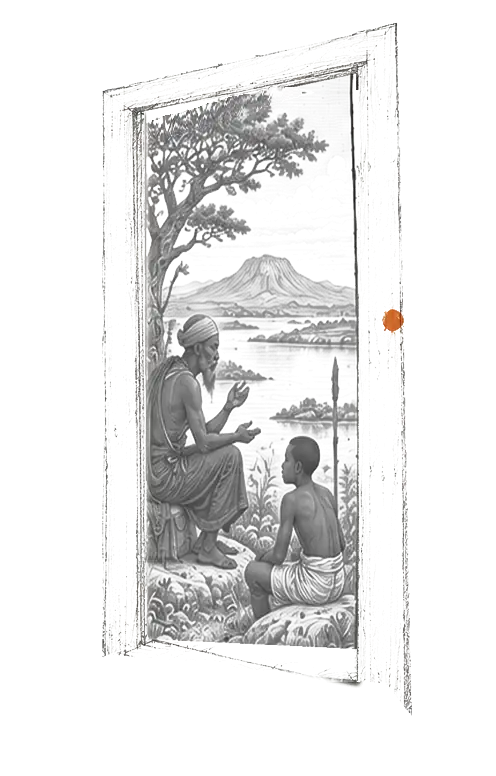
Poems written over some ten years and arranged in four parts, including sketches of London and a return home. Beneath a seemingly harmless conversational tone, drawing on riddles and oral forms, they mock the rulers and those who serve them, artists reduced to selling their wares to tourists, and return to coded images, such as the dawn and the cockerel that recall the party flag.
Timeline
- 1967–1975First novelsLegson Kayira, who walked to the United States, then Sam Mpasu.
- 1987MapanjeHis veiled poems cost him four years in prison without trial.
Reading keys
- Names indicate the group: Chewa in the centre, Tumbuka in the north, Yao in the south-east, with the Bantu class prefixes.
- Chewa societies are matrilineal and matrilocal: the husband settles in his wife's village, and the maternal uncle has authority over his sister's children.
- The Tumbuka societies of the north are patrilineal, which creates two opposed kinship systems within the country.
- The name may carry the trace of the mission school, with a biblical first name attached.
- The regime from 1964 to 1994, its detentions without trial and its censorship board are the frame of all the production of that period.
- Tensions between the north and the centre, and the political marginalisation of the Tumbuka, are an old subject.
- The proverb and the animal fable served to say the unsayable, and that manner remained after the end of censorship.
- Sorcery is an accusation with real consequences, with trials and expulsions from the village.
- Christianity is in the majority, Presbyterian in the north and Catholic in the centre, with an important Yao Islam in the south-east dating from the Swahili trade.
- Chiuta or Mulungu is the name of the creator god, and the mizimu the ancestral spirits.
- The cult of M'bona and the rain shrines of the south of the country are ancient religious institutions, with their mediums and their sacred woods.
- The sing'anga, healer, and the accusation of sorcery frame the explanation of misfortune.
- Mourning includes a wake, a burial and a ceremony of purification, with prohibitions for the widow.
- Gule Wamkulu, the great masked dance of the Chewa, listed as intangible heritage, brings out the spirits of the dead and of animals at funerals and initiations. The appearance of a mask suspends the ordinary order.
- The rain rites addressed to M'bona take place at the end of the dry season.
- 6 July, the day of independence in 1964, is the civil landmark.
- The tales and songs in Chinyanja published in 1907, in the original language with a translation, form the country's oldest documented corpus.
- Gule Wamkulu and its repertoire of named masks are a common knowledge that the texts assume is known.
- The Chichewa proverbs, used as arguments in a conversation, are the raw material of Mapanje's poetry.
- The cult of M'bona and its founding narratives are a religious reference shared with neighbouring Mozambique.
- Chewa matrilineality reverses what a reader expects: the husband is a stranger in his wife's village, and the maternal uncle decides.
- Gule Wamkulu is not a folkloric show but a ritual institution whose masks are presences.
- The obliquity of Malawian poetry is not a preciosity but the result of a censorship that read everything.
- The country has one of the oldest universities in Southern Africa, which contradicts the image of a place without intellectual life.
Tales and mythologies 1
- TaleSome Folk-lore Stories and Songs in ChinyanjaRobert Sutherland Rattray · 1907In Nyasaland, Chinyanja serves as a common language between the districts, but is hardly printed except in translations of the Bible.Literature
A selection to begin with 5 / 7
- NarrativeMan of AfricaNthondoSamuel Josia Nthara · 1933The imaginary life of a nineteenth-century Chewa, from childhood in the village to the trial of faith, in Chichewa.Literature
- NovelNo Easy TaskAubrey Kachingwe · 1965A young journalist caught up in an African colony's march towards independence, the first Malawian novel in its series.Literature
- NovelThe Looming ShadowLegson Kayira · 1967The novel appears three years after the independence of Malawi, the former British Nyasaland, proclaimed in 1964.Literature
- NovelNo Bride PriceDavid Rubadiri · 1967A young civil servant at odds with his minister, between the city, his mistress and office intrigues.Literature
- NarrativePolitical Prisoner 3/75 of Dr. H. Kamuzu Banda of MalawiSam Mpasu · 1995In 1994, Malawi held its first free elections and ended Hastings Banda's one-party rule.Literature