Mexico
- works
- 78
- 40 books · 38 films
- period covered
- 1577–1998
- language of writing
- Spanish
On 12 July 1562, a Franciscan friar had twenty-seven Maya books burned in a square in the Yucatán. Diego de Landa judged them full of the devil's superstitions; they were codices of astronomy, genealogy and ritual, written on fig bark and folded like a concertina. Four years later, back in Spain to justify himself, he wrote a detailed description of Maya religion, calendar and writing. Only four codices remain today, and the principal work that makes it possible to decipher them is by the hand of the man who destroyed the others.
Read moreShow less
That contradiction is the one running through all Mesoamerican documentation. Bernardino de Sahagún, another Franciscan, spent thirty years questioning old men of Tlatelolco in order to compose an encyclopaedia of the Nahua world, in Nahuatl and in Spanish in two columns, with the names of his informants: it is ethnography two centuries before the discipline existed, produced by a man whose mission was to erase what he was recording. Without those books written by adversaries, we would know almost nothing.
Hence a literature obsessed with buried layers. Sor Juana Inés de la Cruz, a seventeenth-century nun, wrote a poem about the soul that rises above the world during sleep, and was forced into silence by her hierarchy. Three centuries later, Juan Rulfo published in 1955 a novel in which a man arrives in a village whose inhabitants are all dead and go on speaking. Between the two, the revolution produced its own genre, and Mexican cinema had in the nineteen forties a golden age that supplied the whole Spanish-speaking world.
What awaits the reader is a country where the dead have not gone away and where the past surfaces without warning. The novel that opens this page lets us hear the voices of a deserted village, in fragments, without order or transition, and García Márquez said he had found in it the way to One Hundred Years of Solitude.
A way to begin
Pedro Páramo
Juan Rulfo · 1955
A village peopled by voices, where a son goes in search of his father: perhaps the most important novel in Mexico.
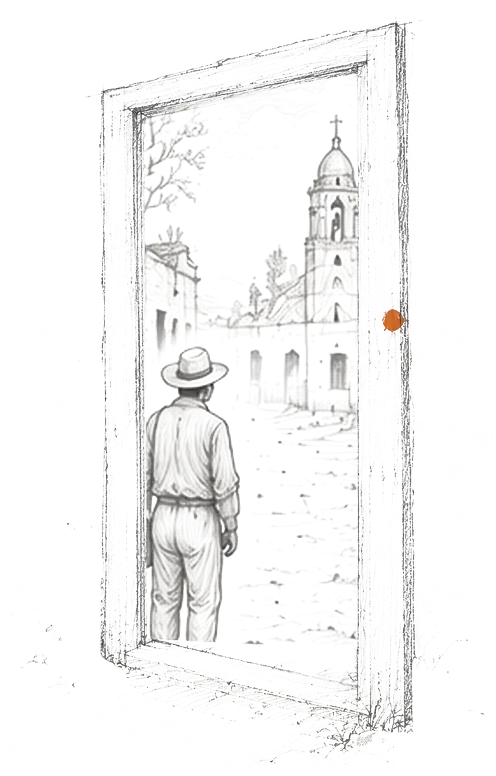
Juan Preciado has promised his dying mother to go to Comala and find his father, Pedro Páramo, whom he has never known. He discovers a deserted village where murmurs and shadowy figures speak to him and answer one another. In fragments, without order or transition, the story emerges of Pedro Páramo, master of the Media Luna, his harshness to all and his stubborn love for Susana San Juan.
Timeline
- –1521Pre-Hispanic worldsNahuatl poetry, Mayan codices. A literature the conquest burned.
- 1650–1695Colonial baroqueSor Juana Inés de la Cruz, nun and poet, the summit of colonial letters.
- 1910–1940RevolutionIt runs through everything: the novel, the fresco, mural painting.
- 1935–1960Golden age of cinemaMexico supplies the whole Spanish-speaking world. Buñuel films his exile there.
- 1950–1970The great novelRulfo, Fuentes, Paz. Three ways of saying the same country.
Reading keys
- The Spanish usage of two surnames applies: Juan Rulfo signed with a shortened name, and one classifies by the father's name.
- Nahuatl and Maya names survive as surnames, and a name like Xochitl or Itzamná signals an identity claim.
- Compadrazgo, godparenthood, creates a network of obligations that crosses classes and structures social and political life.
- The extended family, with the grandmother's house as its centre, is the unit of reference, and emigration to the north is an ordinary event.
- The Tlatelolco student massacre of 1968 was denied for thirty years, and its narrative founded a literature of testimony.
- The revolution of 1910 is a political capital whose monopoly served a single party for seventy years, and contesting it is a literary gesture.
- The indigenous question, the state of Chiapas and the uprising of 1994 are subjects on which every account is situated.
- The violence linked to drug trafficking since the two thousands is a subject on which writing costs dear: dozens of journalists have been killed.
- Catholicism is very much in the majority, with the Virgin of Guadalupe as central figure, appearing according to tradition in 1531 on a hill dedicated to a Nahua divinity.
- The pre-Hispanic cults did not disappear but were superimposed: the saints occupy the places and the functions of the former divinities.
- The nagual, the capacity of certain people to take animal form, and the healers, curanderos, belong to the living stock and not to folklore.
- Santa Muerte, a female skeleton venerated since the two thousands by millions of people, is a contemporary cult that the Church condemns.
- The Day of the Dead, on 1 and 2 November, gathers families around altars loaded with food, yellow flowers and photographs. It is not a macabre carnival but a visit.
- Black is worn in mourning, and the wake with coffee and narratives is held at the home of the deceased.
- The orange of the cempasúchil, the flower of the dead, and cut paper are immediate markers of the season.
- The village patron saints' festivals, with masked dances and fireworks, often serve as a narrative hinge.
- The Legend of the Suns and the Annals of Cuauhtitlán recount the five successive creations of the world and the necessity of sacrifice for the sun to rise.
- Quetzalcóatl, the feathered serpent who departs eastward promising to return, is the most frequently summoned figure of Mexican culture.
- La Llorona, a woman who weeps for her drowned children and haunts watercourses, is known to all and has been brought to the screen countless times.
- Sahagún's Florentine Codex, with its named informants, is the source of almost everything known about the Nahua world.
- The Day of the Dead is not a celebration of death but a reception: the deceased are awaited, and their favourite dish is prepared for them.
- The Maya and Nahua codices are not books lost by accident: four Maya codices survive out of hundreds, and that destruction was methodical.
- Mexico is not a homogeneous country: sixty-eight indigenous languages are recognised there and spoken by several million people.
- Magic realism is not the key to the Mexican novel: Rulfo, who preceded it, proceeds by ellipsis and not by the marvellous.
Tales and mythologies 2
- ChronicleThe Books of Chilam BalamChilam BalamAnonymous · 1700The conquest destroyed the glyphic books; what survives of Maya thought was copied in the Latin alphabet by those who had learned it at church.Literature
- ChronicleFlorentine CodexHistoria general de las cosas de Nueva EspañaBernardino de Sahagún · 1577A comprehensive work on Nahua civilisation, gathered from the elders and recorded in their language.Literature
A selection to begin with 10 / 78
- PoetryFirst DreamPrimero sueñoSor Juana Inés de la Cruz · 1692A soul freed by sleep tries to embrace all the knowledge of the world, in a great poem of the baroque of New Spain.LiteraturePublic domain
- NovelThe UnderdogsLos de abajoMariano Azuela · 1915A peasant from Zacatecas rises up, and his band loses its way in a revolution whose ideals fade.Literature
- Feature filmLos OlvidadosLos olvidadosLuis Buñuel · 1950The street children of a poor suburb of Mexico City, caught between the gang, hunger and the reformatory.Cinema
- Short storiesConfabulario and Other InventionsConfabularioJuan José Arreola · 1952Fables and stories a few pages long, in which absurdity and irony target science, advertising and progress.Literature
- NovelThe Nine GuardiansBalún CanánRosario Castellanos · 1957The end of the order of the great landowners of Chiapas, seen through the eyes of a child of their world.Literature
- Feature filmMacarioRoberto Gavaldón · 1960A poor woodcutter in New Spain is given the gift of healing by a strange guest.Cinema
- Feature filmThe Pearl of TlayucanTlayucanLuis Alcoriza · 1962A peasant steals a saint's pearl to heal his son, and a whole village gets involved.Cinema
- Feature filmThe Days of LoveLos días del amorAlberto Isaac · 1972The first loves of a provincial teenager, in the time when the army is fighting a religious uprising.Cinema
- Feature filmCanoa: A Shameful MemoryCanoaFelipe Cazals · 1976Five young hikers look for shelter in a village that its priest has turned against the communists.Cinema
- NovelLike Water for ChocolateComo agua para chocolateLaura Esquivel · 1989The forbidden love of a youngest daughter bound to her mother, on a Mexican ranch at the time of the revolution.Literature