Spain
- works
- 101
- 70 books · 31 films
- period covered
- 1207–1999
- language of writing
- Spanish
The first picaresque novel appeared without an author's name, in 1554, in four towns at once. A child there serves a blind man, a miserly priest and a penniless squire, and he ends up content by closing his eyes to his wife's conduct with an archpriest. The Inquisition put it on the Index in 1559, then from 1573 let circulate a version expurgated of its passages on the clergy. It is still not known who wrote it, and anonymity was probably the book's condition.
Read moreShow less
That literature was made under surveillance and with identities it was better to keep quiet. The Jews were expelled in 1492, the Moriscos in 1609, and the statutes of purity of blood required proof of Christian ancestry in order to hold an office, which explains the quantity of anonymous texts, of pseudonyms and of double bottoms. To which is added the plurality of languages: Castilian, but also the Galician of Rosalía de Castro, Catalan and Basque, which became official again in their regions after 1978.
The Spanish form is the voice that recounts its own life without complaining, and the parody of the noble genres. The price was paid in the twentieth century: Federico García Lorca was shot in August 1936 and his body was never found, Miguel Hernández died in prison in 1942, the poets of the Republic wrote from Mexico or England. Under Franco, the censors read everything: Carmen Laforet's first novel, in 1945, got through by showing a Barcelona family decomposing, and Viridiana, a Spanish film by Buñuel awarded a prize at Cannes in 1961, was immediately banned in Spain and stripped of its nationality.
What awaits the reader is a literature of hunger, of honour and of comic lucidity, with no metaphysical consolation. The novel that opens this page, dated 1605, sets on the road a hidalgo who has read so many romances of chivalry that he believes himself a knight errant; in the sequel of 1615, characters he meets have read the first book.
A way to begin
Don Quixote
Miguel de Cervantes · 1605
A hidalgo who takes himself for a knight errant, and his peasant squire: the book placed first among works of fiction by a hundred writers in 2002. Free of rights.
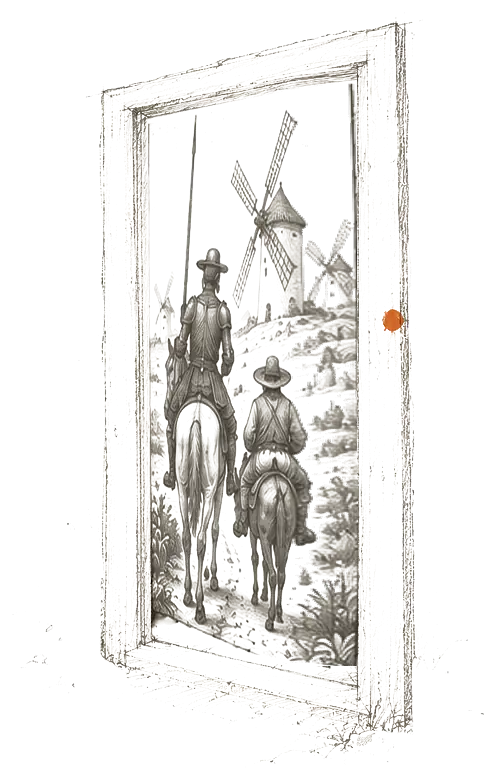
In a village of La Mancha, a poor hidalgo reads so many romances of chivalry that he loses his reason and believes himself a knight errant. He names himself Don Quixote, christens his horse Rocinante, chooses a lady and has himself knighted at an inn he takes for a castle. He sets out again with a neighbour, the peasant Sancho Panza, to whom he promises the governorship of an island, and charges windmills he takes for giants.
Timeline
- 1140Castilian epicThe Cantar de mio Cid, the first great text of the language.
- 1550–1680Golden AgeCervantes, Lope de Vega, Calderón, Quevedo, Góngora. A summit without equal.
- 1554Picaresque novelLazarillo de Tormes invents the tale of the rogue, which spreads everywhere.
- 1830–1870RomanticismBécquer, Espronceda. Spain dreams itself a past.
- 1898Generation of '98After the loss of the colonies, a generation asks what Spain is.
- 1927Generation of '27Lorca, Alberti, Cernuda. A constellation of poets, broken by the war.
- 1936–1975Civil war and FrancoismExile, censorship, indirection. Buñuel films from elsewhere.
- 1975–1990La MovidaAfter Franco, a surge. Almodóvar comes out of it.
Reading keys
- Everyone bears two family names, the father's and then the mother's, and a woman does not change her name on marrying: characters are therefore cited under long forms that French truncates.
- The compound name with the particle de indicates a geographical origin more often than a nobility.
- Don and doña before the first name mark the respect due to a position, and their ironic use is a constant comic device since the sixteenth century.
- Godparenthood and co-parenthood bind families of different conditions, and the village of origin remains a declared belonging.
- The civil war, the mass graves and the amnesty law of 1977 form a still open conflict of memory, revived by the historical memory laws of the past twenty years.
- Catalan and Basque nationalisms, the languages and the independence referendums situate a text from its vocabulary onwards.
- ETA's terrorism, its victims and the end of the organisation in 2018 are a subject in which every word counts.
- The colonial past in America and the expulsion of the Jews and the Moriscos have recently been approached in the terms of reparation.
- Catholicism was the state religion until 1978 and the Inquisition was abolished only in 1834, which explains the weight of suspicion in all the older literature.
- The brotherhoods of Holy Week are civil institutions as much as religious ones, with waiting lists and hierarchies.
- Spanish mysticism, Teresa of Ávila and John of the Cross, provided a language of inner experience that modern poetry re-employs.
- The regional legendary stock, souls in torment, haunted mountains, was fixed by Bécquer between 1858 and 1864 in a prose that still serves as a model.
- Holy Week, with its night processions and its hoods, is the great national rite, and its description in a text always carries a political charge.
- Village festivals, bulls, Saint John's fires, pilgrimages, structure the calendar and serve as a collective scene.
- The late meal, the siesta and the evening outing organise the days, and a novel that ignores them rings false.
- Mourning is worn in black and for a long time, especially in rural settings, and the wake gathers the neighbourhood around the body.
- Don Quixote is a reference usable without explanation, and its characters serve as adjectives.
- The Cantar de mio Cid, around 1200, and the Romancero, a corpus of ballads transmitted since the fifteenth century, form the epic and sung stock.
- The tale collections of Fernán Caballero in 1859 and then of Espinosa in the nineteen twenties are the reference corpora of the popular narrative.
- Don Juan, born in the theatre of the seventeenth century and remade by Zorrilla in 1844, is a figure that Spain considers its own.
- Spain is plurilingual: Catalan, Galician and Basque have their literatures and their institutions, and the catalogue places them under one country for convenience.
- Basque is not a Romance language and has no known kinship with its neighbours.
- The picaresque is not a picturesque genre but a literature of hunger and survival, written in a society of castes.
- Andalusian folklore, flamenco and bulls, was taken for the whole of Spain by French romanticism, something Spanish authors have never stopped correcting.
- The catalogue stops essentially in the nineteen eighties, which reflects rights and translations and not the country's production.
Tales and mythologies 3
- EpicThe Epic of the CidCantar de mio CidAnonymous · 1207Castile at the end of the eleventh century, where a vassal banished by his king takes up arms again to recover his honour.LiteraturePublic domain
- PoetryBook of AlexanderLibro de AlexandreAnonymous · 1230The story of Alexander the Great told in learned thirteenth-century Castilian, as that of a Christian knight.LiteraturePublic domain
- PoetrySpanish BalladsRomancero viejoAnonymous · 1500Short poems sung and passed on by word of mouth, then printed as peddlers' broadsheets at the beginning of the sixteenth century.LiteraturePublic domain
A selection to begin with 10 / 101
- NovelLazarillo de TormesAnonymous · 1554Sixteenth-century Castile, seen through a poor child who passes from master to master.LiteraturePublic domain
- PoetryGalician SongsCantares gallegosRosalía de Castro · 1863A peasant woman sings of Galicia, and other voices from the villages answer her.LiteraturePublic domain
- TheatreBlood WeddingBodas de sangreFederico García Lorca · 1933On her wedding day, a bride runs away with the man she once loved, and the whole wedding party sets off in pursuit of them.Literature
- PoetryThe Unceasing LightningEl rayo que no cesaMiguel Hernández · 1936Sonnets of a love that causes suffering, peopled with bulls and lightning, and the mourning of a comrade.Literature
- NovelNadaCarmen Laforet · 1945An orphaned student discovers, in the family flat on Calle Aribau, the poverty of the years following the Civil War.Literature
- CinemaViridianaLuis Buñuel · 1961A novice gives up the convent and opens a Castilian estate to beggars, in an act of charity poorly repaid.Cinema
- CinemaLife Goes OnEl mundo sigueFernando Fernán Gómez · 1965Two sisters from a poor district of Madrid tear each other apart, jealous of one another and of money.Cinema
- CinemaLa ciudad no es para míPedro Lazaga · 1966Agustín Valverde leaves Calacierva to live with his son, a doctor, in Madrid, where he is out of place.Cinema
- CinemaNine Letters to BertaNueve cartas a BertaBasilio Martín Patino · 1966Back from England in Salamanca, Lorenzo writes nine letters to Berta, who has stayed in England, and tells her of the boredom of his city.Cinema
- CinemaLa piel quemadaJosé María Forn · 1967An Andalusian bricklayer in Lloret de Mar, José spends his last night alone while Juana and their children travel by train to join him.Cinema