Puerto Rico (United States)
- works
- 11
- 11 books
- period covered
- 1849–1980
- language of writing
- Spanish
For fifty years, Puerto Rican children were taught in a language their teachers spoke badly. After the annexation of 1898, the American authorities imposed English as the language of instruction on an entirely Spanish-speaking island, brought in teachers from the mainland, sent students to train in the United States, and had the American anthem sung in the playgrounds. The measure failed: Spanish resisted in the playgrounds and in the homes, school results collapsed, and teaching in Spanish was restored only in 1948, fifty years later.
Read moreShow less
That episode tells of a status without equivalent. Puerto Rico is a territory of the United States whose inhabitants have been American citizens since 1917 and serve in the army, but do not vote in the presidential election and have no voting representative in Congress. Neither a state, nor a colony according to the official vocabulary, nor an independent country: that indeterminacy is the permanent subject of Puerto Rican literature, and the question of status comes back to the vote every ten or twenty years without ever being settled.
The dominant form is the narrative of migration and of mixed language. René Marqués wrote in 1953 the play of a peasant family that leaves the mountain for San Juan and then for New York, and loses something at each stage. Julia de Burgos, a poet who died in New York in 1953, had written in 1938 lines of a freedom that took forty years to be recognised. Luis Rafael Sánchez published in 1976 a novel built entirely on the spoken language of San Juan, with the radio, the advertising and the Spanish shot through with English, and made a music of it.
What awaits the reader is a literature of the linguistic in-between, in which passing from one language to another in mid-sentence is the subject and not the accident. The play that opens this page follows a peasant family from the mountain to a San Juan slum, then to New York, and each of its three acts bears the name of a place.
A way to begin
The Oxcart
René Marqués · 1953
A peasant family from the mountains to San Juan, then to New York: René Marqués's most famous play.
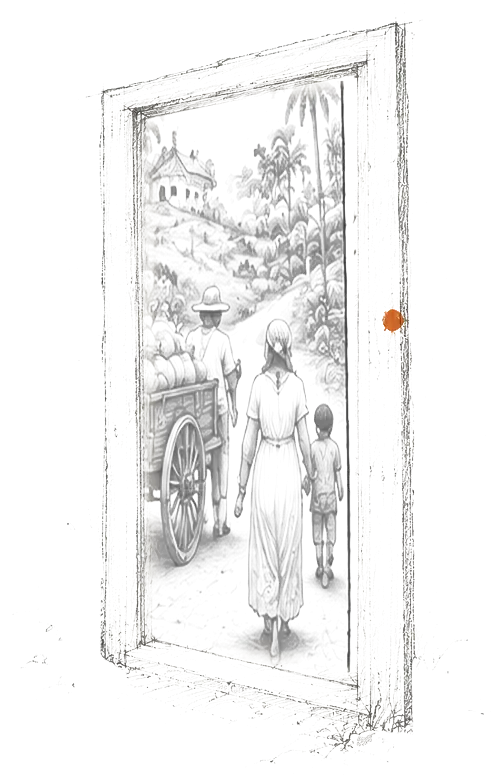
A Puerto Rican peasant family leaves the mountain where it farmed its land; the grandfather refuses to go. Luis, head of the family since his father's death, believes the city will bring them prosperity. In La Perla, a wretched San Juan slum, he loses one factory job after another, then the family moves on to New York, to the Bronx, where winter is harsh and Luis lives only for his work.
Timeline
- 1938–1953FoundationJulia de Burgos sings the river; La carreta tells the exodus to New York.
- 1976La guarachaLuis Rafael Sánchez writes the island in the language of the street.
Reading keys
- The Spanish usage of two surnames applies, and one classifies by the father's name.
- English first names and invented compound first names bear witness to American influence, and a first name places a generation.
- The extended family and the circulation between the island and the mainland, notably New York, are the norm: half of Puerto Ricans live in the United States.
- The Nuyoricans, Puerto Ricans born in New York, have produced their own literature, in English and in Spanglish, and their attachment to the country is debated.
- The question of status, between statehood, independence and the present situation, divides the country and situates any author politically.
- The repression of the independence movement, with the Ponce shooting in 1937 and the police surveillance lists, was long denied.
- The mass sterilisations of Puerto Rican women in the nineteen fifties and sixties are a documented and painful subject.
- The mixing of Spanish and English is judged by some as a degradation, and using it in literature is a position.
- Catholicism is in the majority, with an evangelical Protestantism deeply implanted since the American annexation.
- Santería of Cuban origin and espiritismo, a spiritist current come from France in the nineteenth century and become very popular, coexist with the church.
- The spirits of the dead and consultations with mediums are a common social fact, and the narrative treats them as such.
- The Taíno cosmogony of Boriquén, known through the Relación of 1498, is claimed as identity depth, and the petroglyphs of Caguana bear witness to it.
- The wake and the nine days of prayers organise the mourning.
- Black is worn in mourning, and the anniversary of the death is marked by a mass.
- The patron saints' festivals of each town, with their processions and their dances, are the local event of the year.
- The vejigantes of the Ponce carnival, horned papier-mâché masks, and bomba and plena, Afro-Puerto Rican musics, are identity markers.
- The collection published between 1916 and 1929 in an American journal, with tales, riddles and décimas, is the most extensive documented corpus of the island.
- Pané's Relación and the Taíno cosmogony, with Yúcahu and Atabey, are a stock shared with Haiti, Cuba and the Dominican Republic.
- The jíbaro, the mountain peasant, is the national identity figure, celebrated and debated.
- The bomba, the plena and the décima are musical and poetic forms that every text assumes are known.
- Puerto Rico is not an independent country, and its inhabitants are American citizens without the presidential vote: that status is the subject of its literature.
- Spanish never ceased to be the language of the island despite fifty years of schooling in English.
- Spanglish is not a linguistic laziness but a practice described and worked on by writers since the nineteen seventies.
- Nuyorican literature, written in English in New York, belongs to the same history, and excluding it from the Puerto Rican corpus is a debatable decision.
Tales and mythologies 1
- TalePorto-Rican Folk-LoreJ. Alden Mason and Aurelio M. Espinosa · 1916The texts were gathered during a scientific survey of the island, conducted by the New York Academy of Sciences with the island government.Literature
Available in English 7
The books from this country that can be read in English, in the original or in translation.
- NovelThe PondLa charcaManuel Zeno Gandía · 1894The poverty of the coffee day labourers on the island's heights, under Spain, in a naturalist novel.Literature
- PoetryRío Grande de LoízaJulia de Burgos · 1938In the thirties, the Nationalist Party demands the independence of Puerto Rico, a colony of the United States.Literature
- TheatreThe OxcartLa carretaRené Marqués · 1953In the middle of the century, the exodus of Puerto Rican peasants to San Juan and then to New York transforms the island.Literature
- Short storiesSpiksPedro Juan Soto · 1956Uprooted and poor Puerto Rican emigrants, who dream of their island in the streets of Harlem, in brief narratives.Literature
- NovelMacho Camacho's BeatLa guaracha del Macho CamachoLuis Rafael Sánchez · 1976Puerto Rico, a state associated with the United States, sees its capital overrun by cars, radio and culture from the mainland.Literature
- Short storiesThe Youngest DollPapeles de PandoraRosario Ferré · 1976Stories and poems against the roles imposed on the women of Puerto Rico, from the upper bourgeoisie to the common people.Literature
- EssayPuerto Rico: The Four-Storeyed Country and Other EssaysEl país de cuatro pisos y otros ensayosJosé Luis González · 1980The successive layers that formed Puerto Rico, storey by storey, according to a writer in exile in Mexico.Literature
A selection to begin with 9 / 11
- ChronicleEl gíbaroManuel A. Alonso · 1849not translated into EnglishWeddings, dances and cockfights of the peasants of Puerto Rico, in prose and verse, by a Romantic doctor from San Juan.LiteraturePublic domain
- NovelThe PondLa charcaManuel Zeno Gandía · 1894The poverty of the coffee day labourers on the island's heights, under Spain, in a naturalist novel.Literature
- NovelLa llamaradaEnrique A. Laguerre · 1935not translated into EnglishA newly graduated agronomist between the peons and the masters of the cane, in the Puerto Rico of the Great Depression.Literature
- PoetryTuntún de pasa y griferíaLuis Palés Matos · 1937not translated into EnglishThe Afro-Antillean poetry of Puerto Rico, its rhythms, its dances and its black queens, in a founding collection of negrismo.Literature
- PoetryRío Grande de LoízaJulia de Burgos · 1938In the thirties, the Nationalist Party demands the independence of Puerto Rico, a colony of the United States.Literature
- Short storiesSpiksPedro Juan Soto · 1956Uprooted and poor Puerto Rican emigrants, who dream of their island in the streets of Harlem, in brief narratives.Literature
- NovelMacho Camacho's BeatLa guaracha del Macho CamachoLuis Rafael Sánchez · 1976Puerto Rico, a state associated with the United States, sees its capital overrun by cars, radio and culture from the mainland.Literature
- Short storiesThe Youngest DollPapeles de PandoraRosario Ferré · 1976Stories and poems against the roles imposed on the women of Puerto Rico, from the upper bourgeoisie to the common people.Literature
- EssayPuerto Rico: The Four-Storeyed Country and Other EssaysEl país de cuatro pisos y otros ensayosJosé Luis González · 1980The successive layers that formed Puerto Rico, storey by storey, according to a writer in exile in Mexico.Literature