Dominican Republic
- works
- 26
- 21 books · 5 films
- period covered
- 1882–1995
- language of writing
- Spanish
In October 1937, at the border, people were asked to say a word. They had to pronounce perejil, parsley in Spanish, with its two r's and its jota. A Creole-speaking Haitian cannot articulate them as a Spanish speaker does. Those who failed were killed with machetes, by the thousand, on the orders of the dictator Trujillo who wanted to whiten the border. A difference of pronunciation served as a sentence, and the episode still bears, in Spanish as in Creole, the name of that word.
Read moreShow less
That massacre is the extreme expression of a question that runs through Dominican culture: the country shares an island with Haiti and long defined itself against it, calling itself Hispanic and Catholic against a black and vodou neighbour. Trujillo's regime, from 1930 to 1961, made that opposition a state doctrine, rewrote the school textbooks, encouraged the lightening of skin in the administrative categories and brought in European refugees to whiten the population. An entire literature served that, and another fought it, sometimes from the pen of the same author at two moments of his life.
That is where the Dominican form is played out. Manuel del Cabral published in 1943 a sequence of poems about a peasant hero of the Cibao, and Blas Jiménez claimed in 1984 for the island an African ancestry that colonial history had hidden. Ramón Marrero Aristy had written in 1939 the first novel about the cane cutters, many of whom were Haitian. Pedro Mir composed in 1949 a long poem about a country that exists, that of the landless peasants. Cinema followed late, with in 1988 a film about stowaways who died in the hold of a cargo ship and in 1995 a comedy about the emigrant come back from New York.
What awaits the reader is a literature that quarrels with its own definition, between proclaimed Hispanic character and denied African one, and that has not finished deciding. The book that opens this page gathers eighteen short tales of love and fancy, and a critic notes the irony with which the best known treats a grave subject.
A way to begin
Cuentos frágiles
Fabio Fiallo · 1908
Eighteen short tales of love and fancy, free of rights: Fabio Fiallo's best-known prose book.
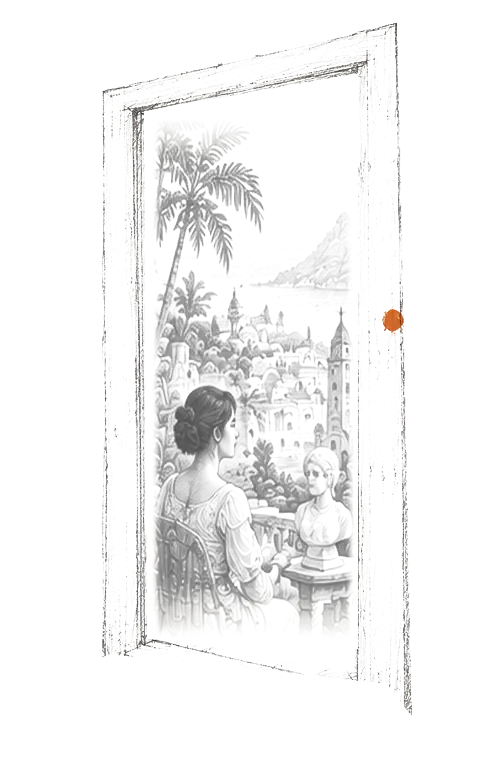
Eighteen short tales of love and fancy, from the kiss to revenge, from the little countess to the lion tamer. In the most discussed, a man consumed by groundless jealousy suspects his wife, Margarita, and his closest friend, the painter Tristán, and feeds his suspicions on a marble bust in the house, mixing his inquiry with an examination of his own fears.
Timeline
- 1891–1908FoundationPenson, Salomé Ureña, Fiallo. Modernismo reaches Santo Domingo.
- 1924–1949Poetry and the social novelBalaguer, Manuel del Cabral, Pedro Mir. Writing under Trujillo.
- 1939OverMarrero Aristy tells the life of the cane cutters in the sugar mills.
- 1963–1988Dominican cinemaFranklin Domínguez, then Meléndez and Un pasaje de ida.
- 1978–1996ContemporariesBlas Jiménez questions Dominican blackness; Nueba Yol is a huge hit.
Reading keys
- The Spanish usage of two surnames applies, and one classifies by the father's name.
- The categories of colour used in the civil registry, including indio to designate brown skin, are a direct inheritance of the whitening policy and a subject in themselves.
- Families are often extended and matrifocal, and emigration to New York is part of the ordinary journey.
- Dominicans of Haitian origin, including those born in the country, saw their nationality contested by a 2013 decision, which is a raw stake.
- The massacre of 1937 was long erased from the textbooks and remains little taught.
- Trujillo's dictatorship, from 1930 to 1961, and the complicity of part of the intellectual elite are uncomfortable subjects.
- Anti-Haitianism is an old doctrine, officially abandoned and socially persistent, that literature has addressed head-on since the nineteen seventies.
- The African character of the country was denied by the state, and affirming it long remained a minority position.
- Catholicism is in the majority, with a strongly growing evangelical Protestantism.
- Dominican vodú exists with its own divisions of saints, and it was repressed in the name of the struggle against Haitian influence.
- The galipotes, men able to transform themselves, the bacás, spirits obtained by pact, and the ciguapa, a woman with backwards feet who leads travellers astray, form the local bestiary.
- The Taíno cosmogony, known through the Relación of 1498 written on this very island, is claimed as national depth.
- The wake and the nine days of prayers, the novena, organise the mourning, with a commemoration at the end of a year.
- Black is worn in mourning, often for several months.
- The February carnival, with its diablos cojuelos in costumes hung with bells and bladders, is the national event.
- Merengue and bachata, long despised as brothel music, are the country's two musics and signal a social class.
- The narratives collected in 1930 by a Dominican folklorist, with the galipotes, the bacás and the ciguapas, form the documented corpus.
- The cimarrón tales published in 1958 gather the narratives of the maroons and of the countryside.
- Enriquillo, a Taíno chief who resisted the Spaniards in the sixteenth century and gave his name to a national novel of 1882, is the major historical reference.
- Pané's Relación and the Taíno cosmogony of Hispaniola are a stock shared with Haiti and Puerto Rico.
- The Dominican Republic and Haiti share an island but not a language, a majority religion or a national narrative, and their relation is the central subject of Dominican culture.
- The word indio in the civil registry does not designate an Amerindian ancestry but a way of not saying black.
- Bachata is not an inoffensive romantic music: it was despised for decades because of its social origin.
- The claimed Hispanic character of the country is a political construction of the twentieth century, and its literature has contested it for fifty years.
Tales and mythologies 2
- TaleCuentos cimarronesSócrates Nolasco · 1958not translated into EnglishPeasant tales from the South, taken down from the mouths of their tellers and rewritten by a man of letters.Literature
- TaleFolk-lore from the Dominican RepublicManuel José Andrade · 1930The largest early collection of Dominican folk tales, taken down from the dictation of storytellers by a linguist close to Franz Boas.Literature
Available in English 6
The books from this country that can be read in English, in the original or in translation.
- NovelThe Cross and the SwordEnriquilloManuel de Jesús Galván · 1882A Taíno cacique raised by the Spaniards rises against the conquest: the Dominican national novel.Literature
- EssaySix Essays in Search of Our ExpressionSeis ensayos en busca de nuestra expresiónPedro Henríquez Ureña · 1928How the Spanish-American world can find its voice: the founding essays of a great Dominican philologist.Literature
- PoetryThere Is a Country in the WorldHay un país en el mundoPedro Mir · 1949The beauty of a sugar island and the dispossession of its peasants, sung from exile.Literature
- EssaySocial Composition of the Dominican RepublicComposición social dominicana: historia e interpretaciónJuan Bosch · 1970A social history of the country, written by a former head of state in exile after his overthrow.Literature
- PoetryCaribbean African upon AwakeningCaribe africano en despertarBlas Jiménez · 1984A Dominican poet claims Africa in a country that preferred to forget it.Literature
- NovelIn the Time of the ButterfliesJulia Alvarez · 1994The novel of three opponents of Trujillo, whom the underground called the butterflies, written in English by a novelist whose family had fled the dictatorship.Literature
A selection to begin with 10 / 26
- NovelOverRamón Marrero Aristy · 1939not translated into EnglishThe counter of a sugar mill, where a young clerk learns to cheat the men who cut the cane.Literature
- PoetryCompadre MonManuel del Cabral · 1943not translated into EnglishA peasant hero of the Cibao, between legend and reality, who has become the allegory of an entire country.Literature
- PoetryThere Is a Country in the WorldHay un país en el mundoPedro Mir · 1949The beauty of a sugar island and the dispossession of its peasants, sung from exile.Literature
- CinemaLa sillaFranklin Domínguez · 1963An actor alone before the camera, to speak of the dictatorship in the wake of its fall.Cinema
- EssaySocial Composition of the Dominican RepublicComposición social dominicana: historia e interpretaciónJuan Bosch · 1970A social history of the country, written by a former head of state in exile after his overthrow.Literature
- CinemaLumiantenaMartín López · 1981Ten minutes of visual experiment on the way newspapers transmitted their photographs.Cinema
- PoetryCaribbean African upon AwakeningCaribe africano en despertarBlas Jiménez · 1984A Dominican poet claims Africa in a country that preferred to forget it.Literature
- CinemaOne Way TicketUn pasaje de idaAgliberto Meléndez · 1988A drama of clandestine emigration drawn from a real event, and the first feature film shot in the country by an entirely Dominican crew.Cinema
- CinemaAbril: la trinchera del honorRené Fortunato · 1988The first look of Dominican cinema at the April civil war and the American intervention, edited from archive footage.Cinema
- CinemaNueba YolÁngel Muñiz · 1995The comedy that finally took a popular character of Dominican television to New York, and whose success revived the country's cinema.Cinema