São Tomé and Príncipe
- works
- 8
- 8 books
- period covered
- 1880–1989
- language of writing
- Portuguese
For centuries, a Portuguese play of the sixteenth century has been performed on this island. The Tragedy of the Marquis of Mantua recounts a trial at the court of Charlemagne: the emperor's son murders a nephew of the marquis, and imperial justice must condemn its own heir. The São Toméans perform it in the open air, masked, with costumes borrowed from mixed periods, over several hours, in Portuguese interspersed with Creole. It is called the tchiloli, and it is the central cultural institution of the country.
Read moreShow less
Nobody asked the inhabitants to preserve it. A European text about the justice of a king who must judge his son became, on an island of plantations peopled by deported slaves, a way of staging power, fault and judgement. The tchiloli groups pass the roles down by family, over several generations, and the lines have drifted from being spoken so often. It is a rare case of complete appropriation: the play no longer belongs to whoever wrote it, and the São Toméans perform it without concerning themselves with fidelity to the printed text.
The rest of the country's history throws light on that choice. São Tomé was in the sixteenth century the first great plantation colony of the Atlantic world, the prototype of the sugar system founded on servile labour that would then be exported to Brazil and the Caribbean. The roças, immense cocoa estates, functioned with workers under contract into the twentieth century, and in 1953 the repression of a movement of refusal caused hundreds of deaths at Batepá. Alda do Espírito Santo, poet and activist, wrote that massacre, and her verses became the anthem of the country.
What awaits the reader is a brief literature, closely tied to song and to the stage, in which the question of justice constantly returns. The collection that opens this page gathers the poetry of struggle of a woman who later became a minister and wrote the words of the national anthem.
A way to begin
É nosso o solo sagrado da terra
Alda do Espírito Santo · 1978
The poetry of struggle of the author of the São Tomé anthem, gathered after independence.
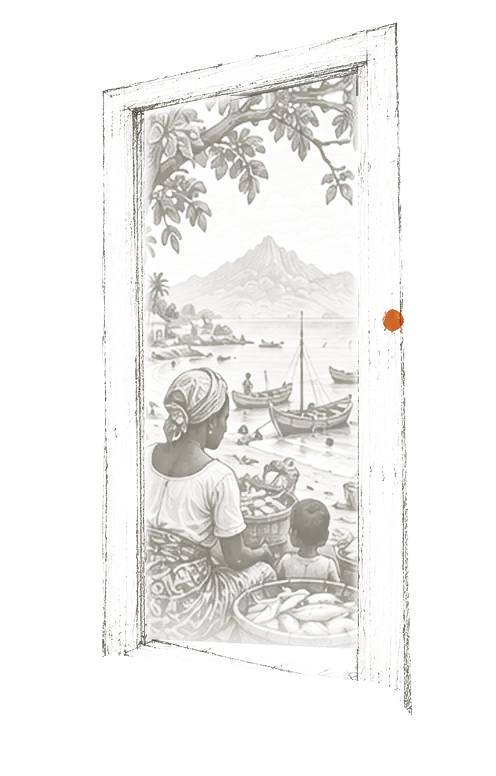
Poems written during the colonial period, up to 1970: the women of the island, the mother who sells fish to feed the little ones, the child who carries his brother on his back, the contract workers torn from their land. Facing the “sharks of the seas”, the man of the tropics raises his hands to buy back the land.
Timeline
- 1500–1900RoçasThe sugar and then cocoa plantations make the islands a society of contract and servitude.
- 1950–1975Poets of the struggleAlda Espírito Santo and Francisco José Tenreiro write a poetry of négritude in Portuguese.
- 1953BatepáThe massacre of Forro workers by the Portuguese administration becomes the central motif of the poetry.
- 1975–2015IndependenceA tiny national publishing scene issues poetry and stories, often printed in Lisbon.
Reading keys
- Family names are Portuguese, including for the descendants of slaves and of workers under contract.
- The name may indicate the origin of the group: forros descended from the first freed slaves, angolares descended from shipwrecked people or from maroons, tongas born on the plantations to contract parents, Cape Verdeans come to work the cocoa.
- Women have a strong economic place and matrifocal families, organised around the mother, are frequent.
- The name of the roça of origin places a character socially as surely as a surname does.
- The Batepá massacre of 1953 is the founding date of national consciousness and is recounted with gravity.
- The hierarchies between forros, angolares and descendants of tongas are real and rarely named head-on.
- The system of the roças and contract labour, a form of prolonged slavery, are a memory still close.
- Forro Creole and Angolar serve intimacy, Portuguese administration, and the passage from one language to another places the scene.
- Catholicism is in the majority and the saints' festivals organise the village calendar.
- Practices of healing and protection of Bantu origin coexist with the mass.
- The djambi, a ceremony of possession and healing, belongs to the Afro-São Toméan stock.
- The souls of the dead and the spirits of abandoned plantations people the narratives.
- Mourning includes a wake, songs and anniversary masses.
- The tchiloli is performed during the patron saints' festivals and its calendar structures the cultural year.
- The danço-congo, another danced and masked theatre, completes the tchiloli in the island's repertoire.
- 12 July, the day of independence in 1975, is the civil landmark.
- The tchiloli and its plot, the son of Charlemagne judged for murder, are known to all and cited as self-evident.
- The Creole narratives of the island, with their cunning animals, belong to the Bantu and Cape Verdean stock.
- The Batepá massacre of 1953 is the common historical reference.
- The memory of the roças, with their hospitals, their chapels and their cemeteries, serves as setting and narrative stock.
- The tchiloli is not a folkloric survival of the coloniser but a work entirely reappropriated, performed for local reasons.
- The country is made of two distinct islands, and Príncipe has its own history and its own creole.
- The tongas are not recent immigrants but the descendants of workers brought from Angola, Mozambique and Cape Verde.
- The small size of the written corpus does not measure the cultural activity, which passes through the stage and through song.
Tales and mythologies 1
- TheatreTchiloliAnonymous · 1880not translated into EnglishAround 1880, in São Tomé, the “sons of the land” make an old Portuguese tragedy about the justice of kings their own.Literature
A selection to begin with 6 / 8
- PoetryVersosCaetano da Costa Alegre · 1916not translated into EnglishThe verse of a São Toméan student in Lisbon, at the end of the nineteenth century, on his colour and his island.Literature
- PoetryIlha de Nome SantoFrancisco José Tenreiro · 1942not translated into EnglishA Black student in Lisbon, under the dictatorship, writes the island he left as a child.Literature
- PoetryAlto como o silêncioManuela Margarido · 1957not translated into EnglishThe intimate collection of a poet from Príncipe, written in Lisbon in the 1950s.Literature
- NovelVila FlogáSum Marky · 1963not translated into EnglishThe troubles of a black cook in the service of two white men, in a colonial comedy of manners.Literature
- Short storiesRosa do Riboque e outros contosAlbertino Bragança · 1985not translated into EnglishFour stories from the poor districts of São Tomé under Portuguese colonisation.Literature
- PoetryO canto do ossobóMarcelo da Veiga · 1989not translated into EnglishSixty years of poems by a São Toméan from Príncipe, on the language, the identity and the people of the archipelago.Literature