Seychelles
- works
- 5
- 5 books
- period covered
- 1900–2000
- language of writing
- French and Creole
There was nobody. Before 1770, the Seychelles archipelago was uninhabited: no indigenous population, no ancient language, no mythology of the place. A first settlement of some fifteen colonists and slaves was founded that year on Sainte-Anne island, and everything that exists in the country today was brought by boat and recomposed on the spot. It is a rare case, and it obliges one to put differently the question of what a national culture is. The hundred and fifteen islands of the archipelago therefore have no name earlier than French.
Read moreShow less
The answer was Creole. Formed in one generation out of the French of the colonists and the languages of East Africa and Madagascar from which the slaves came, Seselwa became everyone's language. A collection of fables and songs in Mauritian Creole appeared in Mauritius as early as 1822, at a time when nobody was writing those languages anywhere. And in 1981 the country did what no other Creole-speaking state had dared: give its Creole the status of a full official language and make it the language in which reading is learnt at school.
That choice has formal consequences. Antoine Abel, considered the first writer of the country, published in 1969 texts going back to the tales heard as a child, to the spirits of the islands and to the figures of the fisherman and the gran-dimoun, the elder. He is not writing an ancient tradition: he is fabricating one, out of what three generations of islanders composed with pieces come from elsewhere. The price of that freedom is the absence of a historical depth to draw on, and the necessity of inventing the stock one leans on, which explains the place held by the collecting and shaping of tales.
What awaits the reader is a recent literature, brief and close to the oral, in which the sea and the island hold the place that the village holds elsewhere. The collection that opens this page bears the name of an Indian Ocean seabird, and it is the first poetry published in the Seychelles.
A way to begin
Paille en queue
Antoine Abel · 1969
The first poetry published in the Seychelles: some forty poems on childhood on Mahé and the nature of the archipelago.
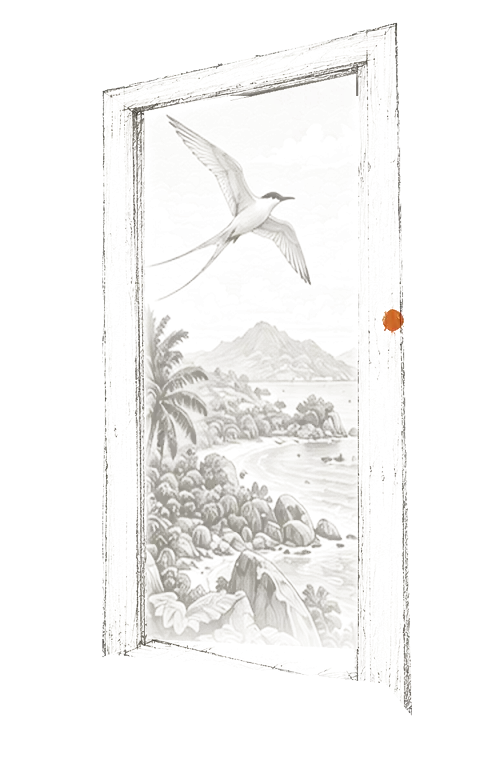
The author's first collection, a booklet of some forty poems published at his own expense, in French and English. He recounts memories of childhood and youth on Mahé and brings the nature of the archipelago into poetry: fruit bats, corals, octopuses, turtles, cicadas and the south-east monsoon. The tropicbird of the title is a seabird of the Indian Ocean.
Timeline
- 1822First bookEssays of an African Bobre, written by a Seychellois.
- 1969–1985Abel and créolitéThe father of Seychellois letters; Mancienne writes in Creole.
Reading keys
- Family names are for the most part French, assigned to the freed at the abolition, and therefore indicate no European ancestry.
- Indian and Chinese names attest to later migrations of traders.
- The extended family and kinship through the neighbourhood are the rule, and kinship terms apply widely.
- The gran-dimoun, the elder, is a category of respect and a source of authority in the narratives.
- The coup of 1977 and the single party until 1993 form a period that literature approaches with caution.
- Dependence on tourism and its effect on daily life are little treated head-on.
- Creole was long judged unworthy of writing, and writing it remains a decision.
- Rumour and gossip, held to be a real social danger in a country of small size, are a frequent narrative device.
- Catholicism is very much in the majority and structures the calendar and the life of the parishes.
- Gris-gris and practices of protection, inherited from Africa and Madagascar, coexist with the mass. A character who consults a healer is not an unbeliever.
- The nanm, souls of the dead, and the spirits of places inhabit the forest and the rocks.
- There is no indigenous mythology: the beliefs of the archipelago are an Afro-Malagasy and European compound, which is a historical fact and not a gap.
- Catholic mourning organises the wake and the anniversary mass, with Creole songs.
- The moutya, a dance born in slavery, is performed at night around a drum heated over a fire, and was long repressed.
- 29 June, the day of independence in 1976, is the civil landmark.
- The coco de mer, the largest seed in the world, endemic to two islands, serves as an emblem and a literary motif.
- The Creole tales of the archipelago, with Soungoula the cunning one, are the common narrative stock and belong to the African trickster cycles.
- The narratives of pirates and hidden treasures, notably that of Olivier Levasseur, belong to the local imagination.
- Creole proverbs, often shared with Mauritius and Réunion, are used as arguments.
- La Fontaine's fables adapted into Seychellois Creole by Rodolphine Young are part of the school heritage.
- The absence of an indigenous population is not an omission from the national narrative: it is a fact, and it makes this country a laboratory rather than an inheritance.
- Seselwa is not a dialect of French but an official language, taught and standardised.
- The image of a luxury destination is external to the country and the authors write about a population of workers, fishermen and civil servants.
- Seychellois, Mauritian and Réunionnais Creole resemble one another without being the same, and a hasty reader confuses them.
Tales and mythologies 1
- PoetryFables de La Fontaine traduites en créole seychelloisRodolphine Young · 1900not translated into EnglishIt is the first known text written in Seychellois Creole, which remained in manuscript until its discovery.Literature
Available in English 1
The books from this country that can be read in English, in the original or in translation.
- Short storiesVoices: Seychelles Short StoriesGlynn Burridge · 2000The author, who came from Iran at the time of the revolution, lived for two decades on an isolated island in the Amirantes.Literature
A selection to begin with 3 / 5
- NovelFler fletriLeu Mancienne · 1985not translated into EnglishThe novel appeared in the years when the Seychelles state encouraged writing in Creole, which had become the national language.Literature
- NovelLes Mémoires imaginés de Jean-Baptiste Quéau de QuinssyGuy Lionnet · 1988not translated into EnglishA historian of the archipelago gives voice to the commandant who lived through the end of French rule without leaving his post.Literature
- Short storiesVoices: Seychelles Short StoriesGlynn Burridge · 2000The author, who came from Iran at the time of the revolution, lived for two decades on an isolated island in the Amirantes.Literature