Sri Lanka
- works
- 37
- 22 books · 15 films
- period covered
- 930–2000
- language of writing
- Sinhala
A text written in the fifth century by a monk still serves as a political argument. The Great Chronicle, composed in Pali in a monastery, recounts the arrival of prince Vijaya, the Buddha's visits to the island and the victory of a Sinhalese king over a Tamil sovereign. That last episode was quoted in the twentieth century to justify the idea that the island belongs first to the Sinhalese Buddhists. A work of monastic devotion thus became, fifteen centuries later, a piece in a conflict that caused tens of thousands of deaths and displaced hundreds of thousands of people.
Read moreShow less
That longevity is explained by an exceptionally continuous written chain, maintained by monasteries that nothing interrupted. Sinhala has been written for more than two thousand years, Pali was preserved there when it was disappearing elsewhere, and the monasteries copied without interruption. The country also has an old Tamil literature, a Muslim stock and a production in English, so that three traditions are written there in parallel and read one another little, each with its publishers and its prizes.
The dominant form in the twentieth century is the village novel and then cinema. Martin Wickramasinghe published in 1944 the decomposition of a family of rural notables, a novel that became the country's classic. Lester James Peries filmed in 1956 the first feature shot in real locations, in Sinhala, with non-professional actors, and took Sinhalese cinema out of its imitation of the Indian model. The price was paid during the civil war from 1983 to 2009: censorship, self-censorship, and a 1997 film about a father who refuses to admit the death of his soldier son, long held back.
What awaits the reader is an attention to village hierarchies and a slowness that lets one see the relations of power between castes, between generations and between communities. The novel that opens this page is the novel of renunciation of all attachment, and in 1995 it became the first Sinhala novel published in full in French.
A way to begin
The Way of the Lotus
Martin Wickramasinghe · 1956
The novel of renunciation, regarded as one of the greatest works of modern Sinhala fiction.
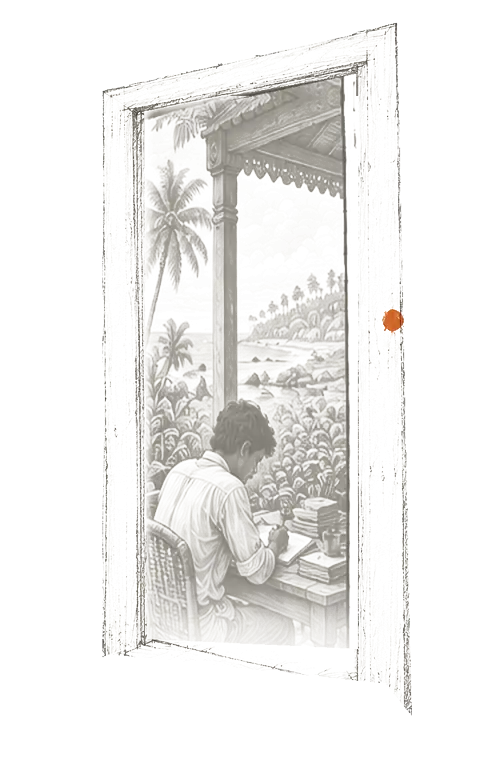
A friend from his youth receives the notebooks in which Aravinda has told his life. Born into a Buddhist family of the South, Aravinda gives up medicine for a clerk's post, lets Sarojini go when she offers to run away with him, and lives alone, paying for the schooling of his servant's daughter despite his sister's reproaches.
Timeline
- 930–1400Buddhist proseGurulugomi, the Pujavaliya. Sinhala is first written for the sermon.
- 1865–1933First novelsAlbert Silva, Piyadasa Sirisena. The novel arrives with the press.
- 1944–1954WickramasingheGamperaliya tells the end of the village and founds the modern novel.
- 1947–1968Lester James PeriesRekava, then a whole school: Sinhala cinema becomes an art.
- 1974–2000Cinema and warPathiraja, Obeysekera, Vithanage. Filming a country tearing itself apart.
Reading keys
- Sinhalese names are long, often composed of the name of the family house followed by a first name, and everyday usage abbreviates.
- Tamil names follow another system, with the initial of the father's first name preceding the personal first name, and immediately signal the community.
- Muslim names and Burgher names, of Dutch or Portuguese descent, form two other recognisable sets.
- Caste exists among the Sinhalese as among the Tamils, without a formal religious hierarchy among the former, and the name reveals it.
- The civil war from 1983 to 2009, its massacres and its final phase are subjects on which every account is situated, and the inquiries into the disappeared remain blocked.
- The pogrom of 1983 against the Tamils and the Sinhalese insurrections of 1971 and 1988 are competing memories.
- The relation between Buddhism and nationalism is a delicate subject, the ordination of monks into politics being an old one.
- The vocabulary itself is disputed, notably the place names that exist in Sinhala and in Tamil.
- Theravada Buddhism is in the majority and enjoys a privileged constitutional status; Tamil Hinduism, Islam and Christianity each concern an important part of the population.
- The cult of the yakku, spirits appeased by nocturnal ceremonies of dance and drumming, coexists with Buddhism without conflict.
- The Vaeddas, hunter-gatherers of the island, have a religion founded on the cult of the dead, documented in 1911.
- The relic of the Buddha's tooth at Kandy is a political as much as a religious object, and its annual procession is a state occasion.
- White is the colour of mourning and of devotional dress, and one goes to the temple in white.
- Buddhist funerals include a wake, a cremation and a ceremony on the seventh day and in the third month.
- The full moon of each month, poya, is a public holiday on which the sale of alcohol and meat is forbidden, which structures the narrative calendar.
- The Kandy procession, with its elephants and its dancers, is the great national gathering.
- The Great Chronicle and the Chronicle of the Island, written in Pali in the fourth and fifth centuries, are the founding and most disputed texts.
- The village tales collected between 1910 and 1914, classified by the caste of the storytellers, form the most original documented corpus in the region.
- The Jataka, previous lives of the Buddha, are told to children and painted in the temples.
- The narratives about the yakku and the ceremonies to appease them are a common knowledge that the texts assume is known.
- Sri Lanka is not an annex of India: Sinhala is an Indo-Aryan language isolated in the region, and the island has its own written history.
- Theravada Buddhism is not here a pacifist spirituality detached from the world: it is constitutionally privileged and politically active.
- The Great Chronicle is a religious text of the fifth century, and using it as a title deed is a twentieth-century reading.
- The Tamils of the island are divided between an old population of the north and workers brought by the British to the plantations, two distinct histories.
Tales and mythologies 3
- Chronicleඑළු අත්තනගලු වංසයAnonymous · 1380not translated into EnglishThe legend of a king who refused to shed blood, and the history of the monastery born on the site of his retreat.Literature
- Narrativeදඹදෙණි අස්නAnonymous · 1270not translated into EnglishAn inventory of the royal capital in the thirteenth century, street by street and trade by trade.Literature
- TaleVillage Folk-Tales of CeylonHenry Parker · 1910Village tales noted down by an irrigation works engineer, at the beginning of the century.Literature
Available in English 7
The books from this country that can be read in English, in the original or in translation.
- TalePujavaliya: A Sinhala Classic of the 13th CenturyපූජාවලියMayurapada Buddhaputra Thera · 1266A devotional compilation of the thirteenth century, written for the learned and the unlearned alike, whose last chapter has become a source for the history of the island.Literature
- NovelThe Way of the LotusවිරාගයMartin Wickramasinghe · 1956A man who keeps apart from what his family and his milieu expect of him, told from the inside in the mid-fifties.Literature
- TheatreManameමනමේEdiriweera Sarachchandra · 1956A prince, a princess and the king of the forest people: the play that founded modern Sinhala theatre.Literature
- NovelGirayaPunyakante Wijenaike · 1971An aristocratic provincial household, told from the inside and in English by the young wife who enters it.Literature
- NovelOut of the Darknessඅසත්ය කතාවක්Gunadasa Amarasekara · 1977A policeman caught between his career and the death of his student brother, in the time of the uprisings of Sinhalese youth.Literature
- NovelFunny BoyShyam Selvadurai · 1994A Tamil boy in Colombo discovers who he is, on the eve of ethnic violence: Shyam Selvadurai's first novel.Literature
- NovelReefRomesh Gunesekera · 1994A young cook in the service of a marine biologist, in the Sri Lanka of the sixties: Romesh Gunesekera's first novel.Literature
A selection to begin with 10 / 37
- NarrativeඅමාවතුරGurulugomi · 1200not translated into EnglishA life of the Buddha in classical prose, written in a Sinhala almost free of learned borrowings.Literature
- CinemaLine of DestinyරේඛාවLester James Peries · 1956A village on the island thrown into turmoil by a prediction and by a healing gift attributed to a child.Cinema
- TheatreManameමනමේEdiriweera Sarachchandra · 1956A prince, a princess and the king of the forest people: the play that founded modern Sinhala theatre.Literature
- Cinemaහන්තානේ කතාවSugathapala Senarath Yapa · 1969Student love affairs in the hills of Kandy, towards the end of the 1960s.Cinema
- NovelGirayaPunyakante Wijenaike · 1971An aristocratic provincial household, told from the inside and in English by the young wife who enters it.Literature
- NovelOut of the Darknessඅසත්ය කතාවක්Gunadasa Amarasekara · 1977A policeman caught between his career and the death of his student brother, in the time of the uprisings of Sinhalese youth.Literature
- CinemaThe Girlsගැහැනු ළමයිSumitra Peries · 1978A poor young village woman and the love she refuses, in a society where rank decides everything.Cinema
- CinemaThe Wasps Are Hereබඹරු ඇවිත්Dharmasena Pathiraja · 1978A fishing community whose hierarchies are shaken by money coming from the town, in the 1970s.Cinema
- NovelFunny BoyShyam Selvadurai · 1994A Tamil boy in Colombo discovers who he is, on the eve of ethnic violence: Shyam Selvadurai's first novel.Literature
- CinemaDeath on a Full Moon Dayපුරහඳ කළුවරPrasanna Vithanage · 1997An old blind man faces the sealed coffin that the army sends back to the village, in the midst of the civil war.Cinema