Taiwan
- works
- 14
- 11 books · 3 films
- period covered
- 1915–1994
- language of writing
- Chinese
All the Austronesian languages come from this island. Linguists situate in Taiwan the centre from which set out, some five thousand years ago, the navigators whose descendants today speak Malagasy, Tagalog, Maori, Hawaiian and Samoan. The languages of the indigenous peoples of Taiwan present an internal diversity greater than that of all the rest of the family combined, which indicates that they are the oldest. An island of thirty-six thousand square kilometres is the origin of a cultural space stretching from East Africa to Easter Island.
Read moreShow less
From that point of departure, almost nothing was written. The sixteen recognised indigenous peoples had no writing, and what was recorded was recorded by others: the Dutch in the seventeenth century, who described the religion of the Siraya, then the Japanese administrators between 1895 and 1945, who conducted massive ethnographic surveys in Japanese. The present majority population came from Fujian and Guangdong from the seventeenth century, and a third wave arrived in 1949 with the defeated nationalist government, bringing Mandarin.
Hence a culture obsessed with the question of who is from here. Taiwanese cinema has posed it better than the book. Hou Hsiao-hsien filmed in 1989 a family during the years that follow 1945, including the repression of 1947 which could not be spoken of, in fixed and distant shots. Edward Yang reconstructed in 1991 a news item from 1961 in a Taipei high school where adolescents from families come from the mainland fight between gangs. Those films were made under martial law or just after its lifting in 1987, which explains their caution and their scope.
What awaits the viewer is a slowness that leaves time to understand who speaks which language, for that says everything. The film that opens this page follows a Keelung family from 1945 to the uprising of 28 February 1947, and it is the first Taiwanese film to have shown the massacre that followed.
A way to begin
A City of Sadness
Hou Hsiao-hsien · 1989
A City of Sadness: the first Taiwanese film to show the 1947 massacre, Golden Lion at Venice.
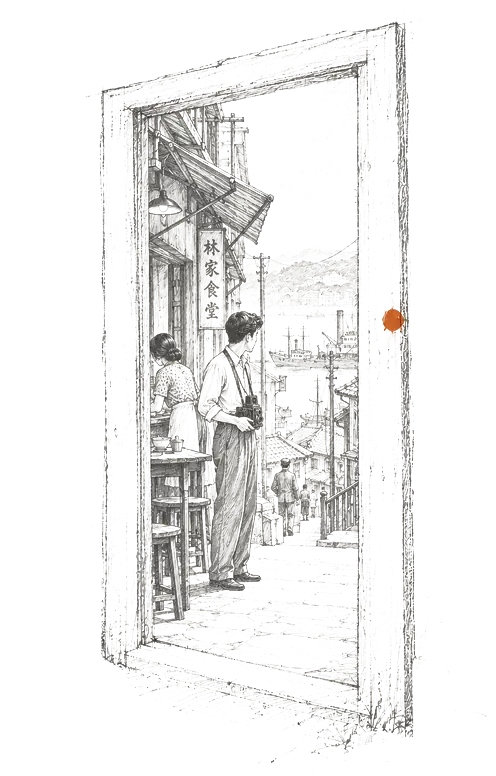
In 1945 Japan surrenders and Taiwan passes to the Chinese Nationalists, welcomed with hope before mistrust, corruption and repression set in. In Keelung the Lin family runs a modest restaurant. The eldest son clashes with gangsters profiting from the disorder, another brother disappears after his arrest, and the youngest, a deaf-mute photographer, grows close to young Hinomi, when the uprising of 28 February 1947 breaks out.
Timeline
- 1989A City of SadnessHou Hsiao-hsien films 1947, two years after martial law is lifted.
- 1991–1992New waveEdward Yang and Stan Lai carry Taiwanese cinema into the world.
Reading keys
- Han names precede the first name, on the Chinese model, and the transcription varies according to the systems, Hou Hsiao-hsien or Hou Xiaoxian.
- The indigenous peoples were long forced to adopt Japanese and then Chinese names, and the resumption of original names since 1995 is a political act.
- The distinction between Taiwanese settled for centuries, called benshengren, and those who arrived in 1949, waishengren, is a major social datum that the name and the accent reveal.
- Several indigenous peoples, including the Amis and the Puyuma, are matrilineal, which contrasts with the surrounding Han society.
- The incident of 28 February 1947 and the White Terror that followed, with thousands of executions, were unsayable until the nineteen nineties.
- The political status of the island is the most sensitive subject, and the vocabulary used to designate it is in itself a position.
- Japanese colonisation is judged in contrasting ways, more favourably than in Korea, which is surprising.
- The Taiwanese and Hakka languages were repressed at school in favour of Mandarin, and their use in a film is a declaration.
- Chinese popular religion dominates, with its neighbourhood temples, its processions and its local divinities, including Mazu, protectress of sailors, the most followed on the island.
- Buddhism and Taoism mingle with that stock with no clear boundary, and the temples house several cults.
- The cult of the ancestors and the month of the ghosts, when the wandering dead are fed, organise the calendar.
- The indigenous religions have been largely replaced by Christianity, which is in the majority among the sixteen recognised peoples, and that is a particularity.
- White is the colour of mourning, red that of celebration, and paper money burnt for the dead is a daily usage.
- Funerals may last several weeks with tents put up in the street, and their cost commits the extended family.
- The ghost festival, in the seventh lunar month, imposes prohibitions that the narratives mention without explaining.
- Temple processions, with palanquins and firecrackers, are the social event of the neighbourhood.
- The Dutch accounts of the seventeenth century, translated in 1903, describe the religion of the Siraya with its priestesses, the only direct source on a Formosan religion before sinicisation.
- The Japanese surveys conducted between 1900 and 1935 collected the Atayal, Bunun, Paiwan and Amis narratives, often in the original language, and form the documented corpus.
- Mazu and her annual pilgrimage of several hundred kilometres are a constant social and literary reference.
- The Han narratives come from Fujian, with the hungry ghosts and the legends of temples, are shared with mainland China.
- Taiwan is not culturally homogeneous: sixteen Austronesian peoples, a majority come from Fujian, a Hakka minority and a wave of 1949 coexist there.
- Taiwanese is not a dialect of Mandarin but a language of the Min group, and the two are not mutually intelligible.
- The indigenous peoples of Taiwan are not a local curiosity: they are the linguistic origin of the whole Austronesian space.
- The slowness of Taiwanese cinema is not an aesthetic pose but a way of making legible an entanglement of languages and memories.
Tales and mythologies 1
- Tale蕃族調查報告書Sayama Yūkichi · 1915not translated into EnglishThe customs and legends of the first inhabitants of Taiwan, recorded by a commission of the Japanese colonial government at the beginning of the twentieth century.Literature
Available in English 9
The books from this country that can be read in English, in the original or in translation.
- Short storyThe Newspaper Carrier新聞配達夫Yang Kui · 1934The story in Japanese that made a Taiwanese writer known in colonial Japan, an account of the exploitation of a young emigrant.Literature
- NovelOrphan of Asiaアジアの孤児Wu Zhuoliu · 1946A Taiwanese regarded as Japanese by the Chinese and as Chinese by the Japanese, written in the midst of war, under the surveillance of the colonial police.Literature
- NovelMemories of Peking: South Side Stories城南舊事Lin Haiyin · 1960Childhood stories published in Taiwan in 1960, in which a little girl discovers the adult world in Beijing in the twenties.Literature
- Short storyThe Gong鑼Huang Chun-ming · 1969The long story of a town crier ruined by loudspeakers, by the great storyteller of Taiwan's common people.Literature
- Short storiesTaipei People臺北人Pai Hsien-yung · 1971The exiles from the mainland, who took refuge in Taiwan after 1949, seen by a writer who was himself part of that exodus.Literature
- NovelFamily Catastrophe家變Wang Wen-hsing · 1973Taiwan's great modernist novel, in which a son turns against filial piety.Literature
- NarrativeStories of the Sahara撒哈拉的故事Sanmao · 1976Stories from 1976 about the life of a Taiwanese woman and her Spanish husband in the Western Sahara.Literature
- NovelThe Butcher's Wife殺夫Li Ang · 1983The short novel that caused a scandal in Taiwan in 1983 by depicting a woman imprisoned by custom.Literature
- NovelNotes of a Desolate Man荒人手記Chu T'ien-wen · 1994The notebooks of a grieving Taiwanese homosexual, written by a great screenwriter of the island's cinema.Literature
A selection to begin with 10 / 14
- NovelOrphan of Asiaアジアの孤児Wu Zhuoliu · 1946A Taiwanese regarded as Japanese by the Chinese and as Chinese by the Japanese, written in the midst of war, under the surveillance of the colonial police.Literature
- NovelMemories of Peking: South Side Stories城南舊事Lin Haiyin · 1960Childhood stories published in Taiwan in 1960, in which a little girl discovers the adult world in Beijing in the twenties.Literature
- Short storyThe Gong鑼Huang Chun-ming · 1969The long story of a town crier ruined by loudspeakers, by the great storyteller of Taiwan's common people.Literature
- Short storiesTaipei People臺北人Pai Hsien-yung · 1971The exiles from the mainland, who took refuge in Taiwan after 1949, seen by a writer who was himself part of that exodus.Literature
- NovelFamily Catastrophe家變Wang Wen-hsing · 1973Taiwan's great modernist novel, in which a son turns against filial piety.Literature
- NarrativeStories of the Sahara撒哈拉的故事Sanmao · 1976Stories from 1976 about the life of a Taiwanese woman and her Spanish husband in the Western Sahara.Literature
- NovelThe Butcher's Wife殺夫Li Ang · 1983The short novel that caused a scandal in Taiwan in 1983 by depicting a woman imprisoned by custom.Literature
- CinemaA Brighter Summer Day牯嶺街少年殺人事件Edward Yang · 1991A generation born of the exile of 1949 grows up under martial law, between the White Terror, neighbourhood gangs and American rock.Cinema
- CinemaSecret Love in Peach Blossom Land暗戀桃花源Stan Lai · 1992The author's own adaptation of the play that was the first success of modern theatre in Taiwan.Cinema
- NovelNotes of a Desolate Man荒人手記Chu T'ien-wen · 1994The notebooks of a grieving Taiwanese homosexual, written by a great screenwriter of the island's cinema.Literature