Togo
- works
- 21
- 18 books · 3 films
- period covered
- 1906–1999
- language of writing
- French
A Togolese adolescent, who had fallen from a coconut palm where a python had surprised him, was dedicated by his father to the python cult. Shortly afterwards, in a mission bookshop, he found a book about the Eskimos: people who live without trees, without snakes, surrounded by ice. Tété-Michel Kpomassie decided to go there. It took him eight years, working from country to country across Africa and Europe, before he finally reached an Inuit village where he spent months hunting and listening. He recounted this in a book published in 1980, since become a classic of travel writing.
Read moreShow less
That book is the exact inverse of the usual travel narrative: an African writes the ethnography of an Arctic people, with the same curiosity about customs, food and kinship that Europeans brought to describing Africa. Togo has produced other reversals of that kind. A former German colony divided between France and Britain after 1918, the country inherited three administrations in half a century and an Ewe population cut in two by the Ghanaian border. One writes there in French a culture that the neighbour writes in English.
The liveliest form there is the theatre. The concert party, a popular show mixing sketches, songs and cross-dressing, is performed in Ewe and in Mina before neighbourhood audiences, and Sénouvo Agbota Zinsou drew from it a written theatre that keeps that direct relation to the auditorium. The authors of the following generation, Kossi Efoui and Kangni Alem, pushed the experiment further and left. The price was exile: thirty-eight years of authoritarian rule pushed most of the country's writers out, and they publish in Paris and in Ouagadougou.
What awaits the reader is a taste for decentring and a theatricality that surfaces even in the novels. The book that opens this page is that of a man who left Togo at sixteen for Greenland, which he had dreamed of while reading a book about the Eskimos, and who took eight years to reach it.
A way to begin
An African in Greenland
Tété-Michel Kpomassie · 1980
The journey of a Togolese man who went to live among the Inuit, turning the explorers' gaze around.
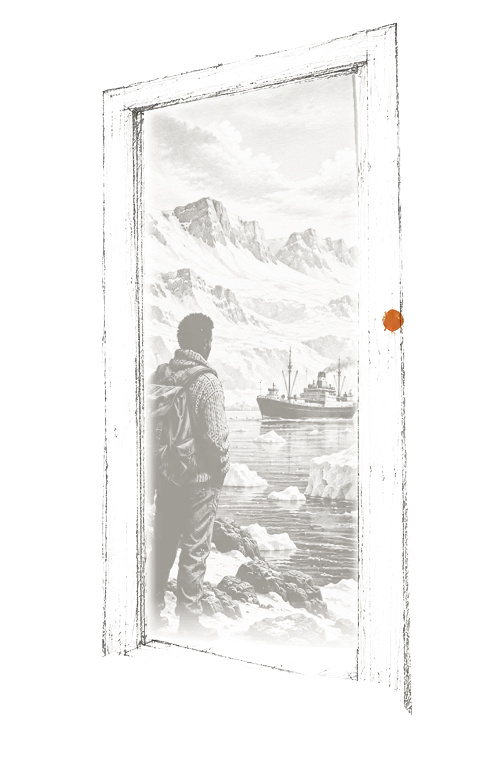
Dedicated by his father to the python cult after a fall from a coconut palm, a Togolese teenager dreams, on reading a book about the Eskimos, of a land without snakes. He runs away at sixteen and, from odd job to odd job, passes through Abidjan, Dakar, Paris and Copenhagen before reaching Greenland in 1965, where the inhabitants share their life with him.
Timeline
- 1955–1967First textsDavid Ananou, Pedro Santos, Modeste d'Almeida.
- 1971–1979Novel and theatreAladji, Dogbé, and Zinsou, who invents a popular theatre.
- 1980–1988A dense generationKpomassie among the Inuit, Gnoussira Analla, Gad Ami, Sami Tchak.
- 1989–1995New waveKossi Efoui, Kangni Alem, and the first Togolese feature films.
Reading keys
- Ewe first names indicate the day of birth, as among the neighbouring Akan: Kofi for a Friday, Kossi likewise, Ama for a Saturday.
- The surname may be Portuguese, Almeida, Santos, de Medeiros, inherited from the Afro-Brazilian merchant families settled on the coast in the nineteenth century.
- Ewe societies are patrilineal, but the maternal uncle keeps a role of recourse.
- The name places the region: Ewe and Mina in the south, Kabye and Tem in the north, which coincides with a political division.
- The Eyadéma regime, from 1967 to 2005, and its succession are subjects that pushed authors into exile rather than into allusion.
- The colonial partition that cut the Ewe country in two, between Togo and Ghana, is an old dispute.
- The division between a schooled south and a north holding military power is a permanent subject.
- Vodun is practised openly and mentioning it does not carry the scandalous charge it takes on elsewhere.
- Vodun, here called vodu, is an organised religious system with its divinities, its initiation convents and its priests. It is from this coast that it went to Haiti and Brazil.
- Mawu is the supreme god, the vodu specialised powers, and the convents train the initiates during months of retreat.
- Christianity and Islam are superimposed without erasing the cults, and many characters practise several registers.
- Twin spirits and possession cults belong to the Ewe and Fon stock.
- Funerals take place in two stages and the second, deferred ceremony is expensive and commits the extended family.
- The white of kaolin marks the initiates coming out of the convent, and an adept's dress can be read.
- The concert party is performed at night, in the open air, and its structure alternates music and sketches over several hours.
- The yam festivals and the Epe Ekpe of the Guin mark the ritual calendar of the coast.
- The Ewe tales collected from 1906 by the missionaries of Bremen, in Ewe with a translation, form the main documented corpus.
- Vodun and its pantheon are a knowledge shared with Benin, Haiti and Brazil.
- Ananse the spider, called Yiyi in Ewe, circulates as in neighbouring Ghana.
- The concert party and its stock characters are a popular reference that the texts assume is known.
- Vodun is not sorcery but a structured religion, and the pejorative use of the word in French is a colonial inheritance.
- Togo and Ghana share the same Ewe people on either side of the border, which makes the word "Togolese" more complex than it appears.
- Kpomassie's narrative is not an exotic book but an inverted ethnography, and it has to be read as such.
- The presence of Portuguese names signals not a European ancestry but a history of Afro-Brazilian trade.
Tales and mythologies 2
- TaleLe Caneton égaréPyabelo Kouly Chaold · 1969not translated into EnglishA duckling who wanders away from its mother, in a picture book for the very young.Literature
- TaleThe Ewe PeopleEwe gliwoAnonymous · 1906The tales of the Ewe country, recorded by German missionaries at the beginning of the twentieth century.Literature
Available in English 1
The books from this country that can be read in English, in the original or in translation.
- NarrativeAn African in GreenlandL'Africain du GroenlandTété-Michel Kpomassie · 1980A Togolese man who went to live among the Inuit of Greenland, and who turns the explorers' gaze around.Literature
A selection to begin with 10 / 21
- NovelLe Fils du féticheDavid Ananou · 1955not translated into EnglishA follower of the old cults, his wives and the son vowed to the fetish, in a village in Watchi country, in southern Togo.Literature
- TheatreOn joue la comédieSénouvo Agbota Zinsou · 1975not translated into EnglishA troupe performs before an audience that constantly interrupts it, and the comedy becomes the trial of apartheid.Literature
- CinemaKouamiMetonou Do Kokou · 1975The first fiction film shot by a Togolese, a short comedy about two country women lost in the city.Cinema
- PoetryRythmes et cadencesPaul Akakpo Typamm · 1981not translated into EnglishA schoolteacher gathers poems and tales in praise of his country, in the wake of négritude.Literature
- NovelOpération MarigotKoffi Gomez · 1982not translated into EnglishA novel about an official agricultural policy, seen from the village it claims to transform.Literature
- Short storiesLeur figure-làTowaly · 1985not translated into EnglishStories, short stories and scenes about a country that is never named, where the dictator has taken on the shape of a monster.Literature
- NovelÉtrange héritageGad Ami · 1985not translated into EnglishA young mother tells her son of the love she shared with his father and what drove them apart.Literature
- TheatreLe CarrefourKossi Efoui · 1990not translated into EnglishA scene that replays endlessly at a crossroads, where prison and the outside world blur together.Literature
- CinemaFemmes aux yeux ouvertsAnne-Laure Folly · 1994A documentary in which West African women themselves say what they are granted, with no commentary speaking in their place.Cinema
- CinemaKawilasiBlaise Kilizou Abalo · 1995A young businesswoman accused of murdering her fiancé, in a drama shot at the beginning of the nineties.Cinema