Tunisia
- works
- 36
- 21 books · 15 films
- period covered
- 1410–2000
- language of writing
- Arabic and French
In January 2011, crowds in the streets of Tunis chanted the verses of a poet who died at twenty-five in 1934. Aboul Qacem Chebbi had written, in a poem addressed to the tyrants of the world, that whoever sows thorns does not harvest grapes, and that the night always ends. Two stanzas of that text already figured in the national anthem. They became again, eighty years later, a demonstration slogan. Few countries can quote a poem that has served twice for the same purpose.
Read moreShow less
Tunisia has a long habit of the written word. Carthage, Kairouan and its juridical school, the Zitouna university, then a reforming nineteenth century that gave the country the first constitution of the Arab world in 1861: the territory has produced scholars without interruption. Ibn Khaldun, born in Tunis in 1332, wrote there an introduction to history that more or less invents sociology, by looking for the laws that make states rise and fall.
The dominant form is the childhood narrative and the portrait of society, often centred on women. Albert Memmi published in 1953 the autobiography of a young Tunisian Jew caught between three worlds, and drew from it a theory of the colonised. Moufida Tlatli filmed in 1994 the servants of a beylical palace and the silence imposed on them. Tunisian cinema has made a precise place for itself in the Arab world: the place where the body, sexuality and childhood can be shown without circumlocution, which Nouri Bouzid and Ferid Boughedir exploited at the risk of scandal. The price was paid under two regimes, with censorship, prison and exile, and several novels published in Paris before being published in Tunis.
What awaits the reader is a writing that is often intimate, attentive to houses, to courtyards and to what is said among women. The novel that opens this page follows a child from the poor Jewish quarter of Tunis who no longer feels at home anywhere, neither among his own, nor among the French, nor in the Tunisia taking shape.
A way to begin
The Pillar of Salt
Albert Memmi · 1953
A child from the poor Jewish quarter of Tunis enters the French school and gains as much as he loses there: a first novel with a preface by Camus.
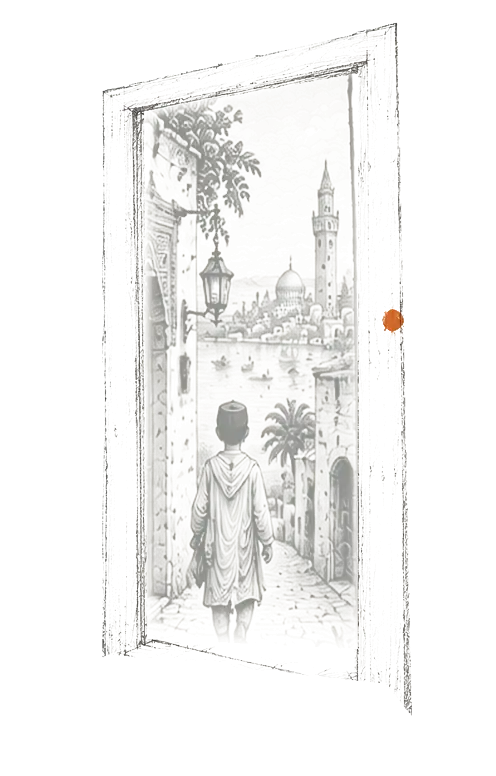
Alexandre Mordekhai Benillouche, son of a poor saddler and an illiterate mother, grows up in an alley near the hara, the Jewish quarter of Tunis. A brilliant pupil, he discovers at school a rationalism that makes him see his family and community with other eyes. He no longer feels at home anywhere, neither among his own, nor among the French, nor in the Tunisia that is taking shape. Then the war reaches Tunis, with the Germans and the labour camp.
Timeline
- 750–1410Ancient textsThe Mu'allaqat compiled by Hammad, then Nefzaoui's Perfumed Garden.
- 1922–1939First cinemaZohra by Albert Samama Chikly, the first Tunisian film.
- 1945–1960Tunisian NahdaDouagi, Chebbi, Messadi. The Arabic of Tunis enters literature.
- 1953–1985Writing in FrenchMemmi, Meddeb, Bekri. The Pillar of Salt opens the way.
- 1986–2000Tunisian cinemaBouzid, Boughedir, Tlatli, Amari. The country films itself head-on.
Reading keys
- The name reads as a genealogy with ben for filiation, and the geographical or tribal origin often appears last.
- Names of Turkish, Andalusian or Jewish origin bear witness to a population composed by successive waves.
- The surname may indicate a beldi family, city dwellers of old Tunisois stock, a social distinction still active.
- The kunya, "father of" followed by the name of the eldest child, is the ordinary respectful form of address.
- The two authoritarian regimes from 1957 to 2011 practised an attentive censorship, and several writers were imprisoned for political affiliation.
- The religious question is treated with caution in a country where the personal status code of 1956 gave women rights without regional equivalent.
- The departure of the Tunisian Jewish community after 1956 and 1967 is a melancholy subject little approached head-on.
- The body and sexuality can be shown in Tunisian cinema more than elsewhere, which has brought repeated controversies.
- Maliki Sunni Islam dominates, with Kairouan as a holy place and the Zitouna as a thousand-year-old institution of teaching.
- The Sufi brotherhoods and the zawiyas, with their saints and their festivals, are a social fact that literature describes without exoticism.
- The jinn belong to Quranic cosmology, and rites of protection against the evil eye are ordinary.
- A Jewish presence of two thousand years, with the Ghriba pilgrimage on Djerba, survives and leaves traces in the narratives.
- Muslim mourning is brief, with burial on the same day and three days of condolences.
- The white of the sefsari, the veil of the women of Tunis, appears in the older narratives as a garment for going out.
- Weddings last several days, with separate ceremonies for men and women, and the hammam is one of their stages.
- Ramadan reverses the rhythm of the days, and the evening gatherings become the time of conversation and of theatre.
- The Tunisian tales collected in 1893 in transcribed dialectal Arabic, with a translation, form the founding documented corpus.
- The Berber tales of Tamezret, collected in 1900 in one of the last Berber-speaking villages of the south, are a rescue document.
- Juha, the cunning simpleton of Arabic jests, is the counterpart of Nasreddin and a common reference.
- Chebbi and his verses are known by heart, and quoting them is enough to signal a political intention.
- Tunisia is not a small uniform Maghreb: Tunis, the Sahel, the south and Djerba have distinct societies and accents.
- The personal status code of 1956 gave Tunisian women rights that came before those of many European countries, which changes the reading of family novels.
- Carthage is not a distant reference: it is claimed as national historical depth.
- Berber still exists in Tunisia, in a few villages of the south, which the image of an entirely Arabic-speaking country erases.
Tales and mythologies 1
- TaleTunisian Tales and PoemsTunisische Märchen und GedichteHans Stumme · 1893Tunis in 1893, where a German linguist has storytellers speak and writes down what he hears, word for word.Literature
Available in English 6
The books from this country that can be read in English, in the original or in translation.
- EssayThe Perfumed Gardenالروض العاطرCheikh Nefzaoui · 1410Tunis under the Hafsids, at the beginning of the fifteenth century, where a dignitary commissions a sheikh to write a book on what the legal treatises do not discuss.Literature
- NovelThe Pillar of SaltLa Statue de selAlbert Memmi · 1953Tunis from the twenties to the forties, where a child from the poor Jewish quarter enters the French school and gains as much there as he loses.Literature
- TheatreThe DamالسدMahmoud Messadi · 1955A valley without water, outside time and outside any country, where a local deity rules over men who have stopped waiting.Literature
- Short storiesSleepless Nightsسهرت منه اللياليAli Douagi · 1969Tunis in the thirties, where a band of penniless writers makes the working-class city their material and the street their language.LiteraturePublic domain
- NovelTalismanoAbdelwahab Meddeb · 1979Tunis and other cities of the Maghreb, travelled by a writer returned from Paris, between the present city and that of former times.Literature
- NovelLion MountainLa Montagne du lionMustapha Tlili · 1988A Maghrebi village, from the protectorate to the first decades of independence, when the Party replaces the elders.Literature
A selection to begin with 10 / 36
- Poetryأغاني الحياةAbu al-Qasim al-Shabbi · 1955not translated into EnglishProtectorate Tunisia, where a young man of twenty writes as one speaks to a people, and dies without seeing his book published.LiteraturePublic domain
- TheatreThe DamالسدMahmoud Messadi · 1955A valley without water, outside time and outside any country, where a local deity rules over men who have stopped waiting.Literature
- Short storiesSleepless Nightsسهرت منه اللياليAli Douagi · 1969Tunis in the thirties, where a band of penniless writers makes the working-class city their material and the street their language.LiteraturePublic domain
- CinemaSun of the Hyenasشمس الضباعRidha Behi · 1977The Tunisian coast of the seventies, where international tourism is transforming the villages of the shore.Cinema
- NovelTalismanoAbdelwahab Meddeb · 1979Tunis and other cities of the Maghreb, travelled by a writer returned from Paris, between the present city and that of former times.Literature
- CinemaAzizaعزيزةAbdellatif Ben Ammar · 1980Tunis in 1980, where a young woman moves from household chores to factory work.Cinema
- CinemaThe Shadow of the Earthظل الأرضTaieb Louhichi · 1982A border encampment in Tunisia, at the moment when pastoral life ceases to be possible.Cinema
- NovelLion MountainLa Montagne du lionMustapha Tlili · 1988A Maghrebi village, from the protectorate to the first decades of independence, when the Party replaces the elders.Literature
- CinemaHalfaouine: Boy of the TerracesحلفاوينFérid Boughedir · 1990The Halfaouine district of Tunis, where a child still moves between the world of women and that of men.Cinema
- CinemaThe Silences of the Palaceصمت القصورMoufida Tlatli · 1994A beylical palace in Tunis in the fifties, on the eve of independence.Cinema