Algeria
- works
- 55
- 29 books · 26 films
- period covered
- 1893–1999
- language of writing
- Arabic and French
"Silence is death. If you speak, you die; if you keep silent, you die. So speak and die." Tahar Djaout, a poet and journalist, wrote that shortly before being murdered outside his home, in May 1993. He is the first of a long list. During the ten years that followed, writers, singers, teachers and journalists were assassinated by the hundred, and that sentence became the watchword of those who went on writing.
Read moreShow less
Algeria has a literary history made of such moments when writing costs dear. The war of independence produced a generation, that of Feraoun, assassinated in 1962 three days before the ceasefire, of Mammeri, of Dib, of Kateb Yacine, whose 1956 novel invented a shattered form that France took twenty years to understand. Then the country nationalised its literature, arabised its schools, and another generation wrote against the state rather than against the coloniser. Writing in French became suspect, writing in Kabyle forbidden, and writing in Arabic an allegiance.
The dominant form there is fragmentation, and it came early. The classic Algerian novel is almost never linear: it circles around an absent centre, superimposes voices, breaks chronology, and it did so even before independence. Cinema followed another path, that of the collective narrative, with a state industry that produced in the nineteen seventies films about the war and about the peasantry, then, with Allouache, about the bored youth of Algiers. Kabyle reached the screen only in the mid-nineties, with two films shot during the civil war.
What awaits the reader is a literature that does not recount but searches, and that assumes one accepts not being able to place everything. The novel that opens this page tells of a childhood in Kabylia, and its author, a schoolteacher, first published it at his own expense in 1950.
A way to begin
The Poor Man's Son
Mouloud Feraoun · 1950
A childhood in Kabylia, the most famous of Mouloud Feraoun's novels.
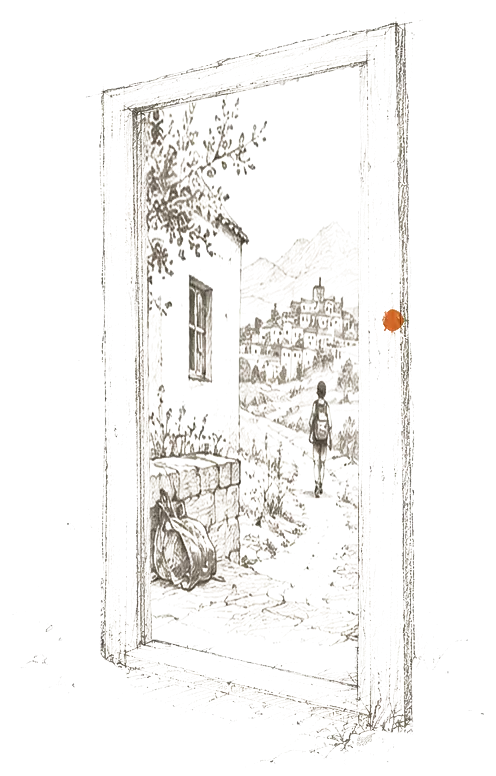
In a village of high Kabylia whose men often leave to work in France, Fouroulou Menrad grows up in a poor family, pampered by the women of the household. He clings to the village school; a scholarship takes him to secondary classes, then to the teachers' college in Algiers, while his family counts on him.
Timeline
- 1950–1962The 1952 generationFeraoun, Dib, Mammeri, Kateb. Writing Algeria in French, against France.
- 1954–1962War of independenceLiterature becomes a front. Fanon draws a philosophy from it.
- 1966–1980Algerian cinemaThe Battle of Algiers, Chronicle of the Years of Fire, Palme d'Or 1975.
- 1970–1990After independenceAssia Djebar, Rachid Boudjedra. Disillusion and the place of women.
Reading keys
- The name reads as a genealogy with ben for filiation, and tribal or regional belonging often appears last.
- Kabyle and Chaoui names, in At or Ou-, designate Amazigh lineages and are immediately distinguishable from Arabic names.
- The civil registry imposed by colonisation in 1882 assigned to many families arbitrary and sometimes humiliating names, and that fact is present in the literature.
- The kunya, "father of" followed by the name of the eldest child, is the ordinary respectful form of address.
- The black decade of the nineteen nineties, with its hundred thousand dead and its disappeared, is a subject framed by a concord law that limits what can be established.
- The war of independence is political capital, and recounting the violence internal to the independence camp remains difficult.
- The Amazigh question and the place of the Kabyle language are an old dispute with the state.
- The harkis and their descendants are a subject long unsayable on both sides of the Mediterranean.
- Maliki Sunni Islam is the state religion, with an old Sufi tradition that the rigorist currents have been contesting since the nineteen eighties.
- The zawiyas, brotherhoods with their sheikh and their shrine, were institutions of teaching and of resistance.
- The cult of saints and local pilgrimages, very much alive in Kabylia and in the west, are a social fact that literature describes.
- The jinn belong to Quranic cosmology, and practices of protection against the evil eye are common.
- Muslim mourning is brief, with burial on the same day, condolences for three days and a reading on the fortieth.
- The white of the haik worn by the women of Algiers, today almost vanished, was the garment for going out and appears in the older narratives.
- Yennayer, the Amazigh new year of 12 January, is today a public holiday, which is recent and politically significant.
- Ramadan reverses the rhythm of the days and the evening gatherings become the time of speech.
- The Kabyle tales collected as early as 1882 and 1887, with their European comparative apparatus, form the founding documented corpus.
- The massive collection made by Frobenius in 1921 and 1922, classified into wonder tales, animal fables and narratives about supermen, completes that stock.
- The Kabyle poems published in 1867 with the text on facing pages, in which Anzar and the spirits of places surface, are a recognised heritage.
- The Kahina, the Berber queen who resisted the Arab armies, and Jugurtha are disputed historical references constantly summoned.
- Algeria is not only Arabic-speaking: Kabyle, Chaoui, Mozabite and Tuareg are mother tongues for millions of people.
- Algerian literature in French is not a colonial literature: it was the principal instrument of the contestation of colonisation.
- The black decade is not a classic civil war and its designation is itself a stake.
- The fragmented novel is not a gratuitous difficulty but a response to a history that does not tell itself in a straight line.
Tales and mythologies 1
- TaleLégendes et contes merveilleux de la Grande KabylieAuguste Mouliéras · 1893not translated into EnglishThe first major collection of Kabyle tales, published in the language of those who told them.Literature
A selection to begin with 10 / 55
- NovelNedjmaKateb Yacine · 1956Four young Algerians and an elusive woman who embodies the country, in a narrative that refuses the straight line.Literature
- CinemaChronicle of the Years of FireChronique des années de braiseMohammed Lakhdar-Hamina · 1975From the droughts of the thirties to the insurrection of 1954, the history of Algeria seen at the level of a peasant thrown onto the roads by poverty.Cinema
- CinemaOmar GatlatoMerzak Allouache · 1976The ordinary youth of Algiers, its chatter, its music and its desires, filmed far from the war and its heroes.Cinema
- CinemaThe Nouba of the Women of Mount ChenouaLa Nouba des femmes du mont ChenouaAssia Djebar · 1977The memory of the peasant women of the Chenoua, recorded on tape and put into images between fiction and documentary.Cinema
- CinemaLeïla et les autresSid Ali Mazif · 1977A schoolgirl whom they want to marry off and a woman worker who demands to be treated as an equal, in Algiers in the mid-seventies.Cinema
- NovelSherazadeShérazade, 17 ans, brune, frisée, les yeux vertsLeïla Sebbar · 1982The wanderings of a teenage runaway, a child of Algerian immigration, in Paris in the early eighties.Literature
- NovelShattered VisionRegard blesséRabah Belamri · 1987A teenager who loses his sight just as his country frees itself, in the heart of the Sétif region.Literature
- NovelThe Honor of the TribeL'Honneur de la tribuRachid Mimouni · 1989A forgotten village that the new regime wants to modernise at a forced pace, told by an old man who keeps its memory.Literature
- NovelThe WatchersLes VigilesTahar Djaout · 1991An inventor grappling with bureaucracy and the mistrust of veterans, in Algeria at the end of the eighties.Literature
- CinemaThe Forgotten HillLa Colline oubliéeAbderrahmane Bouguermouh · 1996The youth of a Kabyle village during the last world war, brought to the screen in its own language.Cinema