Libya
- works
- 18
- 15 books · 3 films
- period covered
- 1898–1999
- language of writing
- Arabic
Between 1929 and 1934, the Italian army shut the population of Cyrenaica into camps. Tens of thousands of people were displaced with their herds across the desert, penned behind barbed wire at El Agheila and Soluch, where a large part of them died of hunger and disease. The resistance was led by an old master of a Quranic school, Omar al-Mukhtar, captured and hanged in 1931 in front of the internees of the Soluch camp. That episode is the founding fact of Libyan national consciousness, and it was filmed in 1981 with a Hollywood budget and American actors.
Read moreShow less
The country did not exist as a unit before that. Three provinces with no administrative link, Tripolitania turned towards Tunisia, Cyrenaica towards Egypt, Fezzan towards the Sahara, were brought together by Italian colonisation, then by a kingdom, then by forty-two years of a regime that made literature an instrument and publishing a state monopoly. The very name of the country was coined by an Italian geographer. Production took place in Arabic, largely in short stories published in newspapers, the only workable form when publishing depends on a ministry.
Hence the exception constituted by a whole body of work devoted to the desert. Ibrahim al-Koni, born in the Fezzan, a Tuareg of Tamasheq language who moved to Arabic, has written since the nineteen eighties novels in which the Sahara is neither setting nor metaphor but a system of laws, with its prohibitions, its spirits and its vengeances. His 1990 novel follows a man and his spotted camel, and the relation between the two is the substance of the book. He has lived in Switzerland since 1993, after studying in Moscow, and he is today the most widely translated Libyan author in the world.
What awaits the reader is a slow, sententious prose, in which the landscape imposes its law on the characters. The novel that opens this page rests on the bond between a Tuareg and his spotted camel, and it is the Libyan novel most widely read outside the Arab world.
A way to begin
Gold Dust
Ibrahim al-Koni · 1990
Gold Dust: a Tuareg and his spotted camel, in the Libyan novel most widely read outside the Arab world.
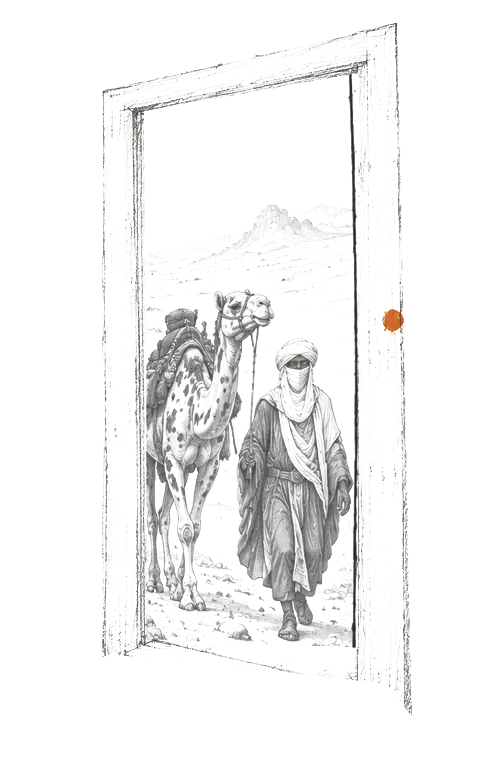
The son of a Tuareg nobleman, Oukhayyed receives on coming of age a spotted camel of matchless but fragile beauty. During his amorous escapades the animal catches mange; its master crosses the desert until he finds the herb that cures it, but must, in atonement, geld it. A chain of faults follows, a forgotten promise and a marriage that gets him driven from his tribe, binding him ever more closely to his animal.
Timeline
- 1910–1950DivansAl-Baruni, al-Sini, Abdelkader. Arabic verse under Italy and after.
- 1965–1978The short-story generationFagih, al-Neihum, Shaltami, Bukleb. The short form dominates.
- 1972–1984Libyan cinemaZarok, Shaaban, Mushbahi, Ferjani. A few films under Gaddafi.
- 1981Lion of the DesertAkkad films the resistance to Italy with Hollywood means.
- 1990Al-KoniGold Dust: the Sahara becomes a character, translated everywhere.
Reading keys
- The name reads as a genealogy with bin, and tribal belonging, often placed last, remains a determining social and political datum.
- The tribes of Cyrenaica, Tripolitania and the Fezzan have distinct histories, and the name immediately places a person.
- Tuareg and Amazigh names from the south and the Nafusa mountains are distinguishable from Arabic names.
- The kunya, "father of" followed by the name of the eldest child, is the ordinary respectful form of address.
- The Italian period, the camps and the deportation are an official subject and one never settled with Italy.
- The regime from 1969 to 2011, its prisons and the Abu Salim massacre in 1996 are subjects that literature could speak of only afterwards.
- The regional divisions between the three provinces are a permanent political subject, reactivated since 2011.
- The Amazigh minority, long denied by the state, has been recognised since 2011 and its language is regaining a public place.
- Maliki Sunni Islam is practised by nearly the whole population, with a particular brotherhood, the Sanussiya, which provided the royal dynasty and the framework of the resistance.
- An Ibadi community exists in the Nafusa mountains, with its own juridical tradition.
- The jinn and the spirits of the desert belong to Quranic cosmology and to the Tuareg stock, and al-Koni stages them as facts.
- The tombs of saints and the zawiyas of the Sanussiya served as schools and as caravan staging posts.
- Muslim mourning is brief, with burial on the same day and three days of condolences.
- The Tuareg men's veil and the indigo of the south mark status and restraint, not religion.
- Ramadan and the Eids order the calendar, with a nocturnal rhythm during the month of fasting.
- 16 September, the day of Omar al-Mukhtar's martyrdom, is commemorated as a national holiday.
- Omar al-Mukhtar, the schoolmaster become leader of the resistance and hanged in 1931, is the absolute national heroic reference.
- The Berber section of the great African collection of 1903 partly covers Tripolitania and the Fezzan and constitutes the accessible early source.
- The bull-god Gurzil, attested among the Louata until the sixth century, and the Libyco-Berber pantheon form a claimed depth.
- The Tuareg narratives of the Fezzan, with their desert spirits and their prohibitions, are al-Koni's raw material.
- Libya is not a homogeneous country: three provinces with distinct histories were brought together there late and from outside.
- Al-Koni's desert is not an exotic setting but a juridical and religious order with its sanctions.
- Libyan literature has existed since 1910 and cannot be reduced to the period of the regime nor to the one that followed it.
- Berber is present in Libya, in the Nafusa and at Zuwara, which the image of an entirely Arab country erases.
Tales and mythologies 1
- TaleMärchen und Gedichte aus der Stadt Tripolis in NordafrikaHans Stumme · 1898not translated into EnglishThe tales and songs that the inhabitants of Tripoli told one another at the end of Ottoman rule, recorded in their own speech.Literature
Available in English 2
The books from this country that can be read in English, in the original or in translation.
- NovelGold DustالتبرIbrahim al-Koni · 1990A Tuareg and his spotted mehari, in a Sahara where gold corrupts what beauty had made sacred.Literature
- NovelGardens of the Nightسأهبك مدينة أخرىAhmed Fagih · 1991The crisis of a Libyan intellectual, between memories, depression and dreams of the future, in a Libya transformed by oil.Literature
A selection to begin with 10 / 18
- Novelاعترافات إنسانMohammed Farid Sayala · 1961not translated into EnglishThe novel that many Libyan critics hold to be the country's first, a plea for the emancipation of women.Literature
- Poetryديوان شاعر الوطن الكبيرAhmed Rafiq al-Mahdawi · 1965not translated into EnglishThe posthumous collection of the man Libya called its national poet, in the time of the Italian occupation and of exile.Literature
- Poetryالليل والسنون الملعونةAli al-Regeie · 1966not translated into EnglishA collection published in the year of its author's death, in which a self-taught poet of Tripoli describes what the kingdom has done to his city.Literature
- Poetryديوان البلبل والوكرIbrahim al-Asta Umar · 1967not translated into EnglishThe posthumous collection of a blind poet of Tripoli, whose verses had circulated by word of mouth under the Italian occupation.LiteraturePublic domain
- Novelمن مكة إلى هناSadeq al-Neihum · 1970not translated into EnglishA black fisherman of Cyrenaica confronts the beliefs of his village and the authority of the imam.Literature
- Poetryتذاكر للجحيمMohamed Shaltami · 1970not translated into EnglishThe first collection by a schoolteacher from Benghazi, published at the same time as a magazine that carried it to its readers, the year after the military coup.Literature
- Cinemaعندما يقسو القدرAbdallah al-Zarrouq · 1973The film belongs to Libyan production of the 1970s, entirely controlled by the state after the revolution of 1969.Cinema
- CinemaLion of the DesertMoustapha Akkad · 1981Years of Bedouin guerrilla warfare against Fascist Italy, in a superproduction financed by the Libyan state.Cinema
- CinemaالشظيةMohamed Ali al-Ferjani · 1986The mines of the Second World War, never cleared from the Libyan desert, were still killing forty years after the fighting.Cinema
- NovelGardens of the Nightسأهبك مدينة أخرىAhmed Fagih · 1991The crisis of a Libyan intellectual, between memories, depression and dreams of the future, in a Libya transformed by oil.Literature