Vanuatu
- works
- 3
- 3 books
- period covered
- 1891–1983
- language of writing
- Bislama and French
A word that came from Vanuatu entered the vocabulary of all the human sciences. In 1891, an English missionary who spoke the Mota of the Banks Islands published a study in which he defined mana as a power perceived in every object and every person out of the ordinary. Durkheim, Mauss and then Lévi-Strauss would use it to think about the sacred, the gift and the symbol. The notion went round the universities of the world starting from an archipelago of the South Pacific.
Read moreShow less
That detail says something about the place the archipelago has occupied: long described, rarely read. Vanuatu has more than a hundred languages for a very small population, which makes it the most linguistically dense territory on the planet, and it was administered until 1980 by a Franco-British condominium that superimposed two administrations, two school systems and two police forces on the same islands. A third language, Bislama, imposed itself so that everyone could speak to one another, and it is in Bislama that public life is conducted today.
Written literature there is therefore exactly as old as the state. Grace Mera Molisa published in 1983, three years after independence, the country's first collection of poems, and in it she attacked the place given to women in custom as well as in the new politics. Writing in Vanuatu began with a criticism of its own society at the very moment when that society was celebrating itself, which is not the usual trajectory of national literatures. The price was the isolation of that voice for years, in a country where custom and independence had just been declared inseparable.
What awaits the reader is short, frontal poems, in a deliberately dry English, without island ornament or local colour. The collection that opens this page is called "Black Stone", and the stone, cooled lava, stands for what remains and will not be moved.
A way to begin
Black Stone
Grace Mera Molisa · 1983
Grace Mera Molisa's first book, three years after independence: poems that question the promises of the new state.
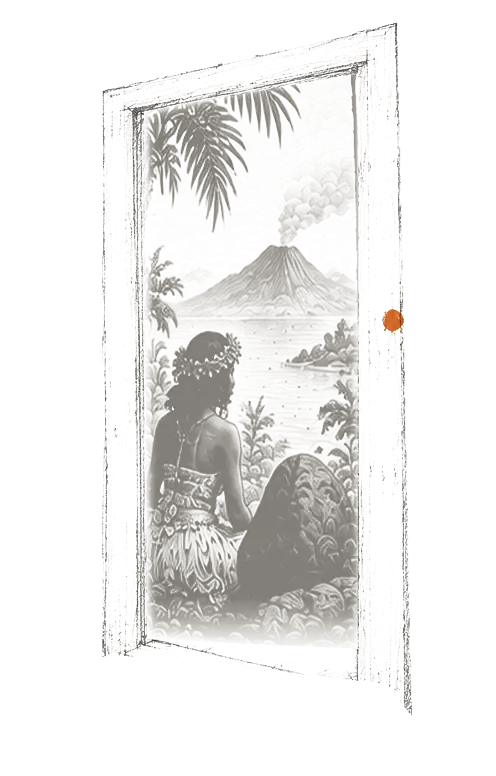
Poems in English, often short and political in tone, written in the first years of independence. They take aim at colonial rule and neocolonialism, at the way the metropolitan press looks at Port Vila, at custom and marriage as they weigh on women. The title poem makes black stone, cooled lava, the image of what remains and will not be moved.
Timeline
- 1800–1900KastomStories, chants and dances are handed down in more than a hundred languages across eighty islands.
- 1906–1980CondominiumThe Franco-British administration leaves a school split between two languages and two systems.
- 1980IndependenceBislama becomes the national language and carries the country's first written texts.
- 1983Black StoneGrace Mera Molisa publishes the first ni-Vanuatu poetry collection and opens a women's writing.
Reading keys
- Personal names refer to the island, the village and the language of origin, and a local reader immediately places someone by their name.
- Classificatory kinship is the rule: the words for brother, sister, father and mother apply to a wide circle of relatives, and a "brother" is not necessarily a son of the same parents.
- Rank is acquired through the nimangki, a system of grades one climbs by offering pigs with curved tusks. A man of high grade is not a hereditary chief.
- Women have their own grade systems on several islands, which older descriptions often neglected.
- Custom, kastom, is a political word. It served to found independence and it also serves to refuse rights to women, and the country's literature works on that ambivalence.
- The Franco-British condominium, nicknamed the pandemonium, left a mistrust of administrations that the texts do not always spell out.
- Certain knowledge is reserved by grade or by sex, and a narrative may stop dead because what follows is not to be told.
- A prolonged silence is an admissible answer and not an embarrassment.
- Presbyterian, Anglican and Catholic Christianity coexists with kastom, and many characters practise both.
- Mana is not an impersonal and abstract force: it manifests itself in particular stones, places and persons.
- The so-called cargo movements, among them the John Frum cult on Tanna, await the return of an abundance and of an announced figure. They are not curiosities but organised political and religious movements.
- Kava, drunk with concentration at nightfall, opens the world of the ancestors and is not a festive drink.
- Mourning unfolds over several days with gifts of mats, pigs and yams, and the value of the gifts is publicly announced.
- The pig with curved tusks, whose canines grow in a circle after extraction, is both a currency and a ritual object. Mentioning it indicates a considerable stake.
- Mats woven by women serve as ceremonial currency and as a measure of obligations.
- 30 July, the day of independence in 1980, is the main civil landmark.
- Mana and the narratives that illustrate it, collected in 1891 in the Banks Islands, constitute the oldest documented stock.
- The narratives of the founding of the islands and the spirits of places, tamate and vui, form the ordinary supernatural cast.
- John Frum, the awaited figure of the Tanna cult, is a reference known to all Ni-Vanuatu.
- Kava and the ritual surrounding it provide a vocabulary common to the whole archipelago.
- The mana of video games and fantasy has nothing left to do with the notion described in Vanuatu, where it is attached to identified persons and objects.
- The cargo cults are not a naivety: they analyse in their own way the sudden arrival of American military wealth during the Pacific war.
- Kastom is not a survival: it is permanently reformulated and is argued over in the courts.
- The number of languages does not indicate an archaic fragmentation but an old choice of multilingualism, each person speaking several neighbouring languages.
Tales and mythologies 1
- NarrativeThe MelanesiansRobert Henry Codrington · 1891An Anglican missionary who spent years in the islands describes their societies and beliefs.Literature
Available in English 2
The books from this country that can be read in English, in the original or in translation.
- PoetrySome Modern Poetry from the New HebridesAlbert Wendt · 1975The young poets of the New Hebrides gathered in 1975, five years before independence.Literature
- PoetryBlack StoneGrace Mera Molisa · 1983The archipelago has been independent since 1980, and a woman who took part in the birth of the State questions its promises.Literature
A selection to begin with 1 / 3
- PoetrySome Modern Poetry from the New HebridesAlbert Wendt · 1975The young poets of the New Hebrides gathered in 1975, five years before independence.Literature