Zimbabwe
- works
- 23
- 19 books · 4 films
- period covered
- 1956–1996
- language of writing
- English
There exists in the centre of the country a city of dry stone, with walls ten metres high raised without mortar, built between the eleventh and the fifteenth centuries. For decades, colonial archaeology refused to admit that Africans had built it, and invented Phoenicians, Arabs, the Queen of Sheba. The Rhodesian government censored the works that concluded otherwise. In 1980, at independence, the country took the name of that site: Zimbabwe, "houses of stone". To take as the name of a state a monument that had been denied you is a declaration.
Read moreShow less
That dispute over who did what runs through all the culture of the country. British colonisation there was late and brutal, with the seizure of land by a minority that still owned most of the commercial farms at the end of the twentieth century, and two wars, that of 1896 and that of 1966 to 1979, whose memory is a permanent stake of legitimacy. Shona and Ndebele carry an abundant literature that English covers over abroad, and several novelists move from one language to another according to the intended audience.
The most singular form came from a writer who refused everything. Dambudzo Marechera published in 1978 a narrative about a young man and his family in a township, written in a dislocated, violent language, without consolation, and declared that he was not an African writer but a writer, full stop. He lived and died in the street at thirty-five. Before him, Solomon Mutswairo had published in Shona a disguised historical novel that was banned, and Charles Mungoshi wrote in both languages. The price was paid by almost all of them: censorship, exile, drink, or silence after 1980.
What awaits the reader is a prose of anger rather than of programme, and a mistrust of official narratives, including those of liberation. The narrative that opens this page is called "The House of Hunger", and it tells of the poverty and violence of a Rhodesian township in a prose built by collage.
A way to begin
The House of Hunger
Dambudzo Marechera · 1978
The poverty and violence of a Rhodesian township, in a prose that breaks narrative apart: Guardian Fiction Prize 1979.
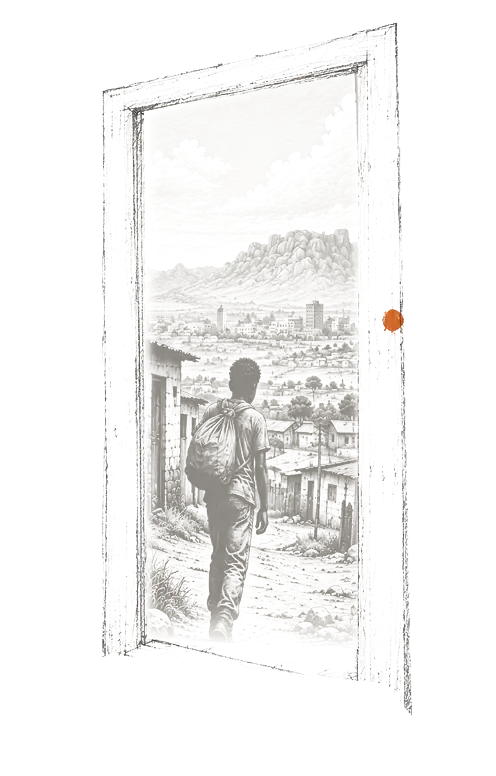
"I got my things and left": the narrator, a young man from the township leaving the house of hunger, looks back on his childhood and adolescence in Ian Smith's Rhodesia, amid poverty, domestic violence, drink and racism. As a student he feels a stranger to his family, his fellow students and the society around him. This long first-person narrative is followed by nine stories.
Timeline
- 1966–1974Writing in ShonaChakaipa and Mutswairo publish under Rhodesia.
- 1975–1978Mungoshi and MarecheraWaiting for the Rain, then The House of Hunger, written in England.
- 1982–1989After independenceHove, Nyamfukudza, Zimunya, Katiyo. A very productive decade.
- 1990–1996Zimbabwean cinemaJit, Neria, then Dangarembga and Sinclair filming women.
Reading keys
- Shona names are sentences: Dambudzo means "the one who brings trouble", Chenjerai "be careful", Tsitsi "pity". The first name comments on the birth.
- The totem, mutupo, designates the clan by an animal, and one greets somebody by naming their totem. One does not marry within one's totem and one does not eat one's animal.
- The Ndebele names of the south-west belong to the Nguni world, as in South Africa, and are immediately distinguishable from Shona names.
- Lobola is negotiated at length and its amount is a frequent narrative device.
- The war of liberation and the question of who won it are a stake of legitimacy that the narratives approach with caution.
- The massacres in Matabeleland in the nineteen eighties long remained unsayable.
- The land reform of the two thousands and the economic collapse are subjects on which every account is situated.
- Sorcery and the accusation of sorcery are social and judicial realities, not fantastical motifs.
- Christianity is in the majority, with powerful independent churches, notably apostolic ones.
- Mwari is the supreme god, whose oracle spoke in the caves of the Matopos, and the mhondoro are the royal spirits attached to a territory.
- The svikiro, mediums possessed by a mhondoro, played a real political role during the wars of liberation.
- The n'anga, healer and diviner, is an ordinary character, distinct from the muroyi, the malevolent sorcerer.
- Mourning includes a wake, burial on the lineage's land, then a deferred ceremony, the kurova guva, which installs the dead person among the ancestors.
- Widowhood imposes public prohibitions on the woman, and the levirate still exists in certain regions.
- The mbira, a lamellophone played during possession ceremonies, calls the ancestors, and an mbira scene is a ritual scene.
- The rain rites addressed to Mwari, with a pilgrimage to the Matopos, take place at the end of the dry season.
- Nehanda, a medium possessed by an ancestral spirit and hanged in 1898 for her role in the first war, is the national heroic reference.
- Great Zimbabwe and its stone birds, one of which appears on the flag, are the historical emblem of the country.
- The Shona and Ndebele tales, with the hare and the hyena, form the domestic stock.
- Mwari, the mhondoro and the mbira constitute a religious knowledge that the texts assume is known.
- Great Zimbabwe is an African construction, and attributing it to others takes up an explicitly political colonial thesis.
- Marechera refused the label of African writer, and reading him as a spokesman for his country contradicts his project.
- Shona is not a dialect: it is a literary language with novels, a poetry and censorship bans to its name.
- The recent economic crisis does not sum up a country whose literary production is old and abundant.
Tales and mythologies 1
- TaleNganoAnonymous · 1973not translated into EnglishThe first volume of Shona evening tales collected by the linguist George Fortune and his students in Salisbury.Literature
A selection to begin with 10 / 23
- NovelFesoSolomon Mutswairo · 1956A Shona kingdom of long ago, invaded and enslaved, which colonial Rhodesia eventually read as an allegory.Literature
- NovelWaiting for the RainCharles Mungoshi · 1975Three generations of a Shona family, at the moment when the educated son is about to leave.Literature
- Short storiesAftermathsStanley Nyamfukudza · 1983The aftermath of independence, seen from below and without fanfare.Literature
- PoetryA Storm Is BrewingKristina Rungano · 1984The first collection of poems published by a woman in Zimbabwe, between anger, love and memories of the war.Literature
- PoetryCountry Dawns and City LightsMusaemura Zimunya · 1985From country dawns to city lights, a poet torn between two worlds.Literature
- NovelCrossroadsSpencer Tizora · 1985Ordinary lives swept up by the war of liberation, between love, commitment and the fear of being betrayed.Literature
- CinemaConsequencesOlley Maruma · 1988A pregnant Zimbabwean schoolgirl, expelled from school, and everything the coming child takes from her.Cinema
- CinemaJitMichael Raeburn · 1990A comedy set to the rhythm of jit music, in which a boy must earn the bride price for his beloved under the eye of an ancestral spirit.Cinema
- CinemaNeriaGodwin Mawuru · 1991A widow dispossessed by her in-laws in the name of custom, in Harare after independence.Cinema
- CinemaFlameIngrid Sinclair · 1996The war of liberation as lived by two young women fighters, and what it cost them within their own side.Cinema