Novel
Seven Days at the Silbersteins
Sewe dae by die Silbersteins
Etienne Leroux · 1962
Synopsis
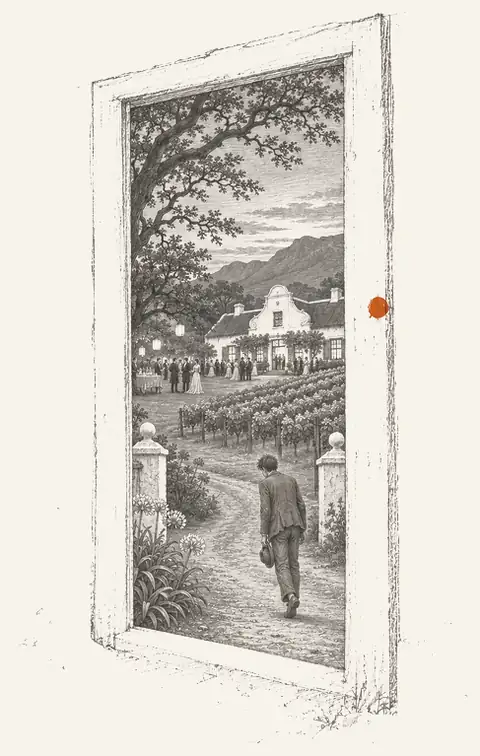
Henry van Eeden, the young fiancé of Salome Silberstein, arrives with his uncle J. J. at Welgevonden, an old wine estate that the Silbersteins' fortune has turned into a model farm. He has come to meet his future in-laws and to see his betrothed for the first time. For a week, each evening brings a party and other guests: rich people, artists, farmers, journalists, lawyers, liberals, followers of moral rearmament. Always badly dressed, Henry looks for Salome and tries to understand good and evil, while the order of the estate gradually comes undone.
Context
Published in 1962 by Human & Rousseau, the book was the first by its author to reach the general public and provoked a national literary quarrel; critics were divided between condemnation and praise. It has been read as a satire of intellectualism and of the rich, conducted through caricature, and as a danse macabre in which death levels the classes; Louise Behrens's review noted in it a black mass and echoes of Dante. Charles Eglington translated it into English in 1964; according to Greg Penfold and Leon de Kock, English-language criticism, reading this translation out of its context, drew fragile conclusions from it, and Penfold produced a new version in 2013.
Who it is for
A novel in Afrikaans, in clear prose and fairly easy to approach, translated into English; its allusions and its satire are better appreciated on rereading.
Prizes and reception
Hertzog Prize 1964; his major novel, regarded, together with André Brink's Lobola vir die lewe, as a turning point in the Afrikaans novel.
Sources for this page 5
The pages consulted to check this page.