Burma (Myanmar)
- works
- 26
- 20 books · 6 films
- period covered
- 1100–1994
- language of writing
- Burmese
In the nineteenth century, the British administrators discovered that Burma could read better than England. Every village had its monastery, every monastery its school, and the monks taught reading, writing and arithmetic free of charge to all boys, in a system without equivalent in Asia. Texts circulated on palm leaves engraved with a stylus, sewn into bundles, kept in lacquered chests. An entire society read, and what it read was Buddhist.
Read moreShow less
That base explains the form taken by Burmese literature. The dominant genre was long the narrative religious poem, the pyo, which recounts a previous life of the Buddha in regulated verse, and prose established itself only in the twentieth century under the influence of the English novel. A seventeenth-century monk composed a pyo that is still quoted, and the verse epistles of an eighteenth-century scholar became models of style. There is no rupture between devotion and literature: it is the same exercise, and one gains merit by copying a text as by composing it.
The turning point was political. Thakin Kodaw Hmaing published from 1914 texts that use the classical forms to attack colonisation, playing on words to the point that the censors understood nothing of them. After independence, literary life shrank under the military regime: prior censorship of every page, rationed paper, imprisoned writers. Journal Kyaw Ma Ma Lay, a novelist and newspaper editor, published in 1955 the story of a young woman whose husband, an admirer of the English, prevents her from seeing her family, and the book remains the country's modern classic.
What awaits the reader is a polished, indirect prose, in which constraint is described through its minute effects. The novel that opens this page tells of a Burmese marriage under colonial rule, in which the young wife stands for the country and her husband for colonial England.
A way to begin
Not Out of Hate
Journal Kyaw Ma Ma Lay · 1955
A Burmese marriage under colonial rule, read as an allegory of the country: one of the few Burmese novels translated into several languages.
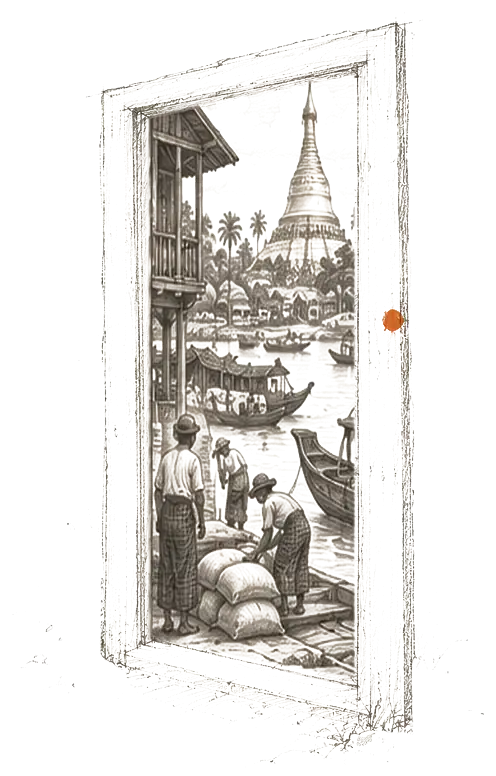
In the thirties, in the Irrawaddy delta, Way Way keeps the accounts of her father, an ailing rice merchant. U Saw Han, agent of a British firm, a Burmese man twenty years her senior wholly won over to English ways, moves into the house next door. Way Way falls for him and marries him; without cruelty but sure of his right, he orders her life in the Western manner and draws her away from her father.
Timeline
- 1600–1800Court poetryRatthasara, Natshinnaung. The pyo and the yadu, classical Burmese forms.
- 1914–1938Nationalist awakeningThakin Kodaw Hmaing, Thein Pe Myint. Writers enter politics.
- 1920–1937First cinemaU Ohn Maung is filming by 1920; Tin Maung founds a studio.
- 1938–1963The Khit San generationMaung Htin, Ma Ma Lay, Zawgyi. A new prose, brief and direct.
- 1963–1975Under Ne WinMa Ma Lay is imprisoned; Min Thu Wun writes for children.
Reading keys
- There is no family name: everyone bears a personal name, often linked to the day of their birth, and the members of a family have no name in common.
- The particles that precede the name indicate age and status: U for a respected man, Daw for a woman, Ko for a young man, Ma for a young woman. They are not part of the name.
- The day of birth determines the first letter of the name and the horoscope, and one may change one's name in order to change one's destiny.
- Kinship terms are used to address strangers according to age, and one calls an elder big brother or aunt.
- The military regime from 1962 to 2011, and again since 2021, practises prior censorship and imprisons writers, which makes allusion obligatory.
- The question of the minorities, Karen, Shan, Kachin, and the fate of the Rohingya are extremely dangerous subjects.
- British colonisation and the Indian immigration it organised left a resentment that the older texts express.
- Restraint is a value: one does not show one's anger, and a character who loses their calm loses face.
- Theravada Buddhism is very much in the majority, and the temporary passage through the monastery is a rite of passage for all boys.
- The nats, spirits officially numbering thirty-seven, receive offerings at domestic altars and during possession festivals. One is Buddhist and one feeds the nats.
- Accumulated merit, kutho, is counted and transferred: offering a meal to the monks or gilding a stupa produces a measurable effect.
- Astrology governs the dates of marriage, of departure and of birth, and a character who ignores it commits an imprudence.
- White and yellow are associated with mourning and with religious life, and black is not used.
- Funerals include a wake, a cremation and an offering to the monks on the seventh day.
- Thingyan, the April new year during which people sprinkle each other with water for several days, brings the whole country to a halt.
- Thanaka, a yellow paste applied to the face, and the longyi, a knotted piece of cloth worn by both sexes, are daily usages.
- The Jataka, previous lives of the Buddha, are known through mural paintings, pyo and childhood narratives.
- The Glass Palace Chronicle, compiled in 1829, traces the Burmese dynasty back to the Buddha's clan, a borrowed genealogy that founds royal legitimacy.
- The thirty-seven nats, with their names and their often violent stories, are a common knowledge.
- The Burmese tales collected in the twentieth century and the animal fables form the domestic stock.
- The absence of a family name makes genealogies illegible: two brothers bear unrelated names.
- The particles U and Daw are not first names but titles, and foreign catalogues often incorporate them by mistake.
- The cult of the nats is not a marginal survival: it coexists with Buddhism in the same people.
- The country is called Burma or Myanmar according to the political position of the speaker, and the choice of word is a taking of sides.
Tales and mythologies 1
- NarrativeThe Thirty-Seven Natsနတ်Anonymous · 1100The legends of the thirty-seven spirits of the Burmese pantheon, a cult that the monarchy, unable to ban it, attached to Buddhism.Literature
Available in English 7
The books from this country that can be read in English, in the original or in translation.
- TheatreThe Water-Sellerရေသည်ပြဇာတ်U Ponnya · 1860A Burmese court play of the nineteenth century, drawn from a jataka, in which a man of the people crosses the king's path.Literature
- NovelMaung Yin Maung and Ma Me MaMaung Yin Maung Ma Me MaJames Hla Kyaw · 1904A dispossessed husband, disguises and a name to clear: Dumas transposed to Burma, at the dawn of the Burmese novel.Literature
- DiaryWartime in Burmaစစ်အတွင်း နေ့စဉ်မှတ်တမ်းTheippan Maung Wa · 1942The diary of a senior Burmese official during the Japanese invasion of 1942, published a quarter of a century later.Literature
- NovelNga BaငဘMaung Htin · 1947The war and the Japanese occupation seen by a peasant of the Burmese delta, in a novel written as the conflict ended.Literature
- NovelNot Out of Hateမုန်း၍မဟူJournal Kyaw Ma Ma Lay · 1955A Burmese marriage under the colony, in which a husband enamoured of English manners keeps his young wife away from her family.Literature
- Short storyThe 13-Carat DiamondKhin Myo Chit · 1955A Burmese couple during the war and the mirage of a diamond: Khin Myo Chit's best-known short story.Literature
- NovelSmile as They BowNu Nu Yi · 1994A cross-dressing medium, his young lover and the Taungbyon spirit festival: a Burmese novel long held back by censorship.Literature
A selection to begin with 10 / 26
- Poetryကိုးခန့်ပျို့Bhikkhu Ratthasara · 1523not translated into EnglishA long Buddhist poem of 1523, drawn from a previous life of the Buddha, in which renunciation spreads from one to the next.Literature
- Chronicleဗိုလ်ဋီကာThakin Kodaw Hmaing · 1914not translated into EnglishSatirical articles of 1913-1914 against the Burmese who copied the manners of the English, even in their names.Literature
- Feature filmLove and Liquorမေတ္တာနှင့်သူရာU Ohn Maung · 1920The first Burmese feature film, a silent film from 1920 against gambling and alcohol.Cinema
- Feature filmDou daung lanParot U Sunny · 1936A Burmese film of 1936 that the colonial authorities banned, and whose title takes up the emblem of the national movement.Cinema
- DiaryWartime in Burmaစစ်အတွင်း နေ့စဉ်မှတ်တမ်းTheippan Maung Wa · 1942The diary of a senior Burmese official during the Japanese invasion of 1942, published a quarter of a century later.Literature
- NovelNga BaငဘMaung Htin · 1947The war and the Japanese occupation seen by a peasant of the Burmese delta, in a novel written as the conflict ended.Literature
- Short storyThe 13-Carat DiamondKhin Myo Chit · 1955A Burmese couple during the war and the mirage of a diamond: Khin Myo Chit's best-known short story.Literature