Bolivia
- works
- 43
- 34 books · 9 films
- period covered
- 1736–1998
- language of writing
- Spanish
There exists in Bolivia a mountain that has been eaten. The Cerro Rico of Potosí supplied from 1545 enough silver to finance Spain's wars and to bring Europe into the world economy, and the expression to be worth a Potosí still exists in Spanish to mean a fortune. The price was paid by a system of forced labour, the mita, which sent every year tens of thousands of men from the Andean communities into the galleries, where many stayed. The town, at four thousand metres of altitude, had more inhabitants than London or Paris at the beginning of the seventeenth century. The mountain itself is today pierced by thousands of galleries and is subsiding at the summit.
Read moreShow less
That precedent explains the place of the mine in all Bolivian culture. Jaime Mendoza published as early as 1911 a novel about the lands of Potosí, and the country has produced a literature and a cinema of the pit, in which the miners venerate at the edge of the shaft a horned figure they call the Uncle and to whom alcohol and coca leaves are offered. He must be seen as an employer with whom one negotiates, not as a demon one fears.
What distinguishes Bolivia from its neighbours is the entry of the indigenous languages into the field. Adela Zamudio, a poet, had already attacked in 1913 the condition imposed on women and clerical hypocrisy. Jesús Lara published Quechua poetry in 1927 and devoted his life to collecting that corpus. Jorge Sanjinés shot from 1966 films in Aymara and in Quechua, with communities that collectively decide the script, and his method founded a school. The Constitution of 2009 makes thirty-six indigenous languages official alongside Spanish.
What awaits the reader is a literature of altitude and of the mine, highly political, in which the collective counts for more than the individual and in which the landscape crushes. The novel that opens this page is made of letters in which a small town judges its women and the women answer back, and it went almost unnoticed before being rediscovered at the end of the century.
A way to begin
Confidences
Adela Zamudio · 1913
Adela Zamudio's only novel, in letters, free of rights: a small town judges its women, and the women answer back.
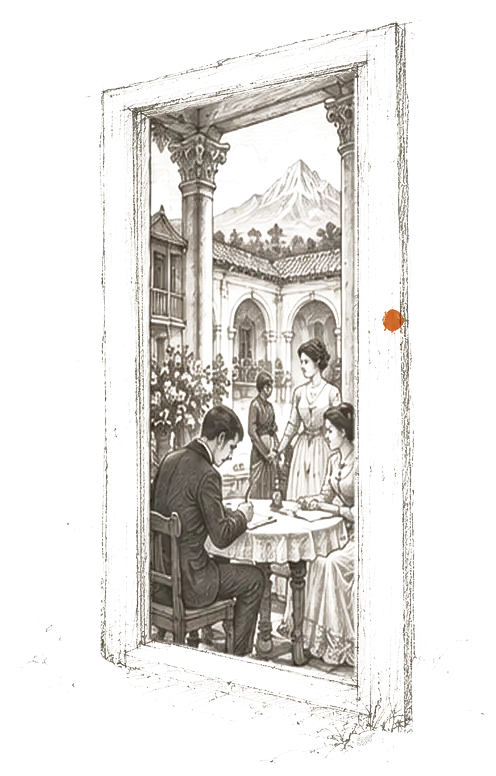
Juan, in Cochabamba on business, writes eleven letters to his friend Armando in which he judges the women of the house that takes him in, and these figures change under his pen. The second part gives two letters from Antonia, a married woman, telling the story of Evangelina Paz, slandered and forced to withdraw from the world.
Timeline
- 1864–1913FoundationsAguirre, Arguedas, Zamudio. The novel and the first feminist voice.
- 1917–1935Modernismo and the ChacoTamayo, Jaimes Freyre, Cerruto. The war changes literature.
- 1947–1960National novelMedinaceli, Díaz Villamil, and Jorge Ruiz's Vuelve Sebastiana.
- 1966–1977UkamauSanjinés films in Aymara and Quechua; Eguino films the city.
- 1982–1990After the dictatorshipsSáenz, Montoya, Paz Soldán. Writing what has just happened.
Reading keys
- The Spanish usage of two surnames applies, and one classifies by the father's name.
- Aymara and Quechua names, Mamani, Condori, Quispe, Choque, are extremely widespread and long meant a social downgrading.
- The ayllu organises the communities, with its rotating charges that a man must exercise in his turn in order to be considered an adult.
- Compadrazgo and the sponsorship of festivals, the padrino, involve considerable expenditure and provide a narrative device.
- The Chaco war, from 1932 to 1935, produced a generation of writers and revealed to the elites the existence of the indigenous population they were sending to the front.
- The revolution of 1952 and then the dictatorships, with the assassination of a novelist who was a minister in 1980, are raw subjects.
- Racism towards Aymaras and Quechuas is structural, and the coming to power of an Aymara president in 2006 made it explicit.
- Coca, a ritual and medicinal plant, is an international political subject, and its criminalisation is experienced as a cultural aggression.
- Catholicism was superimposed on the Andean cults: the Virgin of Copacabana is venerated on a pre-Hispanic place of pilgrimage.
- The Pachamama receives buried offerings, and one neither builds nor digs without asking her.
- The Tío of the mine, a horned figure installed at the bottom of the galleries, receives alcohol, cigarettes and coca. He is neither a Christian devil nor an Andean divinity but the master of the ore.
- The yatiri, Aymara ritual specialists, read the coca leaves and are consulted for all important decisions.
- The wake, the meal of the eighth day and that of the first anniversary organise the mourning, with food for the dead person.
- On 2 November, the ñatitas, skulls kept in families, are brought out, adorned and honoured, a practice very much alive in La Paz.
- The carnival of Oruro, with its diablada and its thousands of dancers, is listed as intangible heritage and lasts several days.
- The ekeko, a statuette of abundance loaded with miniatures during the Alasitas festival in January, is a generalised urban rite.
- The Andean traditions of Huarochirí and the emergence of Manco Cápac from Lake Titicaca are a stock shared with Peru.
- Tunupa, the Aymara divinity of volcanoes and of salt, and the narratives of the salt flat are proper to the highlands.
- The Tío of the mine and the rites of the pit are a knowledge common to the mining regions.
- The Quechua poems collected and published by Jesús Lara constitute the indigenous literary corpus of reference.
- Bolivia does not have a mostly mixed-race population in the sense understood elsewhere: Aymaras and Quechuas together form a considerable and claimed part of the population.
- The Tío of the mine is not a devil cult: it is a negotiation with the owner of the ore.
- Coca is not cocaine: it is a leaf chewed for millennia, offered, exchanged and consulted.
- Potosí is not a historical curiosity: the mountain is still worked and is collapsing.
Tales and mythologies 1
- PoetryKacharpariJuan Wallparrimachi · 1891not translated into EnglishThe highlands of Charcas in the time of the guerrilla wars of independence, where the language of the majority is hardly written down and where a sung farewell passes from mouth to mouth before anyone fixes it in writing.Literature
A selection to begin with 10 / 43
- NovelJuan de la Rosa: Memoirs of the Last Soldier of the Independence MovementJuan de la RosaNataniel Aguirre · 1885Cochabamba between 1810 and 1812, from the uprising against the king to the arrival of the royalist troops.Literature
- NovelEn las tierras del PotosíJaime Mendoza · 1911not translated into EnglishThe tin camps of northern Potosí at the beginning of the twentieth century, around the mines of Llallagua and Uncía.Literature
- NovelBewitched LandsTerres embraséesAdolfo Costa du Rels · 1931The tropical borderlands of Bolivia at the time when oil is being sought there, on an estate that its master holds by a single will.Literature
- NovelYanakunaJesús Lara · 1952not translated into EnglishThe haciendas of the Cochabamba valley before the 1952 revolution, where an indebted Indian family pays in labour and in children.Literature
- CinemaUkamauJorge Sanjinés · 1966An island on Lake Titicaca and the altiplano, where a peasant and a mestizo share neither the same language nor the same rights.Cinema
- CinemaCrimen sin olvidoJorge Mistral · 1968South America in the sixties, where it was known that former Nazis were living under assumed names.Cinema
- NovelThe BreachLos fundadores del albaRenato Prada Oropeza · 1969Southeastern Bolivia in 1967, when a handful of men believe they are opening the revolution of the continent there.Literature
- CinemaLa ChaskañawiJosé Cuéllar Urízar and Hugo Cuéllar Urízar · 1976A town in southern Bolivia where no one crosses the line between the young ladies and the cholas.Cinema
- CinemaSeñores generales, señores coronelesAlfonso Gumucio · 1976Bolivia under dictatorship, seen from the Parisian exile of those whom the military had driven out.Cinema
- CinemaChuquiagoAntonio Eguino · 1977La Paz at the end of the seventies, a city where one goes up and down without ever changing worlds.Cinema