North Korea
- works
- 5
- 2 books · 3 films
- period covered
- 1750–1986
- language of writing
- Korean
In 1978, a South Korean director and his actress wife were kidnapped in Hong Kong on the orders of the son of the North Korean leader, a film enthusiast who wanted to provide his country with a real cinema. Shin Sang-ok first spent years in detention, then was given a studio, a budget and means without equivalent, and shot seven films in three years, including a story of a giant monster woken by the suffering of the peasants. In 1986, while travelling to Vienna, the couple escaped by taxi and requested asylum at the American embassy.
Read moreShow less
That episode tells of a particular conception of art. In North Korea, literature and cinema are organs of the state: authors are salaried members of a writers' union, subjects are commissioned, texts revised collectively, and an official doctrine published in the nineteen seventies prescribes the method of composition, starting from an ideological "seed" around which the work must grow. There is no independent publishing, no criticism, no reader free to choose.
The form that results is the edifying melodrama. The country's best-known film, released in 1972, follows a young girl who sells flowers to pay for her mother's care under the Japanese occupation, and it is constructed to make a whole auditorium weep at the same moment. The technique is real, the emotion manufactured methodically, and the result was seen by millions of spectators in China and Eastern Europe. The price is a literature of which almost nothing is known from within, and whose rare testimonies that leave the country circulate under pseudonyms, sometimes written on sheets of paper passed across the border.
What awaits the viewer is an art of demonstration, which requires looking at once at the work and at the apparatus that produced it. The film that opens this page is the first North Korean film to win a prize abroad, and its lead actress appears on the country's banknotes.
A way to begin
The Flower Girl
Choe Ik-kyu and Pak Hak · 1972
The first North Korean film to win a prize abroad, drawn from an opera the regime attributes to Kim Il-sung.
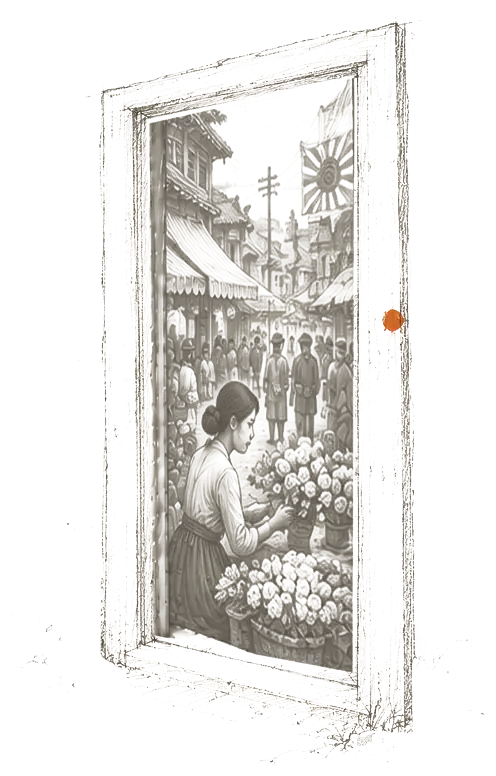
In 1930s Korea, under Japanese occupation, young Kkot-bun sells flowers at the market to pay for care for her sick mother, reduced to serving a cruel landlord to whom the family owes money. Her father is dead, her little sister is blind and her brother has been imprisoned. The landlord's wife hounds the family.
Timeline
- 1972–1978State cinemaThe Flower Girl, drawn from an opera attributed to Kim Il-sung.
- 1985–1986Shin Sang-okThe abducted South Korean director shoots Pulgasari for the North.
Reading keys
- The family name precedes the first name, as in the South, and the same names dominate: Kim, Ri, Pak.
- The official transcription differs from that of the South: the same name is written Ri in the North and Lee in the South, Pak and Park, which complicates searches.
- Songbun, a system of hereditary classification of the population according to the supposed loyalty of the ancestors, determines studies, housing and marriage.
- The cult of the ruling family uses a vocabulary of kinship, and the terms father and mother there refer to political figures.
- Nothing critical can be published inside the country: every work passes through political validation.
- The famine of the nineteen nineties, the camps and the executions are recounted only by defectors, outside the country, often under a pseudonym.
- South Korea is mentionable only as occupied territory, and Japan as former coloniser.
- The vocabulary itself diverges: seventy years of separation have created lexical differences that inter-Korean dictionaries try to bridge.
- All religious practice is closely controlled, and the country is among the most restrictive in the world in that domain.
- The Confucian stock persists in hierarchy and respect for elders, and the cult of the ruling family borrows its forms.
- Shamanism and the cult of the ancestors survive clandestinely, as the testimonies of defectors report.
- Juche, the official doctrine, occupies the place of a complete system of meaning, with its texts, its commentaries and its places.
- The white of traditional mourning coexists with highly codified official rites of commemoration.
- The birthdays of the leaders are the main festivals of the calendar and give rise to mass spectacles.
- The lunar new year and chuseok are celebrated, with visits to the family tombs.
- The mass gymnastics spectacles, with tens of thousands of participants, are an artistic form in their own right.
- The myth of Tangun is claimed as in the South, and a mausoleum was built for him near Pyongyang in 1993.
- Hong Gildong, an illegitimate son become the leader of bandits, is a popular hero common to both Koreas and was brought to the screen in the North.
- Pansori and the traditional sung narratives are preserved in rewritten form.
- The narratives of the war against Japan and of the Korean war constitute the official narrative stock.
- North Korean cinema is not technically poor: it has benefited from considerable means and from trained professionals.
- North Korean literature exists and is published in quantity, but it is not independent, which changes the nature of what one reads.
- The two Koreas share the whole classical stock from before 1945, and an old work belongs to both.
- The transcriptions of names differ between the North and the South, and the same author may appear under two spellings.
Tales and mythologies 1
- NarrativeThe Tale of Chunhyang춘향전Anonymous · 1750The tale comes from pansori, the art of storytelling sung by a singer accompanied by a drum.Literature
A selection to begin with 3 / 5
- Epic백두산Cho Ki-chon · 1947not translated into EnglishIt was the first epic published in the North after liberation, and the model of Korean socialist realism.Literature
- Feature filmPulgasari불가사리Shin Sang-ok · 1985The film was made by a South Korean filmmaker who had been abducted and held in Pyongyang, with Japanese technicians.Cinema
- Feature filmHong Kil-dong홍길동Kim Kil-in · 1986In it, North Korean cinema opened its screens for the first time to choreographed combat, a genre until then judged feudal.Cinema