South Korea
- works
- 75
- 56 books · 19 films
- period covered
- 599–2000
- language of writing
- Korean
In 1443, a king devised an alphabet so that his people could write. Sejong observed that the Koreans had only Chinese characters, long to learn and reserved for scholars, and he had a system produced of twenty-eight signs whose shape reproduces the position of the mouth and the tongue. It was presented as learnable in a morning by an intelligent man, in ten days by a fool. The officials protested: to abandon Chinese would be to fall. The alphabet survived on the margins, used by women and by popular novels, before becoming in the twentieth century the country's only writing.
Read moreShow less
That story tells of a lasting position, that of a country wedged between two immense neighbours and which chose to equip itself with its own tools. Korea was a kingdom tributary to China, then a Japanese colony from 1910 to 1945, with the progressive prohibition of the Korean language in schools, then a country cut in two. Writing in Korean has been, at every stage, a political decision as much as an aesthetic one. The writers of the generation of 1940 had to choose between Japanese and silence.
The dominant form is the narrative of division and of impeded memory. Choe In-hun published in 1960 the story of a man who, a prisoner of war, refuses both the North and the South and chooses a third country. Yi Beom-seon wrote in 1950 the life of a family of refugees in a Seoul in ruins, brought to the screen eleven years later in a film long censored. South Korean cinema exploded after the end of the dictatorship in 1987: it took up the old stories of servants and sacrifices and made of them thrillers of a controlled violence.
What awaits the reader is a literature of restrained resentment, in which injustice is not avenged but accumulates. The novel that opens this page follows a prisoner of war who refuses both North and South, and its author kept revising it from 1961 to 2010.
A way to begin
The Square
Choe In-hun · 1960
The Square: a prisoner of war between North and South, in a novel reprinted more than two hundred times.
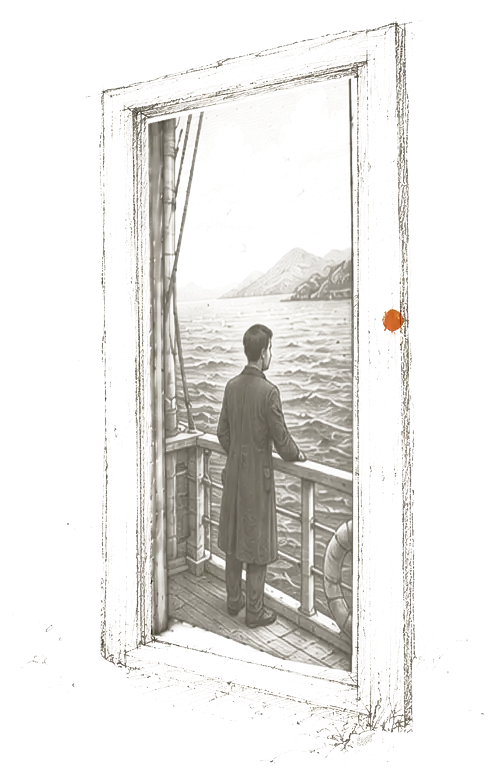
Yi Myeong-jun, a released prisoner of war, is sailing towards a neutral country and looks back on his life. A philosophy student in Seoul, he is questioned by the police because of his father, who went North; he goes North in turn, where he finds not the public square he was seeking but the slogan. Between two regimes and two women, he looks for somewhere to live.
Timeline
- 1446The invention of hangulKing Sejong gives Korean its own alphabet, designed to be learned in a day.
- 1910–1945Japanese occupationThe language is banned in schools. Writing in Korean becomes resistance.
- 1950–1953Korean WarPartition cuts the country in two, and literature with it.
- 1960–1980Under the dictatorshipsCommitted literature, censorship, prison.
- 1996–2010Korean New WaveAfter censorship ends, Korean cinema bursts out and conquers the world.
Reading keys
- The family name precedes the first name and is limited to one syllable: Choe In-hun's family name is Choe. Three names, Kim, Lee and Park, cover nearly half the population.
- The clan is identified by the family name and the place of origin, and two people of the same clan could not marry, a rule abolished late.
- Women keep their family name after marriage, which is disconcerting when reading genealogies.
- One almost never calls an elder by their first name: a title or a kinship term is used, and moving to the first name is an event.
- Japanese colonisation, the question of the collaborators and that of the comfort women are still burning subjects.
- The division, the war of 1950 to 1953 and the impossibility of speaking well of the North structured censorship until the nineteen eighties.
- The Gwangju massacre in 1980 is a subject long forbidden that has become central.
- Han, resentment accumulated with no outlet, is a category that Koreans claim in order to describe themselves and that the narratives stage.
- Confucianism organises family and social hierarchy without being a religion, Buddhism is old, and Protestant and Catholic Christianity today concerns nearly a third of the population.
- Shamanism, with the mudang who are almost all women, is alive: they are consulted for marriages, for business and for the dead who have departed badly.
- The gut, a shamanic ceremony, appeases an angry dead person, and a gut scene is a scene of reparation.
- The cult of the ancestors, jesa, is practised on fixed dates and its abandonment is a motive of family conflict in many narratives.
- White is the colour of traditional mourning, black having established itself in the twentieth century. The two cross according to the period of the work.
- Mourning imposes an armband, a wake of three days and rites on the anniversaries of the death.
- Chuseok in autumn and the lunar new year impose the return to the home region and give rise to national traffic jams, a frequent narrative motif.
- Age is counted differently: one is born at one year old and grows older at the new year, so that an age announced in a narrative may be one or two years out.
- The Memorabilia of the Three Kingdoms, compiled around 1281, contains the myth of Tangun, born of the union of the son of the sky god and of a bear become a woman.
- Chunhyang, a young woman faithful to her husband despite a magistrate who persecutes her, is the most adapted narrative in Korean history, in theatre as in cinema.
- Hong Gildong, an illegitimate son become the leader of avenging bandits, is the popular hero par excellence, claimed in the North as in the South.
- Pansori, a narrative sung by a single performer accompanied by a drum, is the traditional narrative form of reference.
- Han is not melancholy: it is a long-lasting resentment, collective as much as individual, with no hope of reparation.
- Hangul is not a simplified Chinese syllabary but an alphabet designed from scratch, whose shapes describe the vocal apparatus.
- Korea is not a variant of China or Japan: the language belongs to neither of those two families.
- Women keep their name after marriage, which indicates no particular modernity but an old clan rule.
Tales and mythologies 2
- ChronicleSamguk Yusa: Legends and History of the Three Kingdoms of Ancient Korea三國遺事Iryeon · 1281A collection compiled in the thirteenth century by a monk, which preserves the country's foundation myth and its oldest songs.Literature
- NarrativeChun Yang춘향전Anonymous · 1750An anonymous narrative derived from pansori, set down in writing in the eighteenth century, about the love of a courtesan's daughter and a young nobleman.Literature
A selection to begin with 10 / 75
- NovelThe Nine Cloud Dream구운몽Kim Man-jung · 1687A seventeenth-century novel in which a young monk, sent back among men, lives an entire existence of glory and love in Tang China.Literature
- PoetryAzaleas진달래꽃Kim So-wol · 1925Poetry collection of 1925 about the beloved who departs, written in the metre of folk songs.Literature
- NovelScenes from Ch'ŏnggye Stream천변풍경Pak Tae-won · 1936A novel published in two stages, in 1936 and 1937, about life in a working-class district of Seoul, with no main character.Literature
- Short storiesWhen Buckwheat Flowers Bloom메밀꽃 필 무렵Yi Hyo-seok · 1936A short story of 1936 in which three pedlars make their way by night, under the moon, through the buckwheat fields of Gangwon.Literature
- CinemaThe Housemaid하녀Kim Ki-young · 1960A film of 1960 in which a maid hired by a music teacher gains the upper hand over the family that employs her.Cinema
- CinemaHomo Videocus호모 비디오쿠스Lee Jae-yong and Byun Hyuk · 1990A 1990 film school short about a boy who lives only through television and his video camera.Cinema
- CinemaLovers in Woomukbaemi우묵배미의 사랑Jang Sun-woo · 1990A film from 1990 about the affair between a tailor and a workshop worker, both unhappily married.Cinema
- CinemaSilver Stallion은마는 오지 않는다Jang Gil-su · 1991A 1991 film about a village widow rejected by her own people after being raped by foreign soldiers during the war.Cinema
- CinemaJoint Security Area공동경비구역 JSAPark Chan-wook · 2000A film of 2000 about an investigation after a deadly shooting in a North Korean post in the demilitarized zone.Cinema