Scotland
- works
- 28
- 24 books · 4 films
- period covered
- 1375–1999
- language of writing
- English, Scots and Scottish Gaelic
A country of five million inhabitants that has produced three literatures and long kept them apart. Gaelic, spoken in the Highlands and the islands, has had an unbroken poetry since the sixteenth century and today counts fewer than sixty thousand speakers. Scots, a Germanic language sister to English and not its dialect, carries Dunbar, Burns and part of the contemporary novel. English carries the rest. The three meet in the same book more often than elsewhere, and the French reader almost always receives them through the same translation, which flattens them.
A way to begin
Strange Case of Dr Jekyll and Mr Hyde
Robert Louis Stevenson · 1886
A London lawyer worries about an old friend's will and keeps watch to glimpse a stranger: a tale written in three days, according to its author's family. Free of rights.
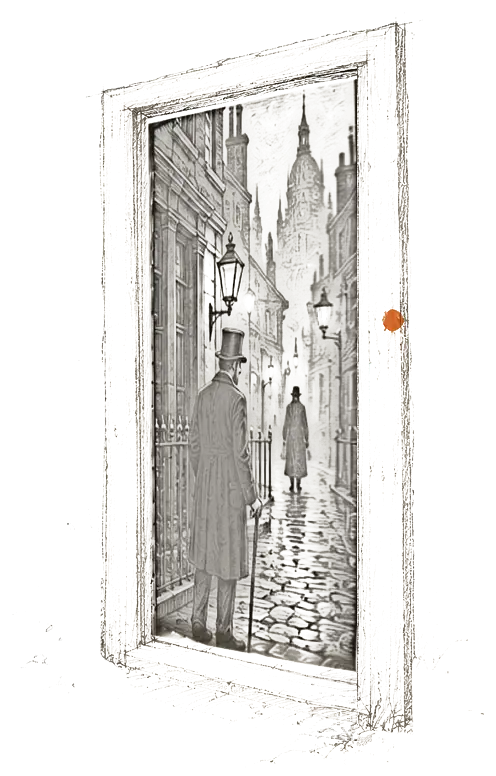
A London lawyer hears how a repulsive little man trampled a girl at a street corner, then, threatened with scandal, had to pay a hundred pounds, partly by a cheque signed with a respected name. That name belongs to an old friend of the lawyer, an esteemed doctor, whose will leaves all his property to this stranger in the event of his death or disappearance. The lawyer starts keeping watch before a windowless door.
Timeline
- 1375–1513The makarsBarbour, Henryson, Dunbar. A court that writes in Scots and is read on a par with English.
- 1560–1707The Reformation and the unionThe Church takes the floor, the parliament loses it. Literature passes to printed English.
- 1760–1832Ossian, Burns, ScottThree men invent the Scotland that Europe will read: a dubious epic, a peasant language, a novelistic past.
- 1880–1930Exile and the kailyardStevenson, Conan Doyle, Barrie write from London. The country becomes a touching setting that the next generation will detest.
- 1920–1955The Scottish RenaissanceMacDiarmid revives Scots, Gibbon and Gunn write the land, MacLean remakes Gaelic poetry.
- 1980–2000Glasgow speaks upGray, Kelman, Welsh write the city and the language spoken there. Cinema is born at the same time.
Reading keys
- The prefix Mac means “son of” and has nothing of a title: MacDonald, MacLean, MacLeod designate lineages that were political powers until the eighteenth century.
- The clan is not an extended family but an allegiance: one bore its name without sharing its blood.
- The Lowlands never worked this way, and the narrative almost always distinguishes a Highland character from a character from Edinburgh or Glasgow by this detail alone.
- Reserve is a national trait of character in the narratives: characters do not say what they feel, and the reader must read what is left unsaid.
- The Presbyterian religion has much to do with it, the confession of feeling long passing for a weakness.
- The Glasgow novels since 1980 do the opposite and let everything be said, in a spoken language that translations render poorly.
- The Reformation of 1560 was more radical than in England: no bishops, no images, a Church governed by assemblies of elders, and a supervision of morals exercised by the parish.
- Predestination, the idea that salvation is decided in advance, runs through the country's literature and explains whole books.
- The witchcraft narratives, very numerous, come from the trials of the seventeenth century, which were proportionally five times deadlier than in England.
- Hogmanay, the passage into the new year, long counted for more than Christmas, which the Church in effect forbade for nearly four centuries.
- Tartan and the kilt, presented as immemorial, were codified in the nineteenth century, in great part on the initiative of a novelist this catalogue includes.
- The wake and the meal that follows it recur in almost every village novel.
- Three defeats structure the imagination: Flodden in 1513, the union of the parliaments in 1707, and Culloden in 1746, followed by the banning of Highland dress.
- The Clearances, the expulsion of Highland peasants in favour of sheep between 1780 and 1860, are the event that literature has never finished dealing with.
- Robert Burns is recited every 25 January all over the world, which no other national poet achieves.
- “Scottish” does not tell the language: a Scottish author may write in English, in Scots or in Gaelic, and the choice is always political.
- Scots is not badly spoken English, and a text in Scots requires a glossary even for an English-speaking reader. “Highlands” does not designate the north but the mountainous north-west; Aberdeen is in the north and is not part of it.
- Finally, Great Britain is not England: the confusion is constant in French and distorts the reading of everything that follows.
Tales and mythologies 1
- TalePopular Tales of the West HighlandsJ. F. Campbell · 1860Tales from the Highlands taken down in Gaelic, with the name, age and occupation of each storyteller.LiteraturePublic domain
A selection to begin with 10 / 28
- PoetryThe Jolly BeggarsRobert Burns · 1799Beggars drink together and each takes a turn to speak and tell what their life is made of.LiteraturePublic domain
- NovelIvanhoeWalter Scott · 1819A knight returned from the Crusade to an England where Saxons and Normans do not speak to one another.LiteraturePublic domain
- TheatrePeter Pan, or The Boy Who Wouldn't Grow UpJ. M. Barrie · 1904A boy who refuses to grow up comes to fetch a girl from London so that she will tell stories to his band.Literature
- NovelThe Wind in the WillowsKenneth Grahame · 1908Four riverside animals keep house, and one of them discovers the motor car.LiteraturePublic domain
- PoetryA Drunk Man Looks at the ThistleHugh MacDiarmid · 1926A drunk man fallen at the roadside addresses a thistle for two thousand lines.Literature
- NovelThe Prime of Miss Jean BrodieMuriel Spark · 1961A schoolmistress takes six little girls under her wing and sets out to make them in her own image.Literature
- CinemaBill Douglas TrilogyBill Douglas · 1972Three films for a single childhood: a mining village, poverty, and a boy's successive placements.Cinema
- CinemaGregory's GirlBill Forsyth · 1980A schoolboy loses his place in the team to a girl, with whom he immediately falls in love.Cinema
- CinemaOrphansPeter Mullan · 1998Four siblings keep vigil over their mother on the night before the funeral, and each spends it elsewhere.Cinema
- CinemaRatcatcherLynne Ramsay · 1999A summer of refuse collectors' strike, a boy who said nothing, and a new house in the middle of fields.Cinema