Ethiopia
- works
- 24
- 19 books · 5 films
- period covered
- 1320–1997
- language of writing
- Amharic
Ethiopia has been writing for two thousand years with an alphabet that belongs to it alone. Fidäl has more than two hundred characters, each noting a consonant and its vowel, and it serves first Geez, a liturgical language now dead, then Amharic and Tigrinya. The manuscripts are copied on parchment, bound in wood, illuminated, and kept in churches that have never ceased to function. No other country of sub-Saharan Africa has a written chain as long and as continuous, and the copyists have never stopped working.
Read moreShow less
That continuity went together with an independence. In March 1896, at Adwa, an Italian army was defeated by Menelik's troops, and Ethiopia remains the only African state not to have been colonised, with the exception of the Italian occupation from 1936 to 1941. That victory made the country a symbol for the whole black world, and at the same time shut it into an image of a besieged Christian fortress that masks its diversity: Islam has been present there since the seventh century, and Amharic is the mother tongue of only a minority.
Modern literature therefore appears in the nineteen hundreds, in Amharic, driven by an elite of civil servants and scholars. Afäwärq Gäbrä Iyäsus published in 1908 the first Amharic novel, an adventure tale in which two children set out to free their father, captive of a pagan king. Heruy Wäldä Sellasie wrote in the nineteen thirties novels about marriage and education. Haddis Alemayehu published in 1966 a great novel of love and feudality that remains the most widely read in the country. The price was paid under the military regime from 1974 to 1991: censorship, exile, and a cinema made almost entirely abroad.
What awaits the reader is a literature that plays on double meaning, inherited from a Geez poetic device in which a line has an apparent sense and a hidden sense. The novel that opens this page turns into story the programme of the Ethiopian reformers, to educate and to correct customs, and its author was foreign minister.
A way to begin
አዲስ አለም
Heruy Wäldä Sellasie · 1932
An Amharic novel of 1932, free of rights, carried by the drive of the Ethiopian reformers.
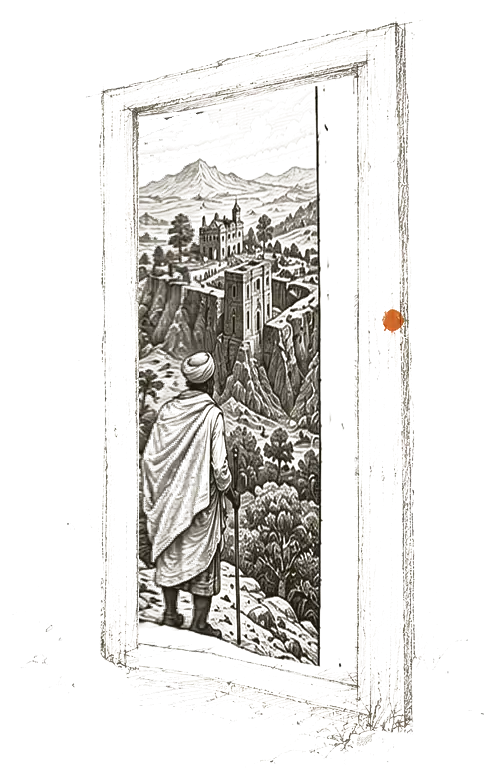
Awwaqa leaves his village of Tegulet to follow a Frenchman to France, where he studies languages and sciences for eight years. Back home out of homesickness, he attacks customs, festivities he finds unworthy and a clergy he holds to be corrupt, praises the telephone and the phonograph, and takes the quarrel before an assembly of priests.
Timeline
- 1908–1931First Amharic novelsAfeworq Gebre Iyesus, then Heruy Wolde Sellasie, minister and writer.
- 1941–1952Under Haile SelassieKebede Mikael, Germachew Tekle Hawaryat. Writing in order to reform the country.
- 1966Haddis AlemayehuLove unto Death, the great novel in Amharic.
- 1973–1990The Derg and exileDaniachew Worku, Abe Gubegna, Hama Tuma. Writing against the revolution.
- 1976–1997Diaspora cinemaHaile Gerima, Salem Mekuria, Yemane Demissie. Filming Ethiopia from afar.
Reading keys
- There is no family name: everyone bears his first name followed by that of his father. Haddis Alemayehu is Haddis, son of Alemayehu, and he is called Haddis, never Alemayehu.
- Alphabetical lists therefore classify authors by their first name, which disconcerts European libraries.
- First names are often religious phrases: Haile Selassie means "power of the Trinity", Wäldä Sellasie "son of the Trinity".
- Baptismal godparenthood creates a lasting kinship, and a family's confessor intervenes in its decisions.
- The military regime from 1974 to 1991, the Red Terror and the famines of 1973 and 1984 are still raw subjects.
- The question of nationalities, Oromo, Tigrayan, Somali, and the historical domination of the Amhara elite run through all political life.
- The device of sem-enna-wärq, "the wax and the gold", consists in saying one thing in order to mean another. It is a poetic art and a technique of survival under censorship.
- Restraint is valued and the direct question is impolite: one circles for a long time before approaching the subject.
- The Ethiopian Orthodox Church, autonomous since the fourth century, follows a calendar of its own: the year has thirteen months and is seven or eight years behind the Western calendar. A date in a novel may therefore be surprising.
- Islam has been present since the seventh century, notably at Harar, and concerns nearly half the population.
- The zar, possession spirits treated by healing rites, and the buda, people suspected of the evil eye, belong to the common stock.
- The tabot, replicas of the ark of the covenant kept in every church, come out in procession and are not shown.
- Mourning includes a wake, a swift burial and commemorations, with mourners and sung lamentations.
- The white of the cotton shawl, the netela, is the garment of church and of ceremonies.
- The Orthodox fast is long and strict, more than two hundred days of fasting a year in total, which structures the table in the narratives.
- Timkat, the feast of Epiphany with the coming out of the tabot, and Meskel, the feast of the Cross with great fires, are the two great gatherings.
- The Kebra Nagast, the narrative of the Queen of Sheba and her son Menelik, founds dynastic legitimacy and remains the national historical reference.
- The Book of Enoch, lost everywhere else and preserved in Geez, is held to be canonical by the Ethiopian Church.
- Sem-enna-wärq, the device of double meaning, is a poetic knowledge that every cultivated reader recognises.
- The victory of Adwa in 1896 is the historical reference shared with the whole of Africa.
- Ethiopia is not a uniformly Christian country: Islam is as old there as elsewhere and concerns half the inhabitants.
- Amharic is not everyone's language: Oromo is more widely spoken, and Tigrinya, Somali and a dozen other languages are mother tongues for millions of people.
- The Ethiopian calendar shifts dates by seven to eight years, which makes internal chronologies disconcerting.
- The absence of colonisation did not mean the absence of internal domination, and Ethiopian literature above all recounts the latter.
Tales and mythologies 1
- ChronicleThe Kebra Nagastክብረ ነገሥትAnonymous · 1320The founding narrative of the Ethiopian monarchy, which makes its sovereigns descend from Solomon and draws their legitimacy from it.Literature
Available in English 12
The books from this country that can be read in English, in the original or in translation.
- EssayThe Hatata InquiriesHatâtaZera Yacob · 1667A philosophical autobiography in Ge'ez, held to be the first text of rational philosophy from Africa.Literature
- NarrativeThe Life and Struggles of Our Mother Walatta PetrosGädlä Wälättä PetrosGalawdewos · 1672The hagiography of an Ethiopian nun, founder of communities and opponent of the Jesuits in the seventeenth century.Literature
- NovelTobbyaልብ ወለድ ታሪክAfäwärq Gäbrä Iyäsus · 1908Two twins who set out to free their father, captive of a pagan king, in an Amharic tale printed in Rome at the beginning of the century.Literature
- TheatreFable: The Comedy of AnimalsFabula : Yawreoch CommediaTekle Hawariat Tekle Mariyam · 1921The first play written in Amharic, a satire of the court in the form of an animal fable, banned after its premiere.Literature
- EssayState & Economy of Early 20th Century EthiopiaMengistna Yehizb AstedaderGebre Hiwot Baykedagn · 1925The first essay in political economy written in Amharic, a plea for a driving state published after its author's death.Literature
- TheatreThe Marriage of UnequalsYalacha GabichaMengistu Lemma · 1963An Amharic comedy of manners, a satire of prejudices of rank through an arranged-marriage plan.Literature
- TheatreOda Oak OracleTsegaye Gabre-Medhin · 1964A play in verse written in English by an Amharic dramatist, about a village where two religions contend for the living.Literature
- NovelLove Unto Cryptፍቅር እስከ መቃብርHaddis Alemayehu · 1966In the time of the lords of Gojjam, a love that crosses ranks collides with the pride of a family and the order of an entire province.Literature
- NovelThe AfersataSahle Sellassie Berhane Mariam · 1969A novel of rural Ethiopia, in which the customary inquiry into a fire reveals the life of a Gurage village.Literature
- NovelThe Thirteenth SunDaniachew Worku · 1973The pilgrimage of an old, sick lord to a mountain shrine, in the Ethiopia of Haile Selassie.Literature
- NovelDefianceAbe Gubegna · 1975During the Fascist occupation, a high-ranking family in the Ethiopian capital refuses to yield.Literature
- NovelOromayBaalu Girma · 1983A roman à clef about a military campaign then under way, written by the man who directed its propaganda.Literature
A selection to begin with 10 / 24
- NovelTobbyaልብ ወለድ ታሪክAfäwärq Gäbrä Iyäsus · 1908Two twins who set out to free their father, captive of a pagan king, in an Amharic tale printed in Rome at the beginning of the century.Literature
- TheatreThe Marriage of UnequalsYalacha GabichaMengistu Lemma · 1963An Amharic comedy of manners, a satire of prejudices of rank through an arranged-marriage plan.Literature
- TheatreOda Oak OracleTsegaye Gabre-Medhin · 1964A play in verse written in English by an Amharic dramatist, about a village where two religions contend for the living.Literature
- Feature filmWho Is Hirut's Father?Hirut abatwa mannew ?Lambros Yokaris · 1965Regarded as the first Ethiopian fiction feature film, a film in Amharic about a single mother and her daughter.Cinema
- NovelLove Unto Cryptፍቅር እስከ መቃብርHaddis Alemayehu · 1966In the time of the lords of Gojjam, a love that crosses ranks collides with the pride of a family and the order of an entire province.Literature
- NovelThe AfersataSahle Sellassie Berhane Mariam · 1969A novel of rural Ethiopia, in which the customary inquiry into a fire reveals the life of a Gurage village.Literature
- CinemaHarvest: 3,000 YearsMirt Sost Shi AmitHaile Gerima · 1976A family of sharecroppers under the thumb of a feudal lord, at the moment when the Ethiopian empire collapses.Cinema
- CinemaTumultGir-girYemane Demissie · 1996The attempt to overthrow Haile Selassie, told from the point of view of a young aristocrat among the conspirators.Cinema
- CinemaBlood Is Not Fresh WaterTheo Eshetu · 1997A video artist of the diaspora returns to his grandfather, a historian, who serves as his guide through Ethiopian memory.Cinema
- CinemaDelugeYe Wonz MaibelSalem Mekuria · 1997A filmmaker looks back on the Ethiopian student revolution and the terror that followed it, through the fate of her own people.Cinema