Sudan
- works
- 17
- 13 books · 4 films
- period covered
- 1805–1999
- language of writing
- Arabic
In the nineteen sixties, a country was put under water. The construction of the Aswan High Dam drowned Nubia: dozens of villages, palm groves, cemeteries and temples engulfed, and tens of thousands of Nubians displaced on either side of the Egyptian-Sudanese border, resettled in aligned housing far from the river. From it came a whole literature of loss, in Arabic and in Nubian languages, in which the Nile is not a landscape but a place vanished under the water, with its houses and its tombs.
Read moreShow less
Sudan is made of that superposition. It is the point where the Arab world and the African world overlap without merging: Arabic is the language of writing and of school there, but a hundred other languages are spoken, and the south, which became a separate state in 2011, belonged to an entirely different world. Medieval Nubia had been Christian for seven centuries, the kingdom of Meroe had its own writing, and Islamisation came through merchants and brotherhoods rather than through conquest.
Hence a literature that made the in-between its subject and its form. Tayeb Salih published in 1966 a novel in which a Sudanese returned from London recounts how he seduced and destroyed English women, before another narrator takes up the story; Arab critics have classified it among the most important novels of the century. Malkat al-Dar Muhammad wrote the first novel by a Sudanese woman, published in 1970. Ibrahim Shadad and Gadalla Gubara made an inventive cinema with almost nothing. The price was censorship and exile under the military regimes, and a country where authors publish in Cairo or in Beirut.
What awaits the reader is an ample prose, with several narrators, in which one returns to the facts without ever fixing them. The novel that opens this page was briefly banned in Sudan for its frankness about desire, and Edward Said counted it among the six great modern Arabic novels.
A way to begin
Season of Migration to the North
Tayeb Salih · 1966
A Nile village face to face with colonial England: the novel the Arab Academy of Damascus named in 2001 the most important of the century.
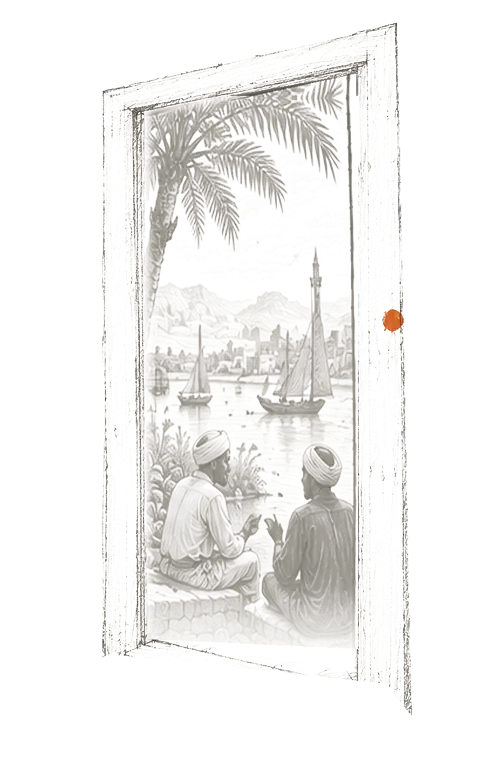
Back in his village on the Nile in the fifties, after a thesis completed in England, the narrator notices a newcomer, Mustafa Saeed, the only one not to marvel at his degrees. One evening over drinks, the man recites English verse in perfect English and gives himself away. Pressed with questions, he gradually tells of his life in London in the twenties, that of a prodigy schooled by colonialism who seduced Englishwomen by playing on their dreams of the East.
Timeline
- 1931–1953First voicesTambal, Osman Hashim, and al-Fayturi, who sings Africa.
- 1950–1960First women novelistsMalkat al-Dar Mohammad opens Sudanese prose to women.
- 1966–1970Tayeb SalihSeason of Migration to the North turns the colonial gaze around.
- 1979–1998Cinema and exileShariffe, Shaddad, Gubara film; Jamal Mahjoub writes in English.
Reading keys
- The name reads as a genealogy, with the first name followed by that of the father and of the grandfather, and tribal belonging often appears last.
- The name makes it possible to distinguish the Arabic-speaking groups of the north from the Nubian, Beja, Fur or Nuba populations, a major social and political distinction.
- The Sufi brotherhoods provide a second belonging, sometimes more determining than the tribe.
- Patrilineal kinship dominates, but several societies of the south and of the Nuba mountains function otherwise.
- The wars of the south, then of Darfur, then the current war, are subjects on which every account is situated and dangerous.
- Slavery, practised by the elites of the north into the twentieth century and reappearing during the wars, is the most difficult subject.
- The application of Islamic law since 1983 has produced a strong moral censorship, and several writers have been prosecuted.
- Racism between Arabic-speaking populations and populations called African is named by recent literature and officially denied.
- Sunni Islam is in the majority in the north, structured by powerful Sufi brotherhoods whose sheikhs are political actors.
- The zar, a possession cult practised above all by women, coexists with Islam and is the object of official disapproval.
- Nubia was Christian from the sixth to the fourteenth century, and its painted churches are a major archaeological fact.
- The Nuba mountains and the south had their own cults, and South Sudan, independent since 2011, belongs to another religious ensemble.
- Muslim mourning is brief, with burial on the same day, condolences for three days and a commemoration on the fortieth.
- The tobe, a piece of cloth worn by the women of the north, indicates status and occasion.
- The zar ceremonies, with music and incense, take place apart and among women.
- Ramadan and the Eids order the calendar, and the mawlid of the brotherhoods gathers crowds around the tombs of saints.
- The chronicles of the Funj sultanate and of Darfur, translated at the beginning of the twentieth century, report the legendary genealogies of the tribes, almost all attached to prestigious Arab ancestors.
- The Nuba, Dinka and Beja tales, collected in the colonial journals and in scholarly collections, form the documented corpus.
- The figure of the Mahdi, who took Khartoum in 1885, is an omnipresent historical and religious reference.
- The Nile, its floods and drowned Nubia constitute a stock of images common to all the country's literature.
- Sudan is not a homogeneous Arab country: a hundred languages are spoken there and the Arabic-speaking populations are themselves African.
- South Sudan has been a distinct state since 2011; authors born in the south have their page there, even for works earlier than that date.
- The zar is not a residual superstition but an organised female therapeutic institution.
- Nubia is not a region of Egypt: it straddles the border, and its submersion is a Sudanese memory as much as an Egyptian one.
Tales and mythologies 1
- Chronicleطبقات ود ضيف اللهMuhammad al-Nur ibn Dayf Allah · 1805The lives of the saints and scholars of the Funj kingdom, recorded in the early nineteenth century by a jurist of Halfaya.Literature
Available in English 3
The books from this country that can be read in English, in the original or in translation.
- NovelSeason of Migration to the Northموسم الهجرة إلى الشمالTayeb Salih · 1966The face-off between a village on the Nile and colonial England, in the aftermath of Sudanese independence.Literature
- NovelNavigation of a RainmakerJamal Mahjoub · 1989A young man born in England looks for his place in his father's war-torn Sudan, on the eve of the military coup.Literature
- NovelThe TranslatorLeila Aboulela · 1999A Sudanese widow in Aberdeen, caught between grief, faith and a love that tests them both.Literature
A selection to begin with 10 / 17
- NovelتاجوجOsman Muhammad Hashim · 1948not translated into EnglishThe most famous love legend of eastern Sudan, turned into a novel in the middle of the century by a poet from Berber.Literature
- Poetryغابة الأبنوسSalah Ahmed Ibrahim · 1958not translated into EnglishThe first collection of a major Sudanese poet, which already raises the question of a mixed identity.Literature
- Novelإنهم بشرKhalil Abdallah al-Hajj · 1960not translated into EnglishOne of the very first Sudanese novels, a realist picture of Omdurman written in the mid-fifties.Literature
- Novelالفراغ العريضMalkat al-Dar Mohammad · 1970not translated into EnglishThe lives of the women of a house in Omdurman, under the authority of an adolescent, in pre-independence Sudan.Literature
- Feature filmTajoujeتاجوجGadalla Gubara · 1977A love legend of the tribes of eastern Sudan, brought to the screen with a popular singer in the leading role.Cinema
- Short filmTigers Are Better LookingHussein Shariffe · 1979A short film made in England, in which a Sudanese painter's exile becomes a visual poem.Cinema
- Short filmThe RopeالحبلIbrahim Shaddad · 1985A parable shot in the Sudanese desert for the film section of the Ministry of Culture.Cinema
- Short filmThe StationالمحطةEltayeb Mahdi · 1989A wordless short film on the Sudanese desert road, restored in Berlin in 2018.Cinema
- NovelNavigation of a RainmakerJamal Mahjoub · 1989A young man born in England looks for his place in his father's war-torn Sudan, on the eve of the military coup.Literature
- NovelThe TranslatorLeila Aboulela · 1999A Sudanese widow in Aberdeen, caught between grief, faith and a love that tests them both.Literature