Kenya
- works
- 19
- 15 books · 4 films
- period covered
- 1905–1996
- language of writing
- English and Swahili
In 1978, a university professor wrote a novel on toilet paper. Ngũgĩ wa Thiong'o had been detained without trial in Kamiti prison since a play performed in Gikuyu by peasants from his village had displeased the authorities. He had no notebook, he had cell paper, rough and solid, and he decided to write no longer in English but in his mother tongue. It would be the first modern novel in Gikuyu, and the beginning of a refusal of English that he never lifted until his death.
Read moreShow less
That gesture sums up a tension that Kenya has not resolved. The country was a settler colony, with land taken for British farmers and a revolt, that of the Mau Mau in the nineteen fifties, repressed in camps whose scale was measured only sixty years later. The question of which language to write in, and therefore for whom, is there political and not aesthetic: Swahili is the national language, English the language of school and administration, and some forty languages are spoken at home. Choosing one amounts to designating a readership and excluding others.
The dominant form is the urban social novel, doubled by a popular theatre. Meja Mwangi wrote in 1973 the idle young men of Nairobi, Grace Ogot had published in 1968 the first Kenyan short stories by a woman, Micere Githae Mugo co-wrote with Ngũgĩ a play about a Mau Mau leader and found herself in exile. Katama Mkangi wrote his novels in Swahili. The price was exile or prison for almost all those who chose an African language, and a national library amputated of its best books.
What awaits the reader is a literature that has not given up addressing its own people, and that constantly questions its capacity to do so. The novel that opens this page follows a Kikuyu child, the first in his family to go to school, while his father farms his ancestors' land for a settler and revolt spreads through the country.
A way to begin
Weep Not, Child
Ngũgĩ wa Thiong'o · 1964
The first novel in English published by an East African writer: a Kikuyu childhood during the Mau Mau revolt.
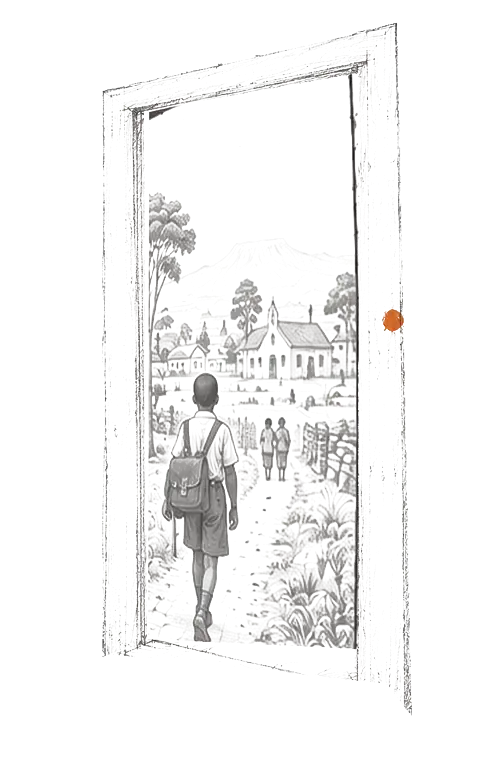
Njoroge, a little Kikuyu boy, is the first in his family to go to school, where he befriends Mwihaki, daughter of a rich African landowner close to the settlers. His father farms for a settler land that was once his ancestors'; Boro, the elder brother, back embittered from the war, joins those who want to rise up. During a strike, the father loses his job, while the state of emergency falls upon the country.
Timeline
- 1964–1968First novelsNgũgĩ opens the East African novel; Grace Ogot is the first woman published.
- 1972–1976The next generationImbuga in the theatre, Meja Mwangi in the city, Micere Mugo.
- 1980–1986Writing powerKatama Mkangi in Swahili; Macgoye tells independence from below.
- 1985–1999Kenyan cinemaSao Gamba, then Wanjiru Kinyanjui and Anne Mungai behind the camera.
Reading keys
- The name indicates the group: Ngũgĩ, Wanjiru, Kamau are Kikuyu; Ogot, Oduya are Luo; the Swahili names of the coast, with bin and binti, belong to another world.
- Among the Kikuyu, a child's first name takes up that of a grandparent in a fixed order, so that the same names alternate from generation to generation.
- Kikuyu age classes and circumcision groups create lasting solidarities between men of the same rank.
- The name may carry the trace of the mission school, with a Christian first name attached, and abandoning that first name is a political act. Ngũgĩ was called James.
- The Mau Mau revolt, the British detention camps and the oaths of resistance are a subject long forbidden, then made official, and still disputed.
- Rivalries between Kikuyu and Luo structure political life and are expressed by detour.
- Detention without trial, practised until the nineteen nineties, produced an important prison literature.
- Circumcision and excision, at stake in a violent confrontation with the missions from the nineteen thirties, remain a heavy subject.
- Christianity is in the majority inland, Islam on the coast for centuries, and the ancestral cults coexist with both.
- Ngai, the Kikuyu god, dwells on Mount Kenya, and one prays turned towards him. The mountain is not a setting.
- The African independent churches, born of the conflict with the missions over circumcision, are numerous and old.
- The oath, among the Kikuyu, physically binds the one who takes it and is taken according to precise rites.
- Mourning includes a wake, burial on the family land and a public collection for the costs, the harambee.
- Being buried on the ancestors' land is a major legal and narrative stake, several famous trials having turned on that question.
- Initiation dress and Maasai ornaments, often reduced to tourist images, in fact mark age and status.
- The calendar mixes Christian feasts, Muslim feasts on the coast and age ceremonies.
- The Maasai and Nandi tales and texts collected in 1905 and 1909, in the original language with a translation, form the oldest documented corpus.
- The Swahili tales of the coast, with Sungura the hare, are shared with Tanzania.
- Ngai and Mount Kenya, with the narrative of Kikuyu origins and of Gikuyu and Mumbi, are a common reference.
- The Mau Mau memory, with its songs and its oaths, is a still living narrative stock.
- Kenya is not a safari setting: Kenyan literature speaks of stolen land, of cities and of schools.
- The choice to write in Gikuyu or in Swahili rather than in English is not an identity withdrawal but a position on the intended audience.
- The Maasai, much photographed, are a minority among some forty peoples, and their image crushes the others.
- The harambee, a collective collection, is not charity but a social institution of funding.
Tales and mythologies 1
- NarrativeThe Masai: Their Language and FolkloreAlfred Claud Hollis · 1905White settlers begin to settle in the Rift Valley and on the highlands where the Maasai lived.Literature
A selection to begin with 10 / 19
- NovelKill Me QuickMeja Mwangi · 1973Ten years after independence, young graduates flock to the capital and discover that school no longer guarantees them anything.Literature
- PoetryVoice of AgonySauti ya DhikiAbdilatif Abdalla · 1973The poems written in detention by a Swahili poet of Mombasa, author of a pamphlet against the government.Literature
- NovelRipples in the PoolRebeka Njau · 1975A pioneering Kenyan novel, in which a Nairobi woman back in the village falls in love with another woman.Literature
- PoetryDaughter of My People, Sing!Micere Githae Mugo · 1976Back from Canada to teach in Nairobi, a young Kenyan academic publishes her first poems in the same year as a play co-written on the revolt of the fifties.Literature
- TheatreBetrayal in the CityFrancis Imbuga · 1976A decade after independence, a young Kenyan playwright sets a satire of dictatorship in an invented country.Literature
- CinemaRise and Fall of Idi AminSharad Patel · 1981The Ugandan dictator had lost power less than a year before filming, which takes place mostly in Kenya.Cinema
- NovelMafutaKatama Mkangi · 1984not translated into EnglishUnder a regime that distrusts academics, a sociologist writes an allegory of social classes in Swahili.Literature
- CinemaSaïkatiAnne Mungai · 1992Since the mid-eighties, Kenyan women directors coming from documentary have begun to make fiction films.Cinema
- CinemaBattle of the Sacred TreeWanjiru Kinyanjui · 1995A Kenyan woman trained at a film school in Berlin shoots her graduation film in a village in her country, with Kenyan performers.Cinema