Guyana
- works
- 23
- 22 books · 1 film
- period covered
- 1883–1997
- language of writing
- English
A lake the size of an inland sea appeared on the maps of the region for more than two centuries. It was called Parime, bore on its shore the golden city of Manoa, and never existed. Walter Raleigh had brought it into his 1596 book on Guiana, following the report of his lieutenant Keymis, and Humboldt established around 1804 that the annual flood of the Rupununi produced, at each rainy season, a sheet of water taken for a lake.
Read moreShow less
The country was built on that gap between the dreamed interior and the real coast. The plantations occupy a strip of land won from the sea, protected by dykes, cultivated by slaves and then, from 1838, by indentured workers come from India. Three stocks have coexisted since, Amerindian, African, Indian, and political life ended by aligning itself on that line: the clashes from 1962 to 1964, before independence in 1966, left a division that everyday vocabulary names without detour.
The form found by the country consists in refusing the ordered narrative. Wilson Harris spent fifteen years surveying the rivers of the interior for the topographical service before writing Palace of the Peacock, in 1960, in which a crew drowns and begins its voyage again. Jan Carew drew Black Midas from the gold seekers of the interior, those pork-knockers who still live off the El Dorado of the maps. The price is remoteness. Martin Carter, whose first collection appeared in 1951, was interned in 1953 when London suspended the constitution and landed troops. Almost all the others left: Mittelholzer died in England in 1965, Beryl Gilroy taught in London, Grace Nichols and John Agard publish from England.
What awaits the reader is a prose that carries the river, the forest and the memory of the crossing, and books that superimpose the three stocks without putting them in order. The novel that opens this page is that of a black engineer from British Guiana, a former RAF airman, whom post-war London refuses to hire and who becomes a teacher in an East End school.
A way to begin
To Sir, With Love
E. R. Braithwaite · 1959
A Black engineer who becomes a teacher in spite of himself in the post-war East End: the book that the Sidney Poitier film made famous.
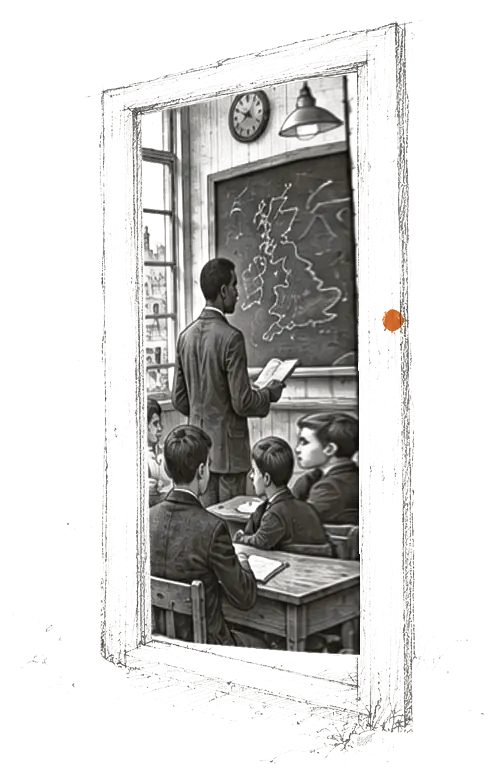
A Black engineer from British Guiana and former RAF airman, Ricky Braithwaite finds no work in post-war London, where he is refused employment because of his colour. He becomes a teacher in an East End school, facing adolescents who try to wear him down with rowdiness. He decides to treat them as adults and to demand their respect in return.
Timeline
- 1883–1951First voicesEgbert Martin, Mittelholzer, and Martin Carter writing in prison.
- 1958–1967The London generationJan Carew, Wilson Harris, Braithwaite. Nearly all write in England.
- 1972–1983Poetry and diasporaAgard, Grace Nichols, Cyril Dabydeen. The country is written from afar.
- 1975–1986Return homeAggro Seizeman, the first Guyanese film; Roy Heath and Shinebourne.
Reading keys
- Afro-Guyanese surnames are English or Scottish because they come from the planters, and they indicate no British origin.
- Indo-Guyanese names signal the religion: Persaud, Ramkissoon or Singh on the Hindu side, Khan, Mohamed or Baksh on the Muslim side, a distinction that also structures marriage.
- Amerindian names belong to the Lokono, Kalinago and Wapishana languages, and the Portuguese names from Madeira or the Chinese ones come from the waves of indentured workers of the nineteenth century.
- Auntie and uncle are used for elders of the neighbourhood with no blood link, and the reader must beware of concluding a kinship from them.
- The dividing line between Indo-Guyanese and Afro-Guyanese has commanded politics since the nineteen fifties, and the creole formula enjoining people to vote for their own is an accusation, not a description.
- The suspension of the constitution in 1953, the British intervention and the American role in the split of the independence movement remain subjects of confrontation.
- The assassination of the historian Walter Rodney in 1980 is not closed, and his name entails a position.
- The Jonestown tragedy of 1978 is American in its actors and Guyanese in its location, which explains the irritation it provokes when it stands in for a summary of the country.
- The dispute with Venezuela over the Essequibo is a question of sovereignty, never a joke.
- Christianity dominates, but Hinduism concerns about a quarter of the population and Islam a notable share, with festivals recognised as public holidays.
- Obeah, a set of practices of protection and attack inherited from Africa, was long forbidden by law and remains practised, which explains why a text designates it without naming it.
- Amerindian cosmologies hold a real place, with the piai, healer and seer, and the kanaima, agent of a vengeance that pursues its target until death.
- Comfa, an Afro-Guyanese possession cult, makes the spirits speak through the bodies of the living, and it is practised on the margins of the churches.
- Mashramani, on 23 February, celebrates the republic with masked parades and floats, and serves as an annual landmark in the narratives.
- Phagwah, the Hindu spring festival, is played with coloured powders and water, and Diwali sets up lamps along the houses.
- The nine-night wake gathers the relatives around tales, songs and games, and ends with a rite of separation intended to send the dead person away.
- White is the colour of Hindu mourning, and burial follows the death closely because of the heat.
- Anansi the spider arrived from Ghana with the slave trade and remains the trickster of reference, shared with Jamaica, Trinidad and Suriname.
- The Ramayana was brought by the indentured workers from 1838 and is still recited, which gives the country a living Indian stock.
- The Arawak, Kalinago and Warao cosmologies were collected by the missionary Brett in 1880, then by the magistrate Roth in 1915, two sources that literature takes up.
- The Berbice slave revolt of 1763, led by Cuffy, is the founding reference of national history.
- El Dorado and the gold seekers of the interior form a repertoire common to novels and songs.
- The country is South American but English-speaking and Caribbean, a member of Caricom, and its horizon is Port of Spain and London rather than Bogotá.
- East Indian designates the descendants of the indentured workers come from India, never the Amerindians, who are called Amerindians.
- The word creole here most often designates Afro-Guyanese people, unlike its use in Suriname or in Haiti.
- Almost all of this literature is written outside the country, which is an effect of emigration and not an aesthetic choice.
- The interior is not empty: it is occupied by Amerindian communities whose land titles are the object of disputes.
Tales and mythologies 1
- TaleAn Inquiry into the Animism and Folk-Lore of the Guiana IndiansWalter Edmund Roth · 1915The great collection of myths of the Amerindian peoples of the Guianas, compiled by a physician and magistrate of the British colony.Literature
A selection to begin with 10 / 23
- NovelA Morning at the OfficeEdgar Mittelholzer · 1950A morning's work in Trinidad, where everyone measures themselves against others by colour and rank.Literature
- PoetryPoems of Resistance from British GuianaMartin Carter · 1954Verse written between the state of emergency and detention, when London reasserted control of its South American colony.Literature
- NovelBlack MidasJan Carew · 1958A diamond prospector from the Guyanese interior, caught between the fortune of the placer deposits and the closed doors of the bourgeoisie.Literature
- NovelPalace of the PeacockWilson Harris · 1960A rising of the waters of the Guyanese forest, between dream and drowning, in the memory of the conquest.Literature
- Feature filmAggro SeizemanJames Mannas and Brian Stuart-Young · 1975A comedy about a bailiff in Georgetown, filmed with local actors in the first years of independence.Cinema
- NarrativeBlack TeacherBeryl Gilroy · 1976The postwar London schools, told by a teacher from British Guiana.Literature
- PoetryMan to PanJohn Agard · 1982A cycle written for the stage and for a steelpan orchestra, about the instrument that the poor of the Trinidad suburbs invented.Literature
- PoetryI is a Long Memoried WomanGrace Nichols · 1983A sequence of poems in which an African captive speaks, from the slave ship to the plantations of the West Indies.Literature
- PoetrySlave SongDavid Dabydeen · 1984The first book of a Guyanese poet, poems in Creole on the world of sugar, awarded a Commonwealth prize.Literature
- Short storiesBackdam PeopleRooplall Monar · 1985Stories of the life of Indian labourers on the cane plantations, written in their Creole.Literature